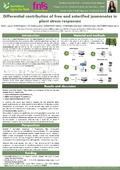
[en] Plant growth, development and stress responses are tightly controlled by low-molecular weight signaling molecules known as plant hormones. Among them, jasmonates (JAs) are most well-known for their critical roles in plant stress responses, notably against fungal pathogens and chewing insects. Structurally speaking, jasmonates are oxidized derivatives of galactolipids and their most famous member is jasmonic acid (JA), although the main biologically active form is conjugated to isoleucine. Jasmonates mostly result from the hydrolysis of galactolipids into free fatty acids, that are oxidized by lipoxygenases (LOXs) and further transformed by the subsequent action of allene oxide synthase and allene oxide cyclase. This forms (dinor-)12-oxophytodienoic acid (OPDA), from which JA is produced. Whereas jasmonates derived from free fatty acids are said to be free, esterified jasmonates result from the LOX2-mediated direct oxidation of fatty acyl chains within complex lipids. For instance, arabidopside B is a monogalactosyldiacylglycerol with OPDA as acyl chains instead of fatty acids. In contrast to free jasmonates, the functions of such complex jasmonates are still poorly understood.
Our work aims in this view to decipher the functions of free jasmonates versus esterified jasmonates in the stress responses of the model plant Arabidopsis thaliana (L.) Heynh using a reverse-genetics approach. More specifically, we investigate in this poster how mutants differentially blocked in the biosynthesis of free and/or esterified jasmonates respond to a common agricultural stress, which is phosphorus scarcity. We analyzed plant parameters that are typically associated with this stress: root and shoot phosphorus content (UV-visible spectrophotometry), shoot anthocyanin content (UV-visible spectrophotometry), root and/or shoot lipid content (GC-MS and LC-MS/MS), shoot-to-root ratio (dry weights), rosette surface and root architecture (RhizoVision). Our results show that jasmonates control some but not all phosphorus starvation responses, and that this control seems to be specifically exerted by free jasmonates. Here, the common responses of Arabidopsis to this stress are thus regulated by free jasmonates, with little to no contribution of esterified jasmonates. We discuss how free jasmonates may control these responses at a transcriptional level, and we further elaborate on the potential functions of esterified jasmonates. Taken together, our results pave the way for a better understanding of free versus esterified jasmonates in plant stress responses.
Disciplines :
Biochemistry, biophysics & molecular biology
Author, co-author :
Vilain, Louise ; Université de Liège - ULiège > TERRA Research Centre > Chemistry for Sustainable Food and Environmental Systems (CSFES)
Genva, Manon ; Université de Liège - ULiège > Département GxABT > Chemistry for Sustainable Food and Environmental Systems (CSFES)
Fauconnier, Marie-Laure ; Université de Liège - ULiège > Département GxABT > Chemistry for Sustainable Food and Environmental Systems (CSFES)
Language :
English
Title :
Differential contribution of free and esterified jasmonates in plant stress responses
Publication date :
19 May 2026
Event name :
77th International Symposium on Crop Protection
Event place :
Ghent, Belgium
Event date :
19/05/2026
Audience :
International
Peer review/Selection committee :
Editorial reviewed
Funders :
F.R.S.-FNRS - Fonds de la Recherche Scientifique ULiège - University of Liège FWB - Fédération Wallonie-Bruxelles FEDER - Fonds Européen de Développement Régional FRIA - Fonds pour la Formation à la Recherche dans l'Industrie et dans l'Agriculture
Funding text :
F.R.S.-FNRS (National Fund for Scientific Research, Belgium): FRIA grant for Louise VILAIN, PDR project 40028569
Mobility grants for Louise VILAIN in : F.R.S.-FNRS, University of Liège (Belgium) and Fédération Wallonie-Bruxelles
Grant portfolio PHENIX n°244, project PHENIX_Analytique_ULiège n°397 (Walloon Region and the Fond Européen de Développement Régional (FEDER))