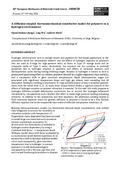
[en] Hydrogen infrastructure such as storage vessels and pipelines for fuel-based applications in the automotive sector has necessitated research into the effects of hydrogen exposure on polymers that are used in O-rings for high-pressure seals, as liners in Type IV storage tanks and in composite shells of Type V tanks. Particularly, the concerns are the variation in material properties due to hydrogen sorption in polymers and effects of sustained pressure and decompression cycles during fueling-refueling stages. Sorption of hydrogen is known to have a pronounced plasticising effect on rubbery polymers denoted by a higher segmental chain mobility and a consequent shift in glass transition temperatures. Rapid decompression stages are associated with significant temperature drops and high gas release rates exceeding that of desorption, leading to swelling in elastomeric O-rings and detachment of semi-crystalline polymer liners from the vessel shell [1, 2]. To study these unique failure modes, a rigorous analysis of the effects of hydrogen sorption on polymer relaxation is essential. To this end, this study proposes a hydrogen diffusion-coupled deformation constitutive law to account for hydrogen-influenced viscoelasticity, viscoplasticity and a Mullins-like effect to model high-pressure loading-unloading scenarios. In addition to the momentum and heat equations, the additional coupling implies a fluid continuity equation which for gaseous diffusion in polymers is found to be a Non-Fickian diffusion equation due to the comparable time scales of diffusion and polymer relaxation [3]. Existing thermomechanical models use Generalised Maxwell-based viscoelasticity with shifted time integration to account for variability in relaxation modulus with temperature [4]. Hyperelastic strain dependent functions are used to model large non-linearities and viscoelastic tension-compression asymmetry [5]. In this work, this formulation is extended to
hydrogen content dependency by using a combined shift factor – a temperature based
Williams-Landel-Ferry shift factor multiplied by a concentration based Dolittle expression [6] to account for a shift in dynamic modulus master curve (and consequently, glass transition
temperature) due to hydrogen. A common approach is to add phenomenological
viscoplasticity with a Perzyna type flow rule and a mixed hardening formulation to displace the yield surface [7]. Ad hoc functions are used to model temperature dependencies of viscosity and hardening moduli [5]. Similar functions are proposed in this study to account for the variability in viscoplastic properties due to varying hydrogen concentration. Combined with the Mullins-like effect, this constitutive law is hypothesised to produce stress-strain behaviour. Furthermore, unlike the entropic Williams-Landel-Ferry shift factor, the Dolittle expression requires an enthalpic contribution that corresponds to mixing terms in the free energy and the fluid flow related chemical potential. Typical assumptions include a modified Flory-Huggins theory to model the mixing of gas in polymer [6,8]. This complex diffusion process is adopted to model deformation-dependent diffusion and to produce linear concentration versus time profiles as induced by a plasticising diffusion front in the polymer during hydrogen permeation [7].
Wu, Ling ; Université de Liège - ULiège > Département d'aérospatiale et mécanique > Computational & Multiscale Mechanics of Materials (CM3)
Noels, Ludovic ; Université de Liège - ULiège > Département d'aérospatiale et mécanique > Computational & Multiscale Mechanics of Materials (CM3)
Language :
English
Title :
A diffusion-coupled thermomechanical constitutive model for polymers in a hydrogen environment
Publication date :
27 May 2026
Event name :
20ᵗʰ European Mechanics of Materials Conference, EMMC 2026
Event organizer :
European Mechanics Society
Event place :
Florence, Italy
Event date :
27 to 29 May 2026
Audience :
International
References of the abstract :
1. Ono, H., et al. "Influence of pressure cycling on damage evolution in an unfilled EPDM exposed
to high-pressure hydrogen." International Journal of Fracture 210.1 (2018): 137-152.
2. Pepin, J., et al. "Determination of key parameters responsible for polymeric liner collapse in
hyperbaric type IV hydrogen storage vessels." International Journal of Hydrogen Energy 43.33
(2018): 16386-16399.
3. Klopffer, M. H., and B. Flaconneche. "Transport properties of gases in polymers: bibliographic
review." Oil & Gas Science and Technology 56.3 (2001): 223-244.
4. Chambers, R-S. "Numerical integration of the hereditary integrals in a viscoelastic model for
glass." Journal of the American Ceramic Society 75.8 (1992): 2213-2218.
5. Jinaga, U-K., et al. "A consistent finite-strain thermomechanical quasi-nonlinear-viscoelastic
viscoplastic constitutive model for thermoplastic polymers." International Journal of Solids and
Structures (2025): 113517.
6. Nguyen, V-D., et al. "A large strain hyperelastic viscoelastic-viscoplastic-damage constitutive
model based on a multi-mechanism non-local damage continuum for amorphous glassy
polymers." International Journal of Solids and Structures 96 (2016): 192-216.
7. Govindjee, S., and J-C. Simo. "Coupled stress-diffusion: Case II." Journal of the Mechanics and
Physics of Solids 41.5 (1993): 863-887.
8. Bargmann, S., et al. "Models of solvent penetration in glassy polymers with an emphasis on case
II diffusion. A comparative review." ASME Applied Mechanics Reviews (2011): 010803.
9. Le Talludec, C., et al. "Consequences of repeated hyperbaric hydrogen exposures on mechanical
properties and microstructure of polyamide 11." Polymer Testing 140 (2024): 108581.
This research was performed within the project HYPOLFAIL - Hydrogen-Induced Damage to Polymers at High Pressure: Understanding Interaction and Failure Mechanisms, selected under the M-ERA.NET Joint Transnational Call 2024. HYPOLFAIL is coordinated by SCIOFLEX Hydrogen GmbH (AT), with consortium partners GDTech S.A. (BE), Seal Maker Produktions- und Vertriebs GmbH (AT), MATELIOS (IT), University of Pannonia (HU), Université de Liège - CM3 (BE), and Johannes Kepler University Linz - IPPE (AT). The project is funded by the respective national and regional funding organizations: FFG-Mobility (Austria), SPW (Belgium), PR Calabria FESR-FSE+ 2021–2027 (Italy), and NKFIH (Hungary).