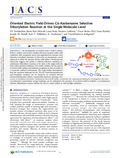
[en] The development of catalysts with a built-in electric field to catalyze and control complex chemical reactions under mild conditions with exceptional stereo and regioselectivity remains a key objective in synthetic chemistry. In this work, we demonstrate a novel approach in which the intrinsic electric field within a break junction nanocavity triggers and probes a substrate-selective, multistep cis-azobenzene diborylation reaction in the dark at the single-molecule level under ambient conditions. Our results combine the key aspects of electric field catalysis and substrate recognition to drive reactions in a nanoscale confined environment. The study further demonstrates how the reactivity landscape for the "N═N" bond functionalization and borylation reactions can be tuned by an oriented external electrical field present within a nanometallic junction, opening a new avenue in borylation chemistry. Furthermore, theoretical studies corroborate the experimental finding by revealing how the trans-cis-azobenzene isomerization energy landscape can be reshaped in the presence of an electric field to facilitate a cis-azobenzene selective diborylation reaction without the aid of a metal catalyst or external light irradiation.
Disciplines :
Chemistry Physics
Author, co-author :
Sreelakshmi, P A ; Department of Inorganic and Physical Chemistry, Indian Institute of Science, Bangalore 560012, India
Mondal, Reetu Rani; Department of Inorganic and Physical Chemistry, Indian Institute of Science, Bangalore 560012, India
Rask, Laust; Department of Chemistry, University of Copenhagen, Universitetsparken 5, 2100 Copenhagen Ø, Denmark
Leitherer, Susanne ; Department of Chemistry and Nano-Science Center, University of Copenhagen, Universitetsparken 5, 2100 Copenhagen Ø, Denmark
Obel, Oscar Berlin; Department of Chemistry, University of Copenhagen, Universitetsparken 5, 2100 Copenhagen Ø, Denmark
Rashid, Umar ; Department of Inorganic and Physical Chemistry, Indian Institute of Science, Bangalore 560012, India
Hamill, Joseph ; Université de Liège - ULiège > Molecular Systems (MolSys) ; Department of Chemistry and Nano-Science Center, University of Copenhagen, Universitetsparken 5, 2100 Copenhagen Ø, Denmark
Mikkelsen, Kurt V ; Department of Chemistry, University of Copenhagen, Universitetsparken 5, 2100 Copenhagen Ø, Denmark
Geetharani, K ; Department of Inorganic and Physical Chemistry, Indian Institute of Science, Bangalore 560012, India
Kaliginedi, Veerabhadrarao ; Department of Inorganic and Physical Chemistry, Indian Institute of Science, Bangalore 560012, India
Language :
English
Title :
Oriented Electric Field-Driven Cis-Azobenzene Selective Diborylation Reaction at the Single-Molecule Level.
Koshland, D. E. Application of a Theory of Enzyme Specificity to Protein Synthesis. Proc. Natl. Acad. Sci. U.S.A. 1958, 44 (2), 98–104, 10.1073/pnas.44.2.98
Breslow, R. Biomimetic Chemistry and Artificial Enzymes: Catalysis by Design. Acc. Chem. Res. 1995, 28 (3), 146–153, 10.1021/ar00051a008
Ye, R.; Mao, X.; Sun, X.; Chen, P. Analogy between Enzyme and Nanoparticle Catalysis: A Single-Molecule Perspective. ACS Catal. 2019, 9 (3), 1985–1992, 10.1021/acscatal.8b04926
Bunjes, O.; Hedman, D.; Rittmeier, A.; Paul, L. A.; Siewert, I.; Ding, F.; Wenderoth, M. Making and Breaking of Chemical Bonds in Single Nanoconfined Molecules. Sci. Adv. 2022, 8 (36), eabq7776 10.1126/sciadv.abq7776
Warshel, A.; Sharma, P. K.; Kato, M.; Xiang, Y.; Liu, H.; Olsson, M. H. M. Electrostatic Basis for Enzyme Catalysis. Chem. Rev. 2006, 106 (8), 3210–3235, 10.1021/cr0503106
Fafarman, A. T.; Sigala, P. A.; Schwans, J. P.; Fenn, T. D.; Herschlag, D.; Boxer, S. G. Quantitative, Directional Measurement of Electric Field Heterogeneity in the Active Site of Ketosteroid Isomerase. Proc. Natl. Acad. Sci. U.S.A. 2012, 109 (6), E299–E308, 10.1073/pnas.1111566109
Fried, S. D.; Bagchi, S.; Boxer, S. G. Extreme Electric Fields Power Catalysis in the Active Site of Ketosteroid Isomerase. Science 2014, 346 (6216), 1510–1514, 10.1126/science.1259802
Tokuriki, N.; Tawfik, D. S. Protein Dynamism and Evolvability. Science 2009, 324 (5924), 203–207, 10.1126/science.1169375
Ciampi, S.; Darwish, N.; Aitken, H. M.; Díez-Pérez, I.; Coote, M. L. Harnessing Electrostatic Catalysis in Single Molecule, Electrochemical and Chemical Systems: A Rapidly Growing Experimental Tool Box. Chem. Soc. Rev. 2018, 47 (14), 5146–5164, 10.1039/C8CS00352A
Zang, Y.; Zou, Q.; Fu, T.; Ng, F.; Fowler, B.; Yang, J.; Li, H.; Steigerwald, M. L.; Nuckolls, C.; Venkataraman, L. Directing Isomerization Reactions of Cumulenes with Electric Fields. Nat. Commun. 2019, 10, 4482 10.1038/s41467-019-12487-w
Aragonès, A. C.; Haworth, N. L.; Darwish, N.; Ciampi, S.; Bloomfield, N. J.; Wallace, G. G.; Diez-Perez, I.; Coote, M. L. Electrostatic Catalysis of a Diels–Alder Reaction. Nature 2016, 531 (7592), 88–91, 10.1038/nature16989
Shaik, S. My Vision of Electric-Field-Aided Chemistry in 2050. ACS Phys. Chem. Au 2024, 4 (3), 191–201, 10.1021/acsphyschemau.3c00064
Sreelakshmi, P.; Mahashaya, R.; Leitherer, S.; Rashid, U.; Hamill, J. M.; Nair, M.; Rajamalli, P.; Kaliginedi, V. Electric Field-Induced Sequential Prototropic Tautomerism in Enzyme-like Nanopocket Created by Single Molecular Break Junction. J. Am. Chem. Soc. 2024, 146 (51), 35242–35251, 10.1021/jacs.4c12423
Rashid, U.; Medrano Sandonas, L.; Chatir, E.; Ziani, Z.; Sreelakshmi, P.; Cobo, S.; Gutierrez, R.; Cuniberti, G.; Kaliginedi, V. Mapping the Extended Ground State Reactivity Landscape of a Photoswitchable Molecule at a Single Molecular Level. J. Am. Chem. Soc. 2025, 147 (1), 830–840, 10.1021/jacs.4c13531
Stone, I.; Starr, R. L.; Zang, Y.; Nuckolls, C.; Steigerwald, M. L.; Lambert, T. H.; Roy, X.; Venkataraman, L. A Single-Molecule Blueprint for Synthesis. Nat. Rev. Chem. 2021, 5 (10), 695–710, 10.1038/s41570-021-00316-y
Chen, H.; Jia, C.; Zhu, X.; Yang, C.; Guo, X.; Stoddart, J. F. Reactions in Single-Molecule Junctions. Nat. Rev. Mater. 2023, 8 (3), 165–185, 10.1038/s41578-022-00506-0
Shaik, S.; Ramanan, R.; Danovich, D.; Mandal, D. Structure and Reactivity/Selectivity Control by Oriented-External Electric Fields. Chem. Soc. Rev. 2018, 47 (14), 5125–5145, 10.1039/C8CS00354H
Yang, C.; Guo, Y.; Zhang, H.; Guo, X. Utilization of Electric Fields to Modulate Molecular Activities on the Nanoscale: From Physical Properties to Chemical Reactions. Chem. Rev. 2025, 125 (1), 223–293, 10.1021/acs.chemrev.4c00327
Shaik, S.; Danovich, D.; Kalita, S.; Dubey, K. D. Oriented Electric Fields─Universal Catalysts. Acc. Chem. Res. 2025, 58 (19), 3071–3080, 10.1021/acs.accounts.5c00508
Long, Z.; Meng, J.; Weddle, L. R.; Videla, P. E.; Menzel, J. P.; Cabral, D. G. A.; Liu, J.; Qiu, T.; Palasz, J. M.; Bhattacharyya, D.; Kubiak, C. P.; Batista, V. S.; Lian, T. The Impact of Electric Fields on Processes at Electrode Interfaces. Chem. Rev. 2025, 125 (3), 1604–1628, 10.1021/acs.chemrev.4c00487
Léonard, N. G.; Dhaoui, R.; Chantarojsiri, T.; Yang, J. Y. Electric Fields in Catalysis: From Enzymes to Molecular Catalysts. ACS Catal. 2021, 11 (17), 10923–10932, 10.1021/acscatal.1c02084
Shaik, S.; Mandal, D.; Ramanan, R. Oriented Electric Fields as Future Smart Reagents in Chemistry. Nat. Chem. 2016, 8 (12), 1091–1098, 10.1038/nchem.2651
Yan, C.; Wei, G.; Jin, Z.; Li, X.; Yang, L.; Zou, L.; Yang, L. Elucidating the Substrate Specificity of Cytochrome P450 Enzymes: Insights into N- And S-Containing Small-Molecule Metabolism. Engineering 2025, 54, S2095809925004400 10.1016/j.eng.2025.07.029
Zhou, Y.; De Veer, S. J.; Tyler, T. J.; Chen, Y.; Durek, T.; Craik, D. J.; Rehm, F. B. H. Asparaginyl Ligases with Engineered Substrate Specificity for Controlled, Sequential Transpeptidation Reactions. J. Am. Chem. Soc. 2025, 147 (25), 21824–21831, 10.1021/jacs.5c04693
Neeve, E. C.; Geier, S. J.; Mkhalid, I. A. I.; Westcott, S. A.; Marder, T. B. Diboron(4) Compounds: From Structural Curiosity to Synthetic Workhorse. Chem. Rev. 2016, 116 (16), 9091–9161, 10.1021/acs.chemrev.6b00193
Ishiyama, T.; Matsuda, N.; Murata, M.; Ozawa, F.; Suzuki, A.; Miyaura, N. Platinum(0)-Catalyzed Diboration of Alkynes with Tetrakis(Alkoxo)Diborons: An Efficient and Convenient Approach to Cis -Bis(Boryl)Alkenes. Organometallics 1996, 15 (2), 713–720, 10.1021/om950672b
Bonet, A.; Pubill-Ulldemolins, C.; Bo, C.; Gulyás, H.; Fernández, E. Transition-Metal-Free Diboration Reaction by Activation of Diboron Compounds with Simple Lewis Bases. Angew. Chem. Int. Ed. 2011, 50 (31), 7158–7161, 10.1002/anie.201101941
Dewhurst, R. D.; Neeve, E. C.; Braunschweig, H.; Marder, T. B. Sp2– Sp3Diboranes: Astounding Structural Variability and Mild Sources of Nucleophilic Boron for Organic Synthesis. Chem. Commun. 2015, 51 (47), 9594–9607, 10.1039/C5CC02316E
Nagashima, Y.; Hirano, K.; Takita, R.; Uchiyama, M. Trans -Diborylation of Alkynes: Pseudo -Intramolecular Strategy Utilizing a Propargylic Alcohol Unit. J. Am. Chem. Soc. 2014, 136 (24), 8532–8535, 10.1021/ja5036754
Cuenca, A. B.; Shishido, R.; Ito, H.; Fernández, E. Transition-Metal-Free B–B and B–Interelement Reactions with Organic Molecules. Chem. Soc. Rev. 2017, 46 (2), 415–430, 10.1039/C6CS00692B
Hommer, H.; Nöth, H.; Sachdev, H.; Schmidt, M.; Schwenk, H. Contributions to the Chemistry of Boron, 231. Synthesis and Structures of Borylated Hydrazines. Chem. Ber. 1995, 128 (12), 1187–1194, 10.1002/cber.19951281209
Braunschweig, H.; Kupfer, T. Stoichiometric and Homogeneous-Catalytic Diboration of the NN Double Bond of Azobenzene. J. Am. Chem. Soc. 2008, 130 (13), 4242–4243, 10.1021/ja8006879
Ansell, M. B.; Kostakis, G. E.; Braunschweig, H.; Navarro, O.; Spencer, J. Synthesis of Functionalized Hydrazines: Facile Homogeneous (N-Heterocyclic Carbene)-Palladium(0)-Catalyzed Diboration and Silaboration of Azobenzenes. Adv. Synth. Catal. 2016, 358 (23), 3765–3769, 10.1002/adsc.201601106
Mondal, R. R.; Pal, A. K.; Geetharani, K. Catalyst-Free Diborylation and Silaboration of Azoarenes: A Simple Photoinduced Approach. Angew. Chem. Int. Ed 2025, 64 (3), e202415913 10.1002/anie.202415913
Shaik, S.; Danovich, D.; Joy, J.; Wang, Z.; Stuyver, T. Electric-Field Mediated Chemistry: Uncovering and Exploiting the Potential of (Oriented) Electric Fields to Exert Chemical Catalysis and Reaction Control. J. Am. Chem. Soc. 2020, 142 (29), 12551–12562, 10.1021/jacs.0c05128
Weberg, A. B.; Murphy, R. P.; Tomson, N. C. Oriented Internal Electrostatic Fields: An Emerging Design Element in Coordination Chemistry and Catalysis. Chem. Sci. 2022, 13 (19), 5432–5446, 10.1039/D2SC01715F
Kareem, S.; Vali, S. R.; Reddy, B. V. S. Electric-Field-Induced Organic Transformations. Eur. J. Org. Chem. 2023, 26 (20), e202300103 10.1002/ejoc.202300103
Ferri, V.; Elbing, M.; Pace, G.; Dickey, M. D.; Zharnikov, M.; Samorì, P.; Mayor, M.; Rampi, M. A. Light-Powered Electrical Switch Based on Cargo-Lifting Azobenzene Monolayers. Angew. Chem. Int. Ed 2008, 47 (18), 3407–3409, 10.1002/anie.200705339
Bandara, H. M. D.; Burdette, S. C. Photoisomerization in Different Classes of Azobenzene. Chem. Soc. Rev. 2012, 41 (5), 1809–1825, 10.1039/C1CS15179G
Rashid, U.; Chatir, E.; Sandonas, L. M.; Sreelakshmi, P.; Dianat, A.; Gutierrez, R.; Cuniberti, G.; Cobo, S.; Kaliginedi, V. Dithienylethene-Based Single Molecular Photothermal Linear Actuator. Angew. Chem. Int. Ed. 2023, e202218767 10.1002/anie.202218767
Kaliginedi, V.; Moreno-García, P.; Valkenier, H.; Hong, W.; García-Suárez, V. M.; Buiter, P.; Otten, J. L. H.; Hummelen, J. C.; Lambert, C. J.; Wandlowski, T. Correlations between Molecular Structure and Single-Junction Conductance: A Case Study with Oligo(Phenylene-Ethynylene)-Type Wires. J. Am. Chem. Soc. 2012, 134 (11), 5262–5275, 10.1021/ja211555x
Adak, O.; Rosenthal, E.; Meisner, J.; Andrade, E. F.; Pasupathy, A. N.; Nuckolls, C.; Hybertsen, M. S.; Venkataraman, L. Flicker Noise as a Probe of Electronic Interaction at Metal–Single Molecule Interfaces. Nano Lett. 2015, 15 (6), 4143–4149, 10.1021/acs.nanolett.5b01270
Rashid, U.; Bro-Jørgensen, W.; Harilal, K.; Sreelakshmi, P.; Mondal, R. R.; Pisharam, V. C.; Parida, K. N.; Geetharani, K.; Hamill, J. M.; Kaliginedi, V. Chemistry of the Au–Thiol Interface through the Lens of Single-Molecule Flicker Noise Measurements. J. Am. Chem. Soc. 2024, 146 (13), 9063–9073, 10.1021/jacs.3c14079
Opodi, E. M.; Song, X.; Yu, X.; Hu, W. A Single Level Tunneling Model for Molecular Junctions: Evaluating the Simulation Methods. Phys. Chem. Chem. Phys. 2022, 24 (19), 11958–11966, 10.1039/D1CP05807J
Nitzan, A.; Ratner, M. A. Electron Transport in Molecular Wire Junctions. Science 2003, 300 (5624), 1384–1389, 10.1126/science.1081572
Hamill, J. M.; Zhao, X. T.; Mészáros, G.; Bryce, M. R.; Arenz, M. Fast Data Sorting with Modified Principal Component Analysis to Distinguish Unique Single Molecular Break Junction Trajectories. Phys. Rev. Lett. 2018, 120 (1), 016601 10.1103/PhysRevLett.120.016601
Cabosart, D.; El Abbassi, M.; Stefani, D.; Frisenda, R.; Calame, M.; Van Der Zant, H. S. J.; Perrin, M. L. A Reference-Free Clustering Method for the Analysis of Molecular Break-Junction Measurements. Appl. Phys. Lett. 2019, 114 (14), 143102 10.1063/1.5089198
Choi, B.-Y.; Kahng, S.-J.; Kim, S.; Kim, H.; Kim, H. W.; Song, Y. J.; Ihm, J.; Kuk, Y. Conformational Molecular Switch of the Azobenzene Molecule: A Scanning Tunneling Microscopy Study. Phys. Rev. Lett. 2006, 96 (15), 156106 10.1103/PhysRevLett.96.156106
Alemani, M.; Peters, M. V.; Hecht, S.; Rieder, K.-H.; Moresco, F.; Grill, L. Electric Field-Induced Isomerization of Azobenzene by STM. J. Am. Chem. Soc. 2006, 128 (45), 14446–14447, 10.1021/ja065449s
Henzl, J.; Mehlhorn, M.; Gawronski, H.; Rieder, K.; Morgenstern, K. Reversible Cis – Trans Isomerization of a Single Azobenzene Molecule. Angew. Chem. Int. Ed 2006, 45 (4), 603–606, 10.1002/anie.200502229
Hartley, G. S.; Le Fèvre, R. J. W. 119. The Dipole Moments of Cis- and Trans-Azobenzenes and of Some Related Compounds. J. Chem. Soc. 1939, (), 531–535, 10.1039/JR9390000531
Li, Y.; Zhao, C.; Wang, R.; Tang, A.; Hong, W.; Qu, D.; Tian, H.; Li, H. In Situ Monitoring of Transmetallation in Electric Potential-Promoted Oxidative Coupling in a Single-Molecule Junction. CCS Chem. 2023, 5 (1), 191–199, 10.31635/ccschem.022.202101757
Papior, N.; Lorente, N.; Frederiksen, T.; García, A.; Brandbyge, M. Improvements on Non-Equilibrium and Transport Green Function Techniques: The next-Generation Transiesta. Comput. Phys. Commun. 2017, 212, 8–24, 10.1016/j.cpc.2016.09.022
Godey, S.; Therssen, H.; Guérin, D.; Mélin, T.; Lenfant, S. Electroisomerization Blinking of an Azobenzene Derivative Molecule. Nanotechnology 2025, 36 (10), 105702 10.1088/1361-6528/ada2f3
Yadav, K.; Mahapatra, S.; Halbritter, T.; Heckel, A.; Gopakumar, T. G. Low-Threshold Reversible Electron-Induced and Selective Photoinduced Switching of Azobenzene Derivatives under Ambient Conditions. J. Phys. Chem. Lett. 2018, 9 (21), 6326–6333, 10.1021/acs.jpclett.8b02875
Scheil, K.; Gopakumar, T. G.; Bahrenburg, J.; Temps, F.; Maurer, R. J.; Reuter, K.; Berndt, R. Switching of an Azobenzene-Tripod Molecule on Ag(111). J. Phys. Chem. Lett. 2016, 7 (11), 2080–2084, 10.1021/acs.jpclett.6b01011
Neese, F. The ORCA Program System. WIREs Comput. Mol. Sci. 2012, 2 (1), 73–78, 10.1002/wcms.81
Neese, F. Software Update: The ORCA Program System─Version 5.0. WIREs Comput. Mol. Sci. 2022, 12 (5), e1606 10.1002/wcms.1606
Perdew, J. P.; Burke, K.; Ernzerhof, M. Generalized Gradient Approximation Made Simple. Phys. Rev. Lett. 1996, 77 (18), 3865–3868, 10.1103/PhysRevLett.77.3865
Perdew, J. P.; Burke, K.; Ernzerhof, M. Generalized Gradient Approximation Made Simple [Phys. Rev. Lett. 77, 3865 (1996)]. Phys. Rev. Lett. 1997, 78 (7), 1396, 10.1103/PhysRevLett.78.1396
Dunning, T. H. Gaussian Basis Sets for Use in Correlated Molecular Calculations. I. The Atoms Boron through Neon and Hydrogen. J. Chem. Phys. 1989, 90 (2), 1007–1023, 10.1063/1.456153
Yanai, T.; Tew, D. P.; Handy, N. C. A New Hybrid Exchange–Correlation Functional Using the Coulomb-Attenuating Method (CAM-B3LYP). Chem. Phys. Lett. 2004, 393 (1–3), 51–57, 10.1016/j.cplett.2004.06.011
Krishnan, R.; Binkley, J. S.; Seeger, R.; Pople, J. A. Self-Consistent Molecular Orbital Methods. XX. A Basis Set for Correlated Wave Functions. J. Chem. Phys. 1980, 72 (1), 650–654, 10.1063/1.438955
Cirera, B.; Wolf, M.; Kumagai, T. Joule Heating in Single-Molecule Point Contacts Studied by Tip-Enhanced Raman Spectroscopy. ACS Nano 2022, 16 (10), 16443–16451, 10.1021/acsnano.2c05642