Keywords :
NIPBL, cohesin, Cornelia de Lange Syndrome, interneurons, brain, developement
Abstract :
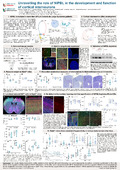
[en] Neuronal development is a complex process involving the spatio-temporal layout of different steps, from progenitors’ proliferation to the establishment of neuronal connections. These processes depend on extrinsic and intrinsic predetermined programs. The genome's architectural organisation is a dynamic phenomenon ensuring the achievement of critical biological processes such as DNA replication, mitosis and sister chromatids segregation. Moreover, the formation of 3D structures such as chromatin loops and TADs (Topologically Associating Domains), is essential in the fine regulation of gene transcription. Chromatin folding is mediated by cohesin, an ATP-dependent complex that extrudes DNA enabling distant cis-regulatory interactions. Heterozygous mutations in the genes encoding cohesin's subunits or its regulators are known to cause cohesinopathies, a spectrum of human congenital disorders. Among these, the Cornelia de Lange Syndrome (CdLS) affects 1 in 50,000 births in Europe and is characterized by birth defects, cognitive and behavioural deficiency. Interestingly, more than 50% of the patients carry a mutation in the NIPBL gene, a ubiquitous protein which promotes cohesin activity. There is increasing evidence of transcriptional deregulation in CdLS cells, which appears to result from a defect in chromatin loop extrusion. However, the pathological mechanisms behind the onset of behavioural manifestations remain understudied. Cortical interneurons (cINs) have been linked to neurological disorders, such as schizophrenia and autism spectrum disorders. Our study aims to unravel the contribution of cINs to the behavioural defects associated with CdLS. We therefore use two complementary mouse models: a constitutive heterozygous Nipbl mutant to recapitulate the global features of CdLS, and a conditional heterozygous Nipbl mutant in cINs, allowing their analysis in a cell-type-specific manner. Our preliminary results suggest that germline depletion of Nipbl does not interfere with normal behaviour. On the other hand, depletion of Nipbl in cINs tends to alter anxiety-like behaviours without, to date, altering their development. Further studies might reveal whether cINs develoment or function is altered, and whether the differences we observed between models rely on distinct mechanisms.