Abstract :
[en] Background. Fatigue is among the most reported and invalidating symptoms following stroke, even in the chronic phase. Stroke survivors may require greater effort to sustain cognitive performance due to fatigue, yet the effects of fatigue on objective cognitive measures remain poorly understood.
Methods. This study applied a fatigue induction protocol manipulating task demand and duration in chronic stroke patients (n=21) and age-matched healthy controls (HC, n=29), with a mean age of 65 years, to evaluate whether stroke survivors show heightened fatigability at a subsequent working memory task. Participants first completed a fatigue induction task with either high or low cognitive demands, depending on the session. Immediately afterwards, participants performed a Sternberg task, judging whether a probe letter belonged to a previously presented sequence, with sequence lengths ranging from 2 to 7 letters. Reaction times (RT) and accuracy were analyzed using linear mixed-effects models with Group, Condition, Sequence Length, and their interactions.
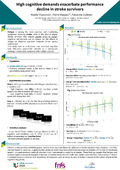
Results. RT increased progressively with sequence length in both groups (p<.001) and were slower following high cognitive demands (p<.001). A Group*Condition interaction indicated that Stroke participants were slower following high cognitive demands (Δ=0.05s, p<.001) compared to HC (Δ=0.02s, p=.03). Accuracy declined with sequence length (p<.001) and was lower in Stroke participants (p=.003), with significant differences emerging at longer sequences (4-7 letters, p<.01).
Conclusions. Chronic stroke survivors exhibited greater sensitivity to cognitive demands, reflected in slower RT and reduced accuracy. These findings suggest that fatigue may capture cognitive resources engaged in the task, and when resources are insufficient, performance declines.