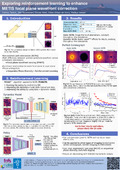
[en] High Contrast Imaging (HCI) on ground-based telescopes suffer from phase aberrations on the observed wavefront caused by atmospheric turbulence. Adaptive Optics (AO) systems are adept at correcting these aberrations, but fall short in the correction of non-common path aberrations (NCPAs). NCPAs arise because the wavefront sensor (WFS) measures and corrects a wavefront that is different from that affecting the science images, thus requiring additional intervention. In the past years we have developed focal-plane wavefront sensing (FPWFS) for vortex coronagraphs, exploring various techniques to lift the sign-ambiguity on even Zernike modes and to estimate NCPAs. We have used Deep Learning (DL) algorithms to train models on laboratory datasets of Zernike coefficients which were used to identify and correct aberrations (Quesnel 2024). Here, we move from DL to Reinforcement Learning (RL) to enable real-time training and correction of NCPAs. We focus on the Mid-infrared ELT Imager and Spectrograph (METIS) and the water vapor seeing that causes significant aberrations on mid-infrared exoplanet observations. We have created a simulation that mimics the METIS instrument, emulates the water vapor-induced aberrations and uses RL to correct disturbed wavefront. Our goal is to optimize these RL algorithms for on-sky demonstrations of this technique, which will be a major milestone for the deployment of FPWFS on METIS.
Disciplines :
Space science, astronomy & astrophysics
Author, co-author :
Taskin, Iremsu ; Université de Liège - ULiège > Département d'astrophysique, géophysique et océanographie (AGO) > Planetary & Stellar systems Imaging Laboratory
Language :
English
Title :
Exploring reinforcement learning to enhance METIS focal plane wavefront correction