Abstract :
[fr] Le « patrimoine bâti » rassemble les biens présentant une valeur patrimoniale dont il convient de garantir la pérennité (Géron 2011). Qu’il soit ancien ou plus récent, le patrimoine bâti participe à notre vie quotidienne. Témoin des valeurs passées et présentes de la société industrielle, valeurs de nature affective, symbolique, culturelle, scientifique ou sociale, il constitue un élément important de l’histoire et contribue de façon efficace à l’image de la région (Bruxelles-Capitale et sites 2005).
Conçus en Belgique et construits en R.D.Congo au début du XXe siècle, les bâtiments à ossatures en acier du Kongo-Central, réalisés par la société anonyme des Grandes Chaudronneries de l’Escaut, présentent un état d’endommagement avancé lié non seulement aux conditions climatiques de la zone (zone tropicale humide), mais aussi à celles d’exploitation par leurs usagers. Au vu de leur valeur patrimoniale, il est donc nécessaire de réaliser des études structurales approfondies de ces bâtiments en vue de déceler les manquements et proposer des solutions permettant de les conserver en tant que témoin de l’histoire commune entre la Belgique et la R.D.Congo.
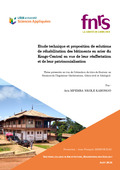
C’est dans ce cadre que le Fonds de la Recherche Scientifique (FNRS) a financé le projet PDR intitulé « Les expérimentations de l’architecture au Kongo-Central sous l’influence des acteurs et facteurs du pouvoir colonial et du contexte local. Tropicalisation de l’ingénierie et de l’architecture ». Ce projet, mené conjointement entre l'Université libre de Bruxelles (ULB) (en charge de la partie architecturale) et l’Université de Liège (ULiège) (en charge de la partie ingénierie), a abouti à la rédaction de deux thèses de doctorat. La première, présentée et défendue par Dalia Perziani, est intitulée : « Construire en métal pour le Bas-Congo : Systèmes, acteurs et adaptations d’une architecture tropicalisée (1885-1930) » et couvre la partie architecturale du projet pour le compte de l’ULB ; tandis que la seconde, couvrant la partie ingénierie et intitulée : « Etude technique et proposition de solutions de réhabilitation des bâtiments en acier du Kongo-Central en vue de leur réaffectation et de leur patrimonialisation », est celle faisant l’objet du présent travail de thèse.
Les recherches entreprises tout au long de ce travail ont permis : (i) de relever les caractéristiques techniques des solutions de bâtiment en acier importées à l'époque coloniale à l’Etat Indépendant du Congo (EIC) ainsi que les alternatives constructives utilisées, (ii) de réaliser l’étude structurale complète d’un bâtiment type (Palais de justice de Mbanza-Ngungu - ancien hôtel ABC de Thysville) afin de mettre en évidence et/ou d’identifier les « atouts » et « faiblesses » de ces structures, (iii) d'identifier les pathologies affectant les éléments structuraux et leurs effets sur les pertes des capacités portantes, et enfin, (iv) de formuler les propositions de solutions de réhabilitation du bâtiment étudié et d’autres bâtiments de la ville de Mbanza-Ngungu répondant au même système constructif - solutions qui devront tenir compte des faiblesses relevées aux points précédents.
[en] The “built heritage” encompasses assets possessing heritage value whose preservation must be ensured (Géron 2011). Whether historical or more recent built heritage forms an integral part of everyday life. As a testament to both past and present values of industrial society, whether emotional, symbolic, cultural, scientific, or social, it constitutes a significant element of history and contributes effectively to the image of a region (Bruxelles-Capitale et sites 2005).
Designed in Belgium and constructed in the Democratic Republic of Congo (DRC) at the beginning of the 20th century, the steel-framed buildings of Kongo-Central, produced by the public limited company Grandes Chaudronneries de l’Escaut, are currently in an advanced state of deterioration. This condition is attributable not only to the climatic environment of the region (humid tropical zone), but also to patterns of use by occupants. Considering their patrimonial value, it is therefore essential to conduct in-depth structural studies of these buildings to identify deficiencies and to propose solutions that would ensure their preservation as part of the shared built heritage between Belgium and the DRC.
Within this framework, the Fonds de la Recherche Scientifique (FNRS) funded the PDR project entitled “Architectural experimentation in Kongo-Central under the influence of actors and factors of colonial power and the local context: tropicalisation of engineering and architecture.” This project, carried out jointly by the Université libre de Bruxelles (ULB) (responsible for the architectural part) and the University of Liège (ULiège) (responsible for the engineering part), resulted in the completion of two doctoral theses. The first, presented and defended by Dalia Perziani, entitled “Building in metal for the Bas-Congo: Systems, actors and adaptations of a tropicalized architecture (1885-1930),” addresses the architectural part of the project on behalf of ULB. The second, covering the engineering component and entitled “Technical study and proposal of rehabilitation solutions for steel buildings in Kongo-Central with a view to their reassignment and heritage recognition,” constitutes the subject of the present doctoral research.
The research conducted throughout this work allowed to: (i) identify the technical characteristics of the steel building solutions imported during the colonial period into the Congo Free State (CFS), as well as the employed alternative construction methods; (ii) carry out a complete structural analysis of a representative building (the courthouse of Mbanza-Ngungu-former ABC Hotel of Thysville), in order to highlight and/or identify the “strengths” and “weaknesses” of these structures; (iii) identify the pathologies affecting structural elements and their effects on the loss of load-bearing capacity; and finally, (iv) Develop rehabilitation strategies for the building under study, as well as for other structures in Mbanza-Ngungu employing the same construction system, ensuring that the proposed solutions address the deficiencies identified in the preceding sections.