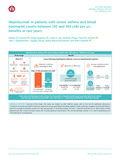
[en] BACKGROUND: Although clinical trial evidence exists, there is limited awareness of the real-world effectiveness of mepolizumab in patients with severe asthma and blood eosinophil counts (BEC) ≥150-<300 cells·μL(-1). METHODS: REALITI-A, an international, prospective, single-arm, observational cohort study enrolled patients with severe asthma initiating mepolizumab. Outcomes assessed over 2 years pre- versus post-mepolizumab exposure included clinically significant exacerbations (CSEs), maintenance oral corticosteroid (mOCS) use, Asthma Control Questionnaire (ACQ)-5 scores and forced expiratory volume in 1 s (FEV(1)). RESULTS: After 2 years of mepolizumab treatment, compared with pre-exposure, the proportion of patients with BEC ≥150-<300 cells·μL(-1) (n=84) experiencing CSEs decreased from 95% to 63%, and the proportion experiencing exacerbations requiring hospitalisation or emergency department visits decreased from 43% to 19%. The rate of CSEs reduced from 4.53 to 1.47 per year (rate ratio 0.32, 95% CI 0.25, 0.41). After 2 years of mepolizumab exposure, the mean (95% CI) clinic pre-bronchodilator % predicted FEV(1) was 80.1 (69.4, 90.7) compared with 62.6 (54.1, 71.1) at baseline (28% relative increase). The median average daily dose of mOCS decreased from 10.0 to 1.5 mg·day(-1) (85% relative reduction from baseline); 44% of patients discontinued completely. The minimum clinically important difference in ACQ-5 (improvement ≥0.5) was achieved by 82% of patients, with a mean (95% CI) reduction of 1.76 (2.34, 1.19). CONCLUSIONS: These real-world findings provide evidence for the 2-year sustained benefit following initiation of mepolizumab in patients with severe asthma who have poor disease control and BEC ≥150-<300 cells·μL(-1).
Disciplines :
Cardiovascular & respiratory systems
Author, co-author :
Canonica, Giorgio W ; Personalized Medicine, Asthma and Allergy, Humanitas Clinical and Research Center, IRCCS, Rozzano, Italy. ; Department of Biomedical Sciences, Humanitas University, Milan, Italy.
Bagnasco, Diego ; Allergy and Respiratory Diseases, IRCCS Policlinic San Martino, University of Genoa, Genoa, Italy.
Lee, Jason K; Toronto Allergists, Toronto, Canada. ; Evidence Based Medical Educator Inc., Toronto, Canada.
Chupp, Geoffrey; Department of Internal Medicine, Yale School of Medicine, New Haven, CT, USA.
Schleich, Florence ; Université de Liège - ULiège > Département des Sciences de l'activité physique et de la réadaptation > Physiologie humaine et physiologie de l'effort physique
Oppenheimer, John J; UMDNJ, Rutgers University School of Medicine, Newark, NJ, USA.
Zhang, Lingjiao; Biostatistics, GSK, Collegeville, PA, USA.
Alfonso-Cristancho, Rafael; Global Real-World Evidence and Health Outcomes Research, GSK, Collegeville, PA, USA.
Howarth, Peter ; Global Medical Affairs, Specialty Medicine, GSK, London, UK.
Language :
English
Title :
Mepolizumab in patients with severe asthma and blood eosinophil counts between 150 and 300 cells per µL: benefits at two years.
Chung KF, Wenzel SE, Brozek JL, et al. International ERS/ATS guidelines on definition, evaluation and treatment of severe asthma. Eur Respir J 2014; 43: 343–373.
Global Initiative for Asthma (GINA). Global Strategy for Asthma Management and Prevention; 2024. Date last accessed: 9 July 2024. https://ginasthma.org/wp-content/uploads/2025/05/GINA-2024-strategy-report_24_05_ 22-WMSA.pdf
Oppenheimer J, Slade DJ, Hahn BA, et al. Real-world evidence: patient views on asthma in respiratory specialist clinics in America. Ann Allergy Asthma Immunol 2021; 126: 385–393.
Azim A, Newell C, Barber C, et al. Clinical evaluation of type 2 disease status in a real-world population of difficult to manage asthma using historic Electronic Health Care Records of Blood Eosinophil counts. Clin Exp Allergy 2021; 51: 811–820.
Heaney L, Pérez de Llano L, Ahmad M, et al. Eosinophilic and noneosinophilic asthma: an expert consensus framework to characterize phenotypes in a global real-life severe asthma cohort. Chest 2021; 160: 814–830.
Price D, Rigazio A, Campbell J, et al. Blood eosinophil count and prospective annual asthma disease burden: a UK cohort study. Lancet Respir Med 2015; 3: 849–858.
European Medicines Agency (EMA). Nucala_SmPC. Date last accessed: June 2024. www.ema.europa.eu/en/ documents/product-information/nucala-epar-product-information_en.pdf
Food and Drug Administration (FDA). Nucala Prescribing Information. Date last accessed: June 2024. www. accessdata.fda.gov/drugsatfda_docs/label/2023/125526Orig1s021,761122Orig1s011Corrected_lbl.pdf
Bel EH, Wenzel SE, Thompson PJ, et al. Oral glucocorticoid-sparing effect of mepolizumab in eosinophilic asthma. N Engl J Med 2014; 371: 1189–1197.
Casale T, Molfino NA, Silver J, et al. Real-world effectiveness of mepolizumab in patients with severe asthma and associated comorbidities. Ann Allergy Asthma Immunol 2021; 127: 354–362.e2.
Chupp GL, Bradford ES, Albers FC, et al. Efficacy of mepolizumab add-on therapy on health-related quality of life and markers of asthma control in severe eosinophilic asthma (MUSCA): a randomised, double-blind, placebo-controlled, parallel-group, multicentre, phase 3b trial. Lancet Respir Med 2017; 5: 390–400.
Domingo Ribas C, Carrillo Diaz T, Blanco Aparicio M, et al. REal worlD effectiveness and safety of mepolizumab in a multicentric Spanish cohort of asthma patients stratified by eosinophils: the REDES study. Drugs 2021; 81: 1763–1774.
Harrison T, Canonica G, Chupp G, et al. Real-world mepolizumab in the prospective severe asthma REALITI-A study: initial analysis. Eur Respir J 2020; 56: 2000151.
Kavanagh J, d’Ancona G, Elstad M, et al. Real-world effectiveness and the characteristics of a ‘super-responder’ to mepolizumab in severe eosinophilic asthma. Chest 2020; 158: 496–506.
Liu M, Bagnasco D, Matucci A, et al. Mepolizumab in patients with severe asthma and comorbidities: 1-year REALITI-a analysis. J Allergy Clin Immunol Pract 2023; 11: 3650–3661.e3.
Llanos JP, Ortega H, Bogart M, et al. Real-world effectiveness of mepolizumab in patients with severe asthma: an examination of exacerbations and costs. J Asthma Allergy 2020; 13: 77–87.
Ortega HG, Liu MC, Pavord ID, et al. Mepolizumab treatment in patients with severe eosinophilic asthma. N Engl J Med 2014; 371: 1198–1207.
Pavord ID, Korn S, Howarth P, et al. Mepolizumab for severe eosinophilic asthma (DREAM): a multicentre, double-blind, placebo-controlled trial. Lancet 2012; 380: 651–659.
Pilette C, Canonica GW, Chaudhuri R, et al. REALITI-A study: real-world oral corticosteroid-sparing effect of mepolizumab in severe asthma. J Allergy Clin Immunol Pract 2022; 10: 2646–2656.
Pini L, Caruso C, Colantuono S, et al. Prospective Italian real-world study of mepolizumab in severe eosinophilic asthma validates retrospective outcome reports. Clin Transl Allergy 2021; 11: e12067.
Silver J, Bogart M, Packnett E, et al. Real-world reductions in oral corticosteroid use in the USA following mepolizumab therapy for severe asthma. J Asthma Allergy 2020; 13: 689–699.
Taille C, Chanez P, Devouassoux G, et al. Mepolizumab in a population with severe eosinophilic asthma and corticosteroid dependence: results from a French early access programme. Eur Respir J 2020; 55: 1902345.
Ortega H, Yancey S, Mayer B, et al. Severe eosinophilic asthma treated with mepolizumab stratified by baseline eosinophil thresholds: a secondary analysis of the DREAM and MENSA studies. Lancet Respir Med 2016; 4: 549–556.
Yancey SW, Keene ON, Albers FC, et al. Biomarkers for severe eosinophilic asthma. J Allergy Clin Immunol 2017; 140: 1509–1518.
Yancey SW, Bradford ES, Keene ON. Disease burden and efficacy of mepolizumab in patients with severe asthma and blood eosinophil counts of ⩾150–300 cells/μL. Respir Med 2019; 151: 139–141.
Caruso C, Canonica GW, Patel M, et al. Prospective REALITI-A study: 2-year real-world benefits of mepolizumab in severe asthma. CHEST Pulmonary 2024; 3: 100107.
Juniper EF, Svensson K, Mork AC, et al. Measurement properties and interpretation of three shortened versions of the asthma control questionnaire. Respir Med 2005; 99: 553–558.
Bonini M, Di Paolo M, Bagnasco D, et al. Minimal clinically important difference for asthma endpoints: an expert consensus report. Eur Respir Rev 2020; 29: 190137.
Porsbjerg CM, Menzies-Gow AN, Tran TN, et al. Global variability in administrative approval prescription criteria for biologic therapy in severe asthma. J Allergy Clin Immunol Pract 2022; 10: 1202–1216.e23.
Thomas D, McDonald VM, Pavord ID, et al. Asthma remission: what is it and how can it be achieved? Eur Respir J 2022; 60: 2102583.
Canonica GW, Colombo GL, Bruno GM, et al. Shadow cost of oral corticosteroids-related adverse events: a pharmacoeconomic evaluation applied to real-life data from the Severe Asthma Network in Italy (SANI) registry. World Allergy Organ J 2019; 12: 100007.
Lommatzsch M. Asthma therapy concepts through the ages. Allergol Select 2024; 8: 1–5.
Pavord I, Gardiner F, Heaney LG, et al. Remission outcomes in severe eosinophilic asthma with mepolizumab therapy: analysis of the REDES study. Front Immunol 2023; 14: 1150162.