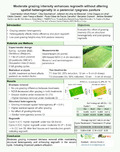
[en] The key to sustainable pasture management is balancing the needs of grazing herbivores with preserving vegetation condition and growth potential over time. One factor that influences this balance is the spatial heterogeneity of grazed vegetation, a consequence of grazing behavior and a driver of forage harvesting efficiency in animals. This study assessed how grazing intensity (GI) affects spatial heterogeneity of sward structure and post-grazing regrowth. The experiment was conducted in spring-summer 2022 on a Lolium perenne pasture. It compared low GI (25% sward height reduction) to moderate GI (50%) on 180 m² paddocks grazed by sheep in a rotational system with a 3-day occupation time. GI treatments were applied by adjusting herd size, three sheep for low GI and six for moderate GI. Normalized Difference Vegetation Index (NDVI) data, acquired using unmanned aerial systems, were combined with ground-based sward height measurements. Over two grazing cycles (C1 and C2), Moran’s global (P = 0.16) and local (P = 0.84) indices, plus semivariance analyses, revealed increased spatial heterogeneity across paddocks, with no significant differences between GI treatments. However, moderate GI tended to favor regrowth during C2 (0.16 vs 0.08 cm day-1, P = 0.02), suggesting more efficient forage utilization under moderate grazing.
Disciplines :
Agriculture & agronomy Animal production & animal husbandry