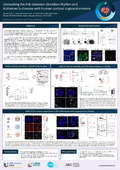
[en] Alzheimer’s disease (AD) is the most common form of dementia among the elderly. Disruption of the circadian rhythm (CR) can occur early during the progression of the disease and further, may control the levels of amyloid beta (Ab) in the brain. However, the mechanisms underlying the link between CR and AD in specific brain cell types are still unknown.
This project investigates how cellular CR contributes to AD pathogenesis using human cortical organoids (hCOs) derived from induced pluripotent stem cells (hiPSCs). We demonstrate the presence of CR in our hCO model in vitro attested by the oscillatory expression of CR modulators. We then challenged pharmacologically basal “sleep-like” neural activity patterns using cholinergic and noradrenergic agonists that increase the presence of “wake-like” activity patterns and alter the CR. This led to increased c-Fos expression and calcium oscillations after 6 hours exposition, with a rescue of c-Fos “sleep-like” rest levels following 7 days or 2-day exposure 5-day recovery, which suggest that CR modification to promote a “wake-like condition” increases neural activity. Next, to assess alterations in neural rhythms and molecular pathways in AD brain cells, we generated hCOs from familial (FAD) and sporadic (SAD) AD patient cells. These AD hCOs showed c-Fos+ cells around Aβ aggregates, suggesting local hyperactivity. Most of these cells had an astrocyte identity, pointing to a potential early role for astrocytes in AD.
These observations suggest that CR alterations may be an early mechanism in AD pathogenesis, highlighting the modulation of CR as a promising target for preventive and therapeutic AD strategies. Further, hCO models may be a useful tool to study the link of CR and AD.
Research Center/Unit :
GIGA Neurosciences-Molecular Regulation of Neurogenesis - ULiège
Disciplines :
Neurology
Author, co-author :
Cambier, Alessia ; Université de Liège - ULiège > Département des sciences biomédicales et précliniques
Gómez Oliva, Ricardo ; Université de Liège - ULiège > Département des sciences biomédicales et précliniques
Ghanavatinejad, Fatemeh ; Université de Liège - ULiège > Département des sciences biomédicales et précliniques
Masset, Gérald ; Université de Liège - ULiège > Département des sciences biomédicales et précliniques
Colinet, Mathilde ; Université de Liège - ULiège > Département des sciences cliniques > Chirurgie réparatrice ; Université de Liège - ULiège > Département des sciences biomédicales et précliniques
Nguyen, Laurent ; Université de Liège - ULiège > Département des sciences biomédicales et précliniques