Keywords :
Capillary system; Driving frequencies; Lissajous; Lower frequencies; Mesoscale phenomenon; Mimetics; Oscillating magnetic fields; Phase locked; Reynold number; Rotation phase; Computational Mechanics; Condensed Matter Physics; Mechanics of Materials; Mechanical Engineering; Fluid Flow and Transfer Processes
Abstract :
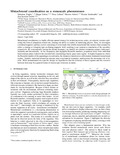
[en] Metachronal coordination is a highly efficient natural strategy for swimming across scales, yet mimetic systems replicating this form of propulsion remain rare, limiting our ability to explore its underlying physics. Here, we investigate a minimal magneto-capillary system consisting of seven beads that exhibit metachronal-like motion when actuated by either a rotating or Lissajous-type oscillating magnetic field, resulting in net rotation or translation of the assembly, respectively. By systematically varying the driving frequency, we identify two distinct swimming regimes, both experimentally and theoretically. At low frequencies and negligible Reynolds numbers, propulsion arises from individual bead rotations phase-locked to the external field, constituting a linear, quasi-static regime. At higher frequencies, where the Reynolds number of the appendages exceeds unity, the dynamics transition to a deformation-dominated metachronal regime. Notably, optimized propulsion emerges near a mechanical resonance, underscoring the increasing role of inertia. While demonstrated on a specific design, we hypothesize that the existence of these regimes and the crossover between them may be a general feature of mesoscopic swimmers in nature.
Funding text :
This work was financially supported by the FNRS CDR Project No. J.0186.23 entitled "Magnetocapillary Interactions for Locomotion at Liquid Interfaces" (MILLI). Further support was provided by the Deutsche Forschungsgemeinschaft Project No. 416229255 SFB 1411 Design of Particulate Products. N.V. thanks the Francqui Foundation (Brussels) for financial support.
Scopus citations®
without self-citations
0