Abstract :
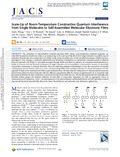
[en] The realization of self-assembled molecular-electronic films, whose room-temperature transport properties are controlled by quantum interference (QI), is an essential step in the scale-up of QI effects from single molecules to parallel arrays of molecules. Recently, the effect of destructive QI (DQI) on the electrical conductance of self-assembled monolayers (SAMs) has been investigated. Here, through a combined experimental and theoretical investigation, we demonstrate chemical control of different forms of constructive QI (CQI) in cross-plane transport through SAMs and assess its influence on cross-plane thermoelectricity in SAMs. It is known that the electrical conductance of single molecules can be controlled in a deterministic manner, by chemically varying their connectivity to external electrodes. Here, by employing synthetic methodologies to vary the connectivity of terminal anchor groups around aromatic anthracene cores, and by forming SAMs of the resulting molecules, we clearly demonstrate that this signature of CQI can be translated into SAM-on-gold molecular films. We show that the conductance of vertical molecular junctions formed from anthracene-based molecules with two different connectivities differ by a factor of approximately 16, in agreement with theoretical predictions for their conductance ratio based on CQI effects within the core. We also demonstrate that for molecules with thioether anchor groups, the Seebeck coefficient of such films is connectivity dependent and with an appropriate choice of connectivity can be boosted by ∼50%. This demonstration of QI and its influence on thermoelectricity in SAMs represents a critical step toward functional ultra-thin-film devices for future thermoelectric and molecular-scale electronics applications.
Scopus citations®
without self-citations
35