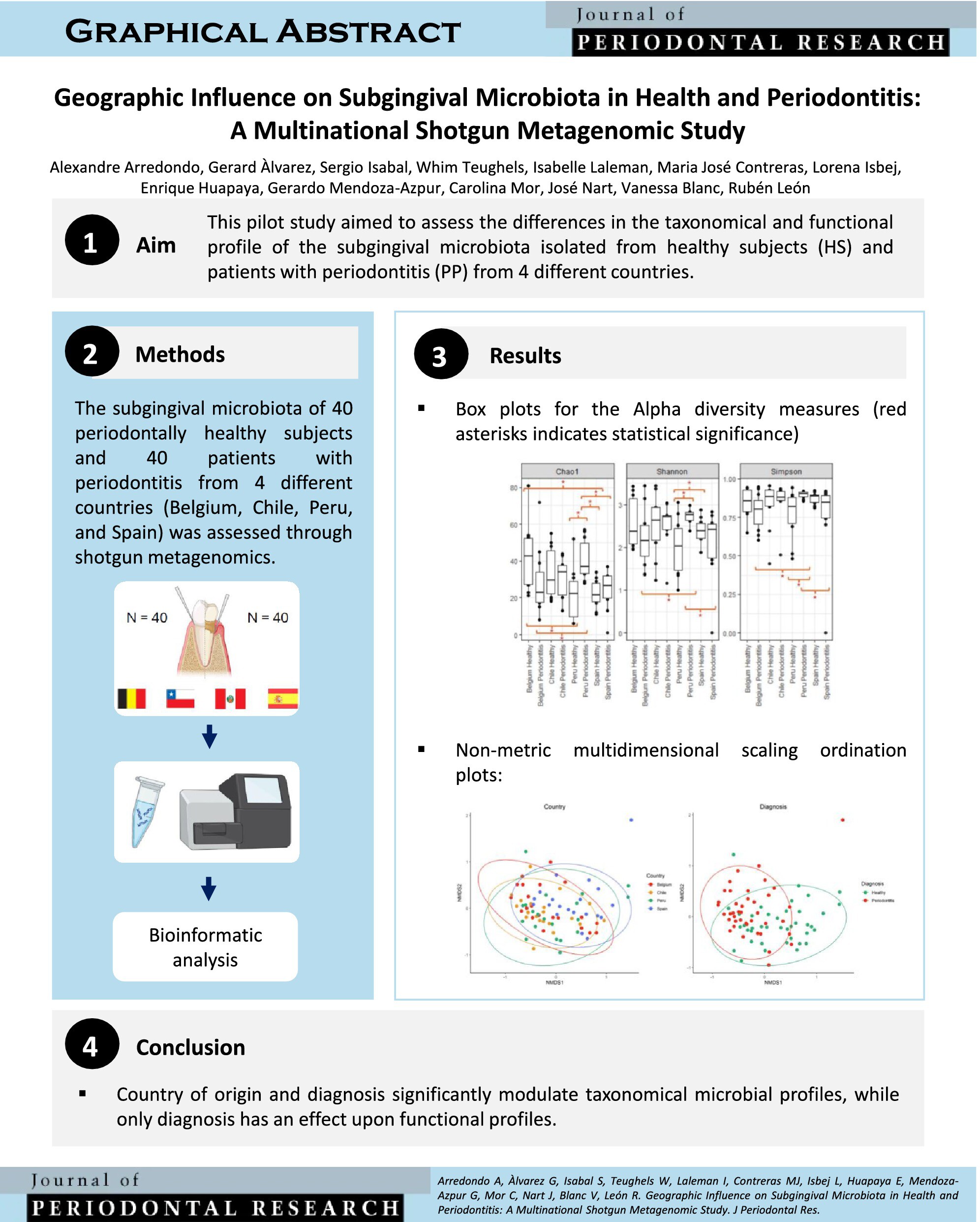
[en] [en] AIMS: To assess the differences in the taxonomical and functional profile of the subgingival microbiota isolated from healthy subjects (HS) and patients with periodontitis (PP) from four different countries.
METHODS: In this study, 80 subgingival samples from HS and PP from four different countries (Belgium, Chile, Peru, and Spain) were analyzed using shotgun metagenomic sequencing.
RESULTS: The results indicated significant variation in α-diversity between HS and PP, segregated by country, with PP from Peru clearly standing out from the rest. In terms of composition, β-diversity was explained more by the country of origin (6.8%) than by the diagnosis (4.1%). In addition, more than 75 different taxa, 63 of which were identified at the species level, showed significantly different relative abundances when comparing the country of origin, diagnosis, and both variables combined. Moreover, 85 metabolic pathways showed significantly different relative abundances between HS and PP, with species commonly associated with periodontitis, such as Porphyromonas gingivalis and Tannerella forsythia, strongly contributing to the reinforcement of periodontitis-associated pathways. On the other hand, differences in functional profiles based on the country of origin were almost nonexistent, suggesting that variability in taxonomic profiles does not have a direct impact on healthy or periodontitis-associated functional profiles.
CONCLUSION: These findings suggest that microbial analysis should take into account the geographic origin of samples in order to provide a more accurate description of the subgingival microbiota. Moreover, they lay the groundwork for larger and more comprehensive studies that might analyze this phenomenon in the future.
Research Center/Unit :
d‐BRU - Dental Biomaterials Research Unit - ULiège
Disciplines :
Microbiology
Author, co-author :
Alexandre, Arredondo ; Department of Microbiology, Dentaid Research Center, Barcelona, Spain
Gerard, Àlvarez; Department of Microbiology, Dentaid Research Center, Barcelona, Spain
Sergio, Isabal; Department of Microbiology, Dentaid Research Center, Barcelona, Spain
Wim, Teughels; Department of Oral Health Sciences, KU Leuven & Dentistry, University Hospitals Leuven, Leuven, Belgium
Laleman, Isabelle ; Université de Liège - ULiège > Département des sciences dentaires ; Centre Hospitalier Universitaire de Liège - CHU > > Service de parodontologie, chirurgie bucco-dentaire et chirurgie implantaire ; d-BRU
Maria José, Contreras; Faculty of Medicine, School of Dentistry, Pontificia Universidad Católica de Chile, Santiago, Chile
Lorena, Isbej ; Faculty of Medicine, School of Dentistry, Pontificia Universidad Católica de Chile, Santiago, Chile ; School of Health Professions Education, Maastrich University, Maastricht, the Netherlands
Enrique, Huapaya; Department of Periodontology, School of Dentistry, Universidad Científica del Sur, Lima, Peru
Gerardo, Mendoza-Azpur; Department of Periodontics, School of Dental Medicine, University of Pennsylvania, Philadelphia, Pennsylvania, USA
Carolina, Mor; Department of Periodontology, Universitat Internacional de Catalunya, Barcelona, Spain
José, Nart; Department of Periodontology, Universitat Internacional de Catalunya, Barcelona, Spain
Vanessa, Blanc; Department of Microbiology, Dentaid Research Center, Barcelona, Spain
Rubén, León; Department of Microbiology, Dentaid Research Center, Barcelona, Spain
M. Sanz, F. D'Aiuto, J. Deanfield, and F. Fernandez-Aviles, “European Workshop in Periodontal Health and Cardiovascular Disease–Scientific Evidence on the Association Between Periodontal and Cardiovascular Diseases: A Review of the Literature,” European Heart Journal Supplements: Journal of the European Society of Cardiology 12 (2010): B3–B12.
M. Sanz, A. Marco del Castillo, S. Jepsen, et al., “Periodontitis and Cardiovascular Diseases: Consensus Report,” Journal of Clinical Periodontology 47 (2020): 268–288.
G. G. Nascimento, S. Alves-Costa, and M. Romandini, “Burden of Severe Periodontitis and Edentulism in 2021, With Projections up to 2050: The Global Burden of Disease 2021 Study,” Journal of Periodontal Research 59 (2024): 823–867.
S. M. Dabdoub, S. M. Ganesan, and P. S. Kumar, “Comparative Metagenomics Reveals Taxonomically Idiosyncratic Yet Functionally Congruent Communities in Periodontitis,” Scientific Reports 6 (2016): 38993.
L. Winning, G. Moran, M. McClory, et al., “Subgingival Microbial Diversity and Respiratory Decline: A Cross-Sectional Study,” Journal of Clinical Periodontology 50 (2023): 921–931.
T. Mineoka, S. Awano, T. Rikimaru, et al., “Site-Specific Development of Periodontal Disease Is Associated With Increased Levels of Porphyromonas gingivalis, Treponema denticola, and Tannerella forsythia in Subgingival Plaque,” Journal of Periodontology 79 (2008): 670–676.
S. Yost, A. E. Duran-Pinedo, R. Teles, K. Krishnan, and J. Frias-Lopez, “Functional Signatures of Oral Dysbiosis During Periodontitis Progression Revealed by Microbial Metatranscriptome Analysis,” Genome Medicine 7 (2015): 27.
A. Basic and G. Dahlén, “Microbial Metabolites in the Pathogenesis of Periodontal Diseases: A Narrative Review,” Frontiers in Oral Health 4 (2023): 1210200.
F. Beghini, L. J. McIver, A. Blanco-Míguez, et al., “Integrating Taxonomic, Functional, and Strain-Level Profiling of Diverse Microbial Communities With bioBakery 3,” eLife 10 (2021): e65088, https://doi.org/10.7554/eLife.65088.
B. Maas, R. J. Pakeman, L. Godet, L. Smith, V. Devictor, and R. Primack, “Women and Global South Strikingly Underrepresented Among Top-Publishing Ecologists,” Conservation Letters 14 (2021): e12797.
A. Arredondo, G. Àlvarez, S. Isabal, et al., “Comparative 16S rRNA Gene Sequencing Study of Subgingival Microbiota of Healthy Subjects and Patients With Periodontitis From Four Different Countries,” Journal of Clinical Periodontology 50 (2023): 1176–1187.
G. I. Lafaurie, Y. Neuta, R. Ríos, et al., “Differences in the Subgingival Microbiome According to Stage of Periodontitis: A Comparison of Two Geographic Regions,” PLoS One 17 (2022): e0273523.
J.-H. Moon and J.-H. Lee, “Probing the Diversity of Healthy Oral Microbiome With Bioinformatics Approaches,” BMB Reports 49 (2016): 662–670.
I. Nasidze, J. Li, D. Quinque, K. Tang, and M. Stoneking, “Global Diversity in the Human Salivary Microbiome,” Genome Research 19 (2009): 636–643.
I. M. Velsko, S. Gallois, R. Stahl, A. G. Henry, and C. Warinner, “High Conservation of the Dental Plaque Microbiome Across Populations With Differing Subsistence Strategies and Levels of Market Integration,” Molecular Ecology 32 (2023): 3872–3891.
G. Àlvarez, A. Arredondo, S. Isabal, et al., “Association of Nine Pathobionts With Periodontitis in Four South American and European Countries,” Journal of Oral Microbiology 15 (2023): 21886360.
J. G. Caton, G. Armitage, T. Berglundh, et al., “A New Classification Scheme for Periodontal and Peri-Implant Diseases and Conditions—Introduction and Key Changes From the 1999 Classification,” Journal of Clinical Periodontology 45, no. S1 (2018): S1–S8.
S. Andrews, FastQC: A Quality Control Tool for High Throughput Sequence Data (2010), http://www.bioinformatics.babraham.ac.uk/projects/fastqc/.
M. Martin, “Cutadapt Removes Adapter Sequences From High-Throughput Sequencing Reads,” EMBnet.Journal 17 (2011): 10.
A. Blanco-Míguez, F. Beghini, F. Cumbo, et al., “Extending and Improving Metagenomic Taxonomic Profiling With Uncharacterized Species Using MetaPhlAn 4,” Nature Biotechnology 41 (2023): 1633–1644.
P. J. McMurdie and S. Holmes, “Phyloseq: An R Package for Reproducible Interactive Analysis and Graphics of Microbiome Census Data,” PLoS One 8 (2013): e61217.
J. Oksanen, F. G. Blanchet, M. Friendly, et al., vegan: Community Ecology Package (2016), https://cran.r-project.org/package=vegan.
H. Wickham, Ggplot2: Elegant Graphics for Data Analysis (Springer-Verlag, 2016).
R Core Team, R: A Language and Environment for Statistical Computing (R Foundation for Statistical Computing, 2013).
H. Lin and S. D. Peddada, “Analysis of Compositions of Microbiomes With Bias Correction,” Nature Communications 11 (2020): 3514.
H. Mallick, A. Rahnavard, L. J. McIver, et al., “Multivariable Association Discovery in Population-Scale Meta-Omics Studies,” PLoS Computational Biology 17 (2021): e1009442.
C. Liu, Y. Cui, X. Li, and M. Yao, “Microeco: An R Package for Data Mining in Microbial Community Ecology,” FEMS Microbiology Ecology 97 (2021): fiaa255.
A. Kim, S. Sevanto, E. R. Moore, and N. Lubbers, “Latent Dirichlet Allocation Modeling of Environmental Microbiomes,” PLoS Computational Biology 19 (2023): e1011075.
N. Murzintcev and C. Nathan, ldatuning: Tuning of the Latent Dirichlet Allocation Models Parameters (2020), https://cran.r-project.org/web/packages/ldatuning/index.html.
Y. Lin, X. Liang, Z. Li, et al., “Omics for Deciphering Oral Microecology,” International Journal of Oral Science 16 (2024): 2.
M. G. I. Langille, M. G. Langille, J. Zaneveld, et al., “Predictive Functional Profiling of Microbial Communities Using 16S rRNA Marker Gene Sequences,” Nature Biotechnology 31, no. 9 (2013): 814–821, https://doi.org/10.1038/nbt.2676.
D. T. Truong, A. Tett, E. Pasolli, C. Huttenhower, and N. Segata, “Microbial Strain-Level Population Structure and Genetic Diversity From Metagenomes,” Genome Research 27 (2017): 626–638.
P. E. Kolenbrander, R. J. Palmer, S. Periasamy, and N. S. Jakubovics, “Oral Multispecies Biofilm Development and the Key Role of Cell–Cell Distance,” Nature Reviews Microbiology 8 (2010): 471–480.
E. Zaura, B. J. Keijser, S. M. Huse, and W. Crielaard, “Defining the Healthy ‘Core Microbiome’ of Oral Microbial Communities,” BMC Microbiology 9 (2009): 259.
D. Greve, A. Moter, M. C. Kleinschmidt, et al., “Rothia aeria and Rothia dentocariosa as Biofilm Builders in Infective Endocarditis,” International Journal of Medical Microbiology 311 (2021): 151478.
H. Seo, J. Hyun, H. Kim, et al., “Risk and Outcome of Infective Endocarditis in Streptococcal Bloodstream Infections According to Streptococcal Species,” Microbiology Spectrum 11, no. 4 (2023): e01049-23, https://doi.org/10.1128/spectrum.01049-23.
C. Phichaphop, N. Apiwattanakul, S. Wanitkun, and S. Boonsathorn, “Bacterial Endocarditis Caused by Actinomyces oris: First Reported Case and Literature Review,” Journal of Investigative Medicine High Impact Case Reports 8 (2020): 2324709620910645, https://doi.org/10.1177/2324709620910645.
C. do Nascimento, N. Monesi, I. Y. Ito, J. P. M. Issa, and R. F. de Albuquerque Junior, “Bacterial Diversity of Periodontal and Implant-Related Sites Detected by the DNA Checkerboard Method,” European Journal of Clinical Microbiology & Infectious Diseases 30, no. 12 (2011): 1607–1613, https://doi.org/10.1007/s10096-011-1267-1.
A. Narayanan, B. Söder, J. Meurman, et al., “Composition of Subgingival Microbiota Associated With Periodontitis and Diagnosis of Malignancy-a Cross-Sectional Study,” Frontiers in Microbiology 14 (2023): 1172340, https://doi.org/10.3389/fmicb.2023.1172340.
P. N. Papapanou, H. Park, B. Cheng, et al., “Subgingival Microbiome and Clinical Periodontal Status in an Elderly Cohort: The WHICAP Ancillary Study of Oral Health,” Journal of Periodontology 91 (2020): S56–S67.
S. S. Koo, J. G. Fernandes, L. Li, et al., “Evaluation of Microbiome in Primary and Permanent Dentition in Grade C Periodontitis in Young Individuals,” Journal of Periodontology 95 (2024): 650–661.
A. Antezack, D. Etchecopar-Etchart, B. La Scola, and V. Monnet-Corti, “New Putative Periodontopathogens and Periodontal Health-Associated Species: A Systematic Review and Meta-Analysis,” Journal of Periodontal Research 58 (2023): 893–906.
N. Zargar, H. Ashraf, S. M. A. Marashi, M. Sabeti, and A. Aziz, “Identification of Microorganisms in Irreversible Pulpitis and Primary Endodontic Infections With Respect to Clinical and Radiographic Findings,” Clinical Oral Investigations 24 (2020): 2099–2108.
P. Khandelwal, H. Andersen, L. Romick-Rosendale, et al., “A Pilot Study of Human Milk to Reduce Intestinal Inflammation After Bone Marrow Transplant,” Breastfeeding Medicine 14, no. 3 (2019): 193–202, https://doi.org/10.1089/bfm.2018.0199.
W. Ritu, W. Enqi, S. Zheng, J. Wang, Y. Ling, and Y. Wang, “Evaluation of the Associations Between Cervical Microbiota and HPV Infection, Clearance, and Persistence in Cytologically Normal Women,” Cancer Prevention Research 12 (2019): 43–56.
P. E. Kolenbrander and J. London, “Adhere Today, Here Tomorrow: Oral Bacterial Adherence,” Journal of Bacteriology 175 (1993): 3247–3252.
Y. Liao, A. Sater, and H. Henderson, “Streptococcus sanguinis Endocarditis Mimicking ANCA-Associated Vasculitis,” JACC Case Reports 29 (2024): 102–691.
S. Elkattawy, R. Alyacoub, I. Younes, A. Mowafy, M. Noori, and M. Mirza, “A Rare Report of Rothia dentocariosa Endocarditis,” Journal of Community Hospital Internal Medicine Perspectives 11 (2021): 413–415.
T. W. Boo, B. Cryan, A. O'Donnell, and G. Fahy, “Prosthetic Valve Endocarditis Caused by Veillonella parvula,” Journal of Infection 50 (2005): 81–83.
E. Caselli, C. Fabbri, M. D'Accolti, et al., “Defining the Oral Microbiome by Whole-Genome Sequencing and Resistome Analysis: The Complexity of the Healthy Picture,” BMC Microbiology 20 (2020): 120.
A. Herreros-Pomares, D. Hervás, L. Bagan-Debón, E. Jantus-Lewintre, C. Gimeno-Cardona, and J. Bagan, “On the Oral Microbiome of Oral Potentially Malignant and Malignant Disorders: Dysbiosis, Loss of Diversity, and Pathogens Enrichment,” International Journal of Molecular Sciences 24 (2023): 3466, https://doi.org/10.3390/ijms24043466.
F. J. Lawal and S. L. Baer, “Capnocytophaga gingivalis Bacteremia After Upper Gastrointestinal Bleeding in Immunocompromised Patient,” Journal of Investigative Medicine High Impact Case Reports 9 (2021): 23247096211020672, https://doi.org/10.1177/23247096211020672.
C. Izidoro, J. Botelho, V. Machado, et al., “Non-Surgical Periodontal Treatment Impact on Subgingival Microbiome and Intra-Oral Halitosis,” International Journal of Molecular Sciences 24 (2023): 2518.
S. Schulz, A. Schlitt, B. Hofmann, H.-G. Schaller, and S. Reichert, “Periodontal Pathogens and Their Role in Cardiovascular Outcome,” Journal of Clinical Periodontology 47 (2020): 173–181.
R. J. Lamont and G. Hajishengallis, “Polymicrobial Synergy and Dysbiosis in Inflammatory Disease,” Trends in Molecular Medicine 21 (2015): 172–183.
E. I. Wilding, J. R. Brown, A. P. Bryant, et al., “Identification, Evolution, and Essentiality of the Mevalonate Pathway for Isopentenyl Diphosphate Biosynthesis in Gram-Positive Cocci,” Journal of Bacteriology 182 (2000): 4319–4327.
Q. Du, H. Wang, and J. Xie, “Thiamin (Vitamin B1) Biosynthesis and Regulation: A Rich Source of Antimicrobial Drug Targets?,” International Journal of Biological Sciences 7 (2011): 41–52.
N. Xie, L. Zhang, W. Gao, et al., “NAD+ Metabolism: Pathophysiologic Mechanisms and Therapeutic Potential,” Signal Transduction and Targeted Therapy 5 (2020): 227.
B. Klabunde, A. Wesener, W. Bertrams, et al., “NAD+ Metabolism Is a Key Modulator of Bacterial Respiratory Epithelial Infections,” Nature Communications 14 (2023): 5818.
T. Nemoto, T. Shiba, K. Komatsu, et al., “Discrimination of Bacterial Community Structures Among Healthy, Gingivitis, and Periodontitis Statuses Through Integrated Metatranscriptomic and Network Analyses,” mSystems 6 (2021): e00886-21, https://doi.org/10.1128/mSystems.00886-21.
N. Favale, R. Farina, A. Carrieri, et al., “Functional Profile of Oral Plaque Microbiome: Further Insight Into the Bidirectional Relationship Between Type 2 Diabetes and Periodontitis,” Molecular Oral Microbiology 39 (2024): 62–79.
A. E. Duran-Pinedo, T. Chen, R. Teles, et al., “Community-Wide Transcriptome of the Oral Microbiome in Subjects With and Without Periodontitis,” ISME Journal 8 (2014): 1659–1672.
P. Ghensi, P. Manghi, M. Zolfo, et al., “Strong Oral Plaque Microbiome Signatures for Dental Implant Diseases Identified by Strain-Resolution Metagenomics,” npj Biofilms and Microbiomes 6 (2020): 47.
P. Buendia, K. Fernandez, C. Raley, A. Rahnavard, K. A. Crandall, and J. G. Castro, “Hospital Antimicrobial Stewardship: Profiling the Oral Microbiome After Exposure to COVID-19 and Antibiotics,” Frontiers in Microbiology 15 (2024): 1346762.
N. Kitamura, T. Kajihara, C. G. Volpiano, et al., “Exploring the Effects of Antimicrobial Treatment on the Gut and Oral Microbiomes and Resistomes From Elderly Long-Term Care Facility Residents via Shotgun DNA Sequencing,” Microbial Genomics 10 (2024): 001180.
C. K. Dias, R. Starke, V. S. Pylro, and D. K. Morais, “Database Limitations for Studying the Human Gut Microbiome,” PeerJ Computer Science 6 (2020): e289.