hot mirror; photothermal conversion phase-change material; radiative heat loss; solar thermal energy storage
Abstract :
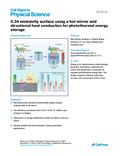
[en] Photothermal conversion phase-change materials (PCPCMs) effectively harvest and store solar thermal energy but suffer from high radiative losses due to their intrinsic infrared emissivity. Here, we report a bidirectional thermal regulation approach integrating spectrally selective low-infrared-emissivity surfaces with directional thermal transport channels to address this issue. This design achieves a mid-infrared emissivity of 0.34 on the surface and a 65% enhancement in internal heat transfer while maintaining enthalpy with negligible reduction. A photothermal physical model with a cutoff wavelength accurately quantifies the convective and radiative losses induced by the hot mirror. The results reveal that the heat dissipation pathway shifts from radiation dominated to convection dominated, leading to a 76% reduction in radiative loss and a 27% improvement in photothermal conversion efficiency. This work decouples optical absorption from thermal emission, providing an efficient and generalizable route for high-performance solar thermal energy harvesting and storage systems.
Disciplines :
Materials science & engineering
Author, co-author :
Zhang, Nan ✱; School of Mechanical Engineering, Southwest Jiaotong University, Chengdu, China ; Tangshan Institute of Southwest Jiaotong University, Tangshan, China
Li, Xiaohan ✱; Université de Liège - ULiège > Urban and Environmental Engineering ; School of Mechanical Engineering, Southwest Jiaotong University, Chengdu, China
Zhang, Zhaoli; School of Mechanical Engineering, Southwest Jiaotong University, Chengdu, China
Luo, Zhixing; College of Architecture, Xi’an University of Architecture and Technology, Xi’an, China
Yang, Liu; College of Architecture, Xi’an University of Architecture and Technology, Xi’an, China
Cao, Xiaoling; School of Mechanical Engineering, Southwest Jiaotong University, Chengdu, China
Yuan, Yanping ✱; School of Mechanical Engineering, Southwest Jiaotong University, Chengdu, China
✱ These authors have contributed equally to this work.
Language :
English
Title :
0.34 emissivity surface using a hot mirror and directional heat conduction for photothermal energy storage
NSCF - National Natural Science Foundation of China
Funding text :
This work was supported by the National Key Research and Development Program of China (no. 2022YFC3802704); the National Natural Science Foundation of China (no. 52378111); and the Hebei Natural Science Foundation, China (no. E2024105026).
Chai, Z. (2024). Composite phase-change materials for photo-thermal conversion and energy storage: A review. Nano Energy 124, 109437. https://doi.org/10.1016/j.nanoen.2024.109437.
Li, Z., Lu, Y., Huang, R., Chang, J., Yu, X., Jiang, R., Yu, X., and Roskilly, A.P. (2021). Applications and technological challenges for heat recovery, storage and utilisation with latent thermal energy storage. Appl Energ 283, 116277. https://doi.org/10.1016/j.apenergy.2020.116277.
Chen, X., Liu, C., and Aftab, W. (2024). Advanced solid-solid phase change thermal storage material. Nano res. energy 3, e9120103. https://doi.org/10.26599/NRE.2023.9120103.
Wang, L., Yu, H., and Feng, W. (2024). Photothermal Phase Change Energy Storage Materials: A Groundbreaking New Energy Solution. Research 7, 0460. https://doi.org/10.34133/research.0460.
Liu, M., Qian, R., Yang, Y., Lu, X., Huang, L., and Zou, D. (2024). Modification of Phase Change Materials for Electric-Thermal, Photo-Thermal, and Magnetic-Thermal Conversions: A Comprehensive Review. Adv Funct Mater n/a, 2400038. https://doi.org/10.1002/adfm.202400038.
Cui, X., Ruan, Q., Zhuo, X., Xia, X., Hu, J., Fu, R., Li, Y., Wang, J., and Xu, H. (2023). Photothermal Nanomaterials: A Powerful Light-to-Heat Converter. Chem. Rev 123, 6891-6952. https://doi.org/10.1021/acs.chemrev.3c00159.
Javadi, F.S. (2020). Performance improvement of solar thermal systems integrated with phase change materials (PCM), a review. Sol Energy 206, 330-352. https://doi.org/10.1016/j.solener.2020.05.106.
Wang, Z., Tong, Z., Ye, Q., Hu, H., Nie, X., Yan, C., Shang, W., Song, C., Wu, J., Wang, J., et al. (2017). Dynamic tuning of optical absorbers for accelerated solar-thermal energy storage. Nat Commun 8, 1478. https://doi.org/10.1038/s41467-017-01618-w.
Jiao, K. (2024). Endowing photothermal materials with latent heat storage: A state-of-art review on photothermal PCMs. Chem. Eng 500, 156498. J. https://doi.org/10.1016/j.cej.2024.156498.
Li, Y., Feng, Y., Qin, M., Chen, K., An, Y., Liu, P., Jiang, Y., Shen, Z., and Chen, X. (2025). Co-anchored Hollow Carbonized Kapok Fiber Encapsulated Phase Change Materials for Upgrading Photothermal Utilization. Small 21, 2500479. https://doi.org/10.1002/smll.202500479.
Chen, X., Lin, J., Feng, Y., Chen, K., Qin, M., Han, S., Jiang, Y., Shen, Z., and Li, Y. (2025). Carbon-metal network boosting photon/phonon transport in photothermal phase change materials. Carbon 238, 120192. https://doi.org/10.1016/j.carbon.2025.120192.
Chen, C., Kuang, Y., and Hu, L. (2019). Challenges and opportunities for solar evaporation. Joule 3, 683-718. https://doi.org/10.1016/j.joule.2018.12.023.
Tao, Y.B., and He, Y.-L. (2018). A review of phase change material and performance enhancement method for latent heat storage system. Renew Sust Energ Rev 93, 245-259. https://doi.org/10.1016/j.rser.2018.05.028.
Zhang, Y., Tang, J., Chen, J., Zhang, Y., Chen, X., Ding, M., Zhou, W., Xu, X., Liu, H., and Xue, G. (2023). Accelerating the solar-thermal energy storage via inner-light supplying with optical waveguide. Nat Commun 14, 3456. https://doi.org/10.1038/s41467-023-39190-1.
Liu, K., Yuan, Z.F., Zhao, H.X., Shi, C.H., and Zhao, F. (2023). Properties and applications of shape-stabilized phase change energy storage materials based on porous material support-A review. Mater Today Sustain 21, 100336. https://doi.org/10.1016/j.mtsust.2023.100336.
Li, Y., Liu, P., Li, P., Feng, Y., Gao, Y., Diao, X., Chen, X., and Wang, G. (2024). Neural network-inspired hybrid aerogel boosting solar thermal storage and microwave absorption. Nano res. energy 3, e9120120. https://doi.org/10.26599/NRE.2024.9120120.
Wu, S., Li, T., Wu, M., Xu, J., Chao, J., Hu, Y., Yan, T., Li, Q.-Y., and Wang, R. (2021). Dual-Functional Aligned and Interconnected Graphite Nanoplatelet Networks for Accelerating Solar Thermal Energy Harvesting and Storage within Phase Change Materials. Acs Appl Mater Inter 13, 19200-19210. https://doi.org/10.1021/acsami.0c22814.
Zhang, P., Qiu, Y., Ye, C., and Li, Q. (2023). Anisotropically conductive phase change composites enabled by aligned continuous carbon fibers for full-spectrum solar thermal energy harvesting. Chem Eng J 461, 141940. https://doi.org/10.1016/j.cej.2023.141940.
Zhang, D., Zhou, B., Yu, J., He, C., Wang, B., Feng, Y., Liu, C., and Shen, C. (2022). Highly thermal conductive phase change composites containing Ag-welding graphene framework with excellent solar-thermal conversion and rapid heat transfer ability. Compos Part A-appl S 161, 107128. https://doi.org/10.1016/j.compositesa.2022.107128.
Feng, Y. (2025). Dual-Functional Phase Change Composites Integrating Thermal Buffering and Electromagnetic Wave Absorption via Multi-interfacial Engineering. Adv. Fiber Mater. https://doi.org/10.1007/s42765-025-00585-y.
Cao, H., Li, S.-Z., Yang, J., Liu, Z.-Y., Bai, L., and Yang, W. (2023). Thermally conductive magnetic composite phase change materials for anisotropic photo/magnetic-to-thermal energy conversion. ACS Appl, Mater, Interfaces 15, 55723−55733. https://doi.org/10.1021/acsami.3c12302.
Zhao, C., Guo, P., Sheng, N., Zhu, C., and Rao, Z. (2023). Cloth-derived anisotropic carbon scroll attached with 2D oriented graphite layers for supporting phase change material with efficient thermal storage. Chem. Eng. J. 454, 139999. https://doi.org/10.1016/j.cej.2022.139999.
Zhao, H., Shu, C., Wang, X., Min, P., Li, C., Gao, F., Li, X., and Yu, Z. (2023). Bioinspired Intelligent Solar-Responsive Thermally Conductive Pyramidal Phase Change Composites with Radially Oriented Layered Structures toward Efficient Solar-Thermal-Electric Energy Conversion. Adv Funct Mater 33, 2302527. https://doi.org/10.1002/adfm.202302527.
Zhao, H.-Y., Shu, C., Min, P., Li, C., Deng, W., Yang, J., Li, X., and Yu, Z.-Z. (2022). Constructing anisotropic conical graphene aerogels with concentric annular structures for highly thermally conductive phase change composites towards efficient solar-thermal-electric energy conversion. J. Mater. Chem. A 10, 22488-22499. https://doi.org/10.1039/D2TA06457J.
Shu, C., Zhao, H.-Y., Lu, X.-H., Min, P., Zhang, Y., Wang, Q., Li, X., and Yu, Z.-Z. (2023). High-quality anisotropic graphene aerogels and their thermally conductive phase change composites for efficient solar-thermal-electrical energy conversion. ACS Sustainable Chem. Eng. 11, 11991-12003. https://doi.org/10.1021/acssuschemeng.3c02154.
Min, P., Liu, J., Li, X., An, F., Liu, P., Shen, Y., Koratkar, N., and Yu, Z.-Z. (2018). Thermally conductive phase change composites featuring anisotropic graphene aerogels for real-time and fast-charging solar-thermal energy conversion. Adv, Funct, Mater, 28, 1805365. https://doi.org/10.1002/adfm.201805365.
Yuan, J., Yan, Y., Kong, X., Wang, C., and Fan, M. (2025). Preparation and application of multilayered flexible phase change material with high thermal conductivity and high enthalpy. Compos. Struct. 353, 118718. https://doi.org/10.1016/j.compstruct.2024.118718.
Tian, Y., Liu, X., Caratenuto, A., Li, J., Zhou, S., Ran, R., Chen, F., Wang, Z., Wan, K., Xiao, G., et al. (2022). A new strategy towards spectral selectivity: Selective leaching alloy to achieve selective plasmonic solar absorption and infrared suppression. Nano Energy 92, 106717. https://doi.org/10.1016/j.nanoen.2021.106717.
Yang, Z. (2024). Optically selective catalyst design with minimized thermal emission for facilitating photothermal catalysis. Nat Commun 15, 7599. https://doi.org/10.1038/s41467-024-51896-4.
Qin, M., Jia, K., Usman, A., Han, S., Xiong, F., Han, H., Jin, Y., Aftab, W., Geng, X., Ma, B., et al. (2024). High-Efficiency Thermal-Shock Resistance Enabled by Radiative Cooling and Latent Heat Storage. Adv. Mater. 36, 2314130. https://doi.org/10.1002/adma.202314130.
Wang, Y., Zhang, X., Liu, S., Liu, Y., Zhou, Q., Zhu, T., Miao, Y.-E., Willenbacher, N., Zhang, C., and Liu, T. (2024). Thermal-Rectified Gradient Porous Polymeric Film for Solar-Thermal Regulatory Cooling. Adv. Mater. 36, 2400102. https://doi.org/10.1002/adma.202400102.
Lee, S.E., Seo, J., Kim, S., Park, J.H., Jin, H.J., Ko, J., Kim, J.H., Kang, H., Kim, J.-T., Lee, H., et al. (2024). Reversible Solar Heating and Radiative Cooling Devices via Mechanically Guided Assembly of 3D Macro/Microstructures. Adv. Mater. 36, 2400930. https://doi.org/10.1002/adma.202400930.
Yang, H., Hu, Z., Wu, S., Yan, J., Cen, K., Bo, Z., and Xiong, G. (2024). Directional-thermal-conductive phase change composites enabling efficient and durable water-electricity co-generation beyond daytime. Adv. Energy Mater 14, 2402926. https://doi.org/10.1002/aenm.202402926.
Chen, H.-L., Cattoni, A., De Lepinau, R., Walker, A.W., Hohn, O., Lackner, D., Siefer, G., Faustini, M., Vandamme, N., Goffard, J., et al. (2019). A 19.9%-efficient ultrathin solar cell based on a 205-nm-thick GaAs absorber and a silver nanostructured back mirror. Nat Energy 4, 761-767. https://doi.org/10.1038/s41560-019-0434-y.
Wang, X., Gao, J., Hu, H., Zhang, H., Liang, L., Javaid, K., Zhuge, F., Cao, H., and Wang, L. (2017). High-temperature tolerance in WTi-al2O3 cermet-based solar selective absorbing coatings with low thermal emissivity. Nano Energy 37, 232-241. https://doi.org/10.1016/j.nanoen.2017.05.036.
Wu, W., Tong, L., Zhou, H., and Fan, T. (2022). Combined experimental and DFT study on 2D MoSe2 toward low infrared emissivity. Adv Funct Materials 32, 2201906. https://doi.org/10.1002/adfm.202201906.
Ren, J., Xie, C., Zong, H., Zhang, S., and Wu, S. (2024). Infrared stealth coating with tunable structural color based on ZnO spheres. Small 20, 2403549. https://doi.org/10.1002/smll.202403549.
Singh, N., and Khullar, V. (2023). Experimental and theoretical investigation into effectiveness of ZnO based transparent heat mirror covers in mitigating thermal losses in volumetric absorption based solar thermal systems. Sol Energy 253, 439-452. https://doi.org/10.1016/j.solener.2023.02.057.
Kaluba, V.S., Mohamad, K., and Ferrer, P. (2020). Experimental and simulated performance of hot mirror coatings in a parabolic trough receiver. Appl Energ 257, 114020. https://doi.org/10.1016/j.apenergy.2019.114020.
Wang, Y., Yu, M., Gao, Y., Liu, S., Yin, X., Pang, N., and Wang, C. (2023). Three-layer composite coatings with compatibility of low infrared emissivity and high wave transmittance. J ALLOY COMPD 943, 169038. https://doi.org/10.1016/j.jallcom.2023.169038.
Wang, Y., Li, X., Wang, C., Jian, X., Zong, L., and Wang, J. (2022). Preparation and characteristics of polymer matrix composite coatings with low infrared emissivity and high-temperature resistance. Polymer Engineering & Sci 62, 1941-1949. https://doi.org/10.1002/pen.25977.
Frank, G., Kauer, E., and Kostlin, H. (1981). Transparent heat-reflecting coatings based on highly doped semiconductors. Thin Solid Films 77, 107-118. https://doi.org/10.1016/0040-6090(81)90365-5.
Ren, Y., Liu, P., Liu, R., Wang, Y., Wei, Y., Jin, L., and Zhao, G. (2022). The key of ITO films with high transparency and conductivity: Grain size and surface chemical composition. J ALLOY COMPD 893, 162304. https://doi.org/10.1016/j.jallcom.2021.162304.
Li, Y., Yin, G., and Schmid, M. (2022). Bifacial semi-transparent ultra-thin Cu(In,Ga)Se2 solar cells on ITO substrate: How ITO thickness and Na doping influence the performance. Sol. Energy Mater. Sol. Cells 234, 111431. https://doi.org/10.1016/j.solmat.2021.111431.
Shin, Y., and Kim, J. (2019). Influences of the Ag and the ITO Thicknesses on the Optical and the Electrical Properties of ITO/Ag/ITO Multilayer Films. J. Korean Phys. Soc. 74, 871-875. https://doi.org/10.3938/jkps.74.871.
Zhang, W., Wang, T., Zhong, L., Wu, X., and Cui, M. (2005). Theoretical Study on Infrared Emissivity of ITO Conductive Film. Acta Physica Sinica 54. 4439-4444 https://qikan.cqvip.com/Qikan/Article/Detail?id=20011194.
Qiu, Y., Xu, Y., Li, Q., Wang, J., Wang, Q., and Liu, B. (2021). Efficiency enhancement of a solar trough collector by combining solar and hot mirrors. Appl Energ 299, 117290. https://doi.org/10.1016/j.apenergy.2021.117290.
Kaluba, V.S., and Ferrer, P. (2016). A model for hot mirror coating on solar parabolic trough receivers. J Renew Sustain Ener 8, 53703. https://doi.org/10.1063/1.4965252.
Mohamad, K., and Ferrer, P. (2019). Parabolic trough efficiency gain through use of a cavity absorber with a hot mirror. Appl Energ 238, 1250-1257. https://doi.org/10.1016/j.apenergy.2019.01.163.
He, C., Zhao, P., Zhang, H., Chen, K., Liu, B., Lu, Z., Li, Y., La, P., Liu, G., and Gao, X. (2023). Efficient warming textile enhanced by a high-entropy spectrally selective nanofilm with high solar absorption. Adv Sci 10, 2204817. https://doi.org/10.1002/advs.202204817.
Etemad-Parishanzadeh, O., Ali, W., Linders, J., Straube, T., Lutz, H., Aggarwal, V., Mayer, C., Textor, T., Gutmann, J.S., and Mayer-Gall, T. (2021). Characterization and Optimization of AZO Nanoparticles as Coatings for Flexible Substrates toward High IR Reflectivity. Acs Appl Mater Inter 13, 61707-61722. https://doi.org/10.1021/acsami.1c22151.
Bi, R., Zheng, C., Yu, W.W., Zheng, W., and Wang, D. (2023). Breaking through the plasma wavelength barrier to extend the transparency range of ultrathin indium tin oxide films into the far infrared. J.Appl. Phys 134, 165301. https://doi.org/10.1063/5.0165653.
Patel, J., Sharme, R.K., Quijada, M.A., and Rana, M.M. (2024). A Review of Transparent Conducting Films (TCFs): Prospective ITO and AZO Deposition Methods and Applications. Nanomaterials 14, 2013. https://doi.org/10.3390/nano14242013.
Sittinger, V., King, H., Kaiser, A., Jung, S., Kabakli, O.S., Schulze, P.S.C., and Goldschmidt, J.C. (2023). Indium-based transparent conductive oxides developed for perovskite and perovskite-silicon tandem solar cell applications. Surface and Coatings Technology 457, 129286. https://doi.org/10.1016/j.surfcoat.2023.129286.
Yu, J., Bai, Y., Qiu, Q., Sun, Z., Ye, L., Qian, C., Ma, Z., Song, X., Chen, T., Yu, J., et al. (2024). Reliability of transparent conductive oxide in ambient acid and implications for silicon solar cells. eScience 4, 100241. https://doi.org/10.1016/j.esci.2024.100241.
Brewer, S.H., and Franzen, S. (2002). Optical properties of indium tin oxide and fluorine-doped tin oxide surfaces: Correlation of reflectivity, skin depth, and plasmon frequency with conductivity. J. Alloys Compd. 338, 73-79. https://doi.org/10.1016/S0925-8388(02)00217-7.
Zhou, Y. (2018). Polyurethane-based solid-solid phase change materials with in situ reduced graphene oxide for light-thermal energy conversion and storage. Sol Energy 338, 117-125. https://doi.org/10.1016/j.cej.2018.01.021.
Zhang, D. (2024). Ti3C2Tx MXene/Graphene hybrid frameworks for constructing thermally conductive phase change composites with solar-thermal conversion ability. Compos Commun 51, 102053. https://doi.org/10.1016/j.coco.2024.102053.
Mu, B., and Li, M. (2019). Fabrication and characterization of polyurethane-grafted reduced graphene oxide as solid-solid phase change materials for solar energy conversion and storage. Sol Energy 188, 230-238. https://doi.org/10.1016/j.solener.2019.05.082.
Li, M., and Wang, C. (2019). Preparation and characterization of GO/PEG photo-thermal conversion form-stable composite phase change materials. Renew Energ 141, 1005-1012. https://doi.org/10.1016/j.renene.2019.03.141.
Allaire, G., and Habibi, Z. (2013). Homogenization of a Conductive, Convective, and Radiative Heat Transfer Problem in a Heterogeneous Domain. SIAM J. Math. Anal. 45, 1136-1178. http://epubs.siam.org/doi/10.1137/110849821.
Richardson, G., Denuault, G., and Please, C.P. (2012). Multiscale modelling and analysis of lithium-ion battery charge and discharge. J Eng Math. 72, 41-72. https://doi.org/10.1016/S0925-8388(02)00217-7.