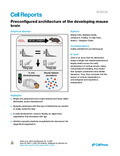
[en] In the adult brain, structural and functional parameters, such as synaptic sizes and neuronal firing rates, follow right-skewed and heavy-tailed distributions. While this organization is thought to have significant implications, its development is still largely unknown. Here, we address this knowledge gap by investigating a large-scale dataset recorded from the prefrontal cortex and the olfactory bulb of mice aged 4-60 postnatal days. We show that firing rates and spike train interactions have a largely stable distribution shape throughout the first 60 postnatal days and that the prefrontal cortex displays a functional small-world architecture. Moreover, early brain activity exhibits an oligarchical organization, where high-firing neurons have hub-like properties. In a neural network model, we show that analogously right-skewed and heavy-tailed synaptic parameters are instrumental to consistently recapitulate the experimental data. Thus, functional and structural parameters in the developing brain are already extremely distributed, suggesting that this organization is preconfigured and not experience dependent.
Disciplines :
Life sciences: Multidisciplinary, general & others
Author, co-author :
Chini, Mattia ; Institute of Developmental Neurophysiology, Center for Molecular Neurobiology, University Medical Center Hamburg-Eppendorf, Hamburg, Germany. Electronic address: mattia.chini@zmnh.uni-hamburg.de
Hnida, Marilena; Institute of Developmental Neurophysiology, Center for Molecular Neurobiology, University Medical Center Hamburg-Eppendorf, Hamburg, Germany
Kostka, Johanna K; Institute of Developmental Neurophysiology, Center for Molecular Neurobiology, University Medical Center Hamburg-Eppendorf, Hamburg, Germany
Chen, Yu-Nan; Institute of Developmental Neurophysiology, Center for Molecular Neurobiology, University Medical Center Hamburg-Eppendorf, Hamburg, Germany
Hanganu-Opatz, Ileana L; Institute of Developmental Neurophysiology, Center for Molecular Neurobiology, University Medical Center Hamburg-Eppendorf, Hamburg, Germany
Language :
English
Title :
Preconfigured architecture of the developing mouse brain.
We thank Sebastian Bitzenhofer and Irina Pochinok for valuable discussions and feedback on the manuscript and P. Putthoff, A. Marquardt, and A. Dahlmann for excellent technical assistance. This work was funded by grants from the European Research Council (ERC-2015-CoG 681577to I.L.H.-O.), Marie Curie Training Network euSNN (MSCA-ITN-H2020-860563 to I.L.H.-O.), Horizon2020 DEEPER 101016787, the German Research Foundation (437610067, 178316478, and 302153259 to I.L.H.-O.), and Landesforschungsf\u00F6rderung Hamburg (LFF76 and LFF73 to I.L.H.-O.). M.C. and I.L.H.-O. designed the experiments and wrote the manuscript. M.C. J.K.K. M.H. and Y.-N.C. carried out the experiments. M.C. analyzed the experimental data and carried out neural network modeling. All authors interpreted the data and discussed and commented on the manuscript. The authors declare no competing interests.We thank Sebastian Bitzenhofer and Irina Pochinok for valuable discussions and feedback on the manuscript and P. Putthoff, A. Marquardt, and A. Dahlmann for excellent technical assistance. This work was funded by grants from the European Research Council ( ERC-2015-CoG 681577 to I.L.H.-O.), Marie Curie Training Network euSNN ( MSCA-ITN-H2020-860563 to I.L.H.-O.), Horizon2020 DEEPER 101016787 , the German Research Foundation ( 437610067 , 178316478 , and 302153259 to I.L.H.-O.), and Landesforschungsf\u00F6rderung Hamburg ( LFF76 and LFF73 to I.L.H.-O.).
Buzsáki, G., Mizuseki, K., The log-dynamic brain: how skewed distributions affect network operations. Nat. Rev. Neurosci. 15 (2014), 264–278.
Buzsaki, G., Buzsaki, G., The Brain from Inside Out. 2021, Oxford University Press.
Levenstein, D., Okun, M., Logarithmically scaled, gamma distributed neuronal spiking. J. Physiol. 601 (2023), 3055–3069.
Wilting, J., Priesemann, V., 25 years of criticality in neuroscience - established results, open controversies, novel concepts. Curr. Opin. Neurobiol. 58 (2019), 105–111.
Barabasi, A.L., Albert, R., Emergence of scaling in random networks. Science 286 (1999), 509–512.
Song, S., Sjöström, P.J., Reigl, M., Nelson, S., Chklovskii, D.B., Highly nonrandom features of synaptic connectivity in local cortical circuits. PLoS Biol., 3, 2005, e68.
Hazan, L., Ziv, N.E., Activity Dependent and Independent Determinants of Synaptic Size Diversity. J. Neurosci. 40 (2020), 2828–2848.
Wittner, L., Henze, D.A., Záborszky, L., Buzsáki, G., Three-dimensional reconstruction of the axon arbor of a CA3 pyramidal cell recorded and filled in vivo. Brain Struct. Funct. 212 (2007), 75–83.
Loewenstein, Y., Kuras, A., Rumpel, S., Multiplicative Dynamics Underlie the Emergence of the Log-Normal Distribution of Spine Sizes in the Neocortex In Vivo. J. Neurosci. 31 (2011), 9481–9488.
Ikegaya, Y., Sasaki, T., Ishikawa, D., Honma, N., Tao, K., Takahashi, N., Minamisawa, G., Ujita, S., Matsuki, N., Interpyramid spike transmission stabilizes the sparseness of recurrent network activity. Cereb. Cortex 1991 23 (2013), 293–304.
Keck, T., Keller, G.B., Jacobsen, R.I., Eysel, U.T., Bonhoeffer, T., Hübener, M., Synaptic scaling and homeostatic plasticity in the mouse visual cortex in vivo. Neuron 80 (2013), 327–334.
Cossell, L., Iacaruso, M.F., Muir, D.R., Houlton, R., Sader, E.N., Ko, H., Hofer, S.B., Mrsic-Flogel, T.D., Functional organization of excitatory synaptic strength in primary visual cortex. Nature 518 (2015), 399–403.
Wang, S.S.-H., Shultz, J.R., Burish, M.J., Harrison, K.H., Hof, P.R., Towns, L.C., Wagers, M.W., Wyatt, K.D., Functional trade-offs in white matter axonal scaling. J. Neurosci. 28 (2008), 4047–4056.
Morales-Gregorio, A., van Meegen, A., van Albada, S.J., Ubiquitous lognormal distribution of neuron densities in mammalian cerebral cortex. Cereb. Cortex 33 (2023), 9439–9449.
Fujisawa, S., Amarasingham, A., Harrison, M.T., Buzsáki, G., Behavior-dependent short-term assembly dynamics in the medial prefrontal cortex. Nat. Neurosci. 11 (2008), 823–833.
Hromádka, T., DeWeese, M.R., Zador, A.M., Sparse Representation of Sounds in the Unanesthetized Auditory Cortex. PLoS Biol., 6, 2008, e16.
Mizuseki, K., Buzsáki, G., Preconfigured, skewed distribution of firing rates in the hippocampus and entorhinal cortex. Cell Rep. 4 (2013), 1010–1021.
Mizuseki, K., Buzsaki, G., Theta oscillations decrease spike synchrony in the hippocampus and entorhinal cortex. Philos. Trans. R. Soc. Lond. B Biol. Sci., 369, 2014, 20120530.
Ponce-Alvarez, A., Jouary, A., Privat, M., Deco, G., Sumbre, G., Whole-Brain Neuronal Activity Displays Crackling Noise Dynamics. Neuron 100 (2018), 1446–1459.e6.
Petermann, T., Thiagarajan, T.C., Lebedev, M.A., Nicolelis, M.A.L., Chialvo, D.R., Plenz, D., Spontaneous cortical activity in awake monkeys composed of neuronal avalanches. Proc. Natl. Acad. Sci. USA 106 (2009), 15921–15926.
Iyer, K.K., Roberts, J.A., Hellström-Westas, L., Wikström, S., Hansen Pupp, I., Ley, D., Vanhatalo, S., Breakspear, M., Cortical burst dynamics predict clinical outcome early in extremely preterm infants. Brain 138 (2015), 2206–2218.
Linkenkaer-Hansen, K., Nikouline, V.V., Palva, J.M., Ilmoniemi, R.J., Long-range temporal correlations and scaling behavior in human brain oscillations. J. Neurosci. 21 (2001), 1370–1377.
Palva, J.M., Zhigalov, A., Hirvonen, J., Korhonen, O., Linkenkaer-Hansen, K., Palva, S., Neuronal long-range temporal correlations and avalanche dynamics are correlated with behavioral scaling laws. Proc. Natl. Acad. Sci. USA 110 (2013), 3585–3590.
Shriki, O., Alstott, J., Carver, F., Holroyd, T., Henson, R.N.A., Smith, M.L., Coppola, R., Bullmore, E., Plenz, D., Neuronal Avalanches in the Resting MEG of the Human Brain. J. Neurosci. 33 (2013), 7079–7090.
Tagliazucchi, E., Balenzuela, P., Fraiman, D., Chialvo, D.R., Criticality in large-scale brain FMRI dynamics unveiled by a novel point process analysis. Front. Physiol., 3, 2012, 15.
Taleb, N.N., The Black Swan: The Impact of the Highly Improbable. 2007, Random House.
Barbour, B., Brunel, N., Hakim, V., Nadal, J.-P., What can we learn from synaptic weight distributions?. Trends Neurosci. 30 (2007), 622–629.
Riquelme, J.L., Hemberger, M., Laurent, G., Gjorgjieva, J., Single spikes drive sequential propagation and routing of activity in a cortical network. Elife, 12, 2023, e79928.
Dragoi, G., The generative grammar of the brain: a critique of internally generated representations. Nat. Rev. Neurosci., 1–16, 2023.
Katz, L.C., Shatz, C.J., Synaptic Activity and the Construction of Cortical Circuits. Science 274 (1996), 1133–1138.
Pan, Y., Monje, M., Activity Shapes Neural Circuit Form and Function: A Historical Perspective. J. Neurosci. 40 (2020), 944–954.
Huszár, R., Zhang, Y., Blockus, H., Buzsáki, G., Preconfigured dynamics in the hippocampus are guided by embryonic birthdate and rate of neurogenesis. Nat. Neurosci. 25 (2022), 1201–1212.
Farooq, U., Dragoi, G., Emergence of preconfigured and plastic time-compressed sequences in early postnatal development. Science 363 (2019), 168–173.
Dragoi, G., Tonegawa, S., Preplay of future place cell sequences by hippocampal cellular assemblies. Nature 469 (2011), 397–401.
Logan, D.W., Brunet, L.J., Webb, W.R., Cutforth, T., Ngai, J., Stowers, L., Learned recognition of maternal signature odors mediates the first suckling episode in mice. Curr. Biol. 22 (2012), 1998–2007.
Kostka, J.K., Bitzenhofer, S.H., How the sense of smell influences cognition throughout life. Neuroform 28 (2022), 177–185.
Chini, M., Hanganu-Opatz, I.L., Prefrontal Cortex Development in Health and Disease: Lessons from Rodents and Humans. Trends Neurosci. 44 (2021), 227–240.
Chini, M., Pfeffer, T., Hanganu-Opatz, I., An increase of inhibition drives the developmental decorrelation of neural activity. Elife, 11, 2022, e78811.
Kostka, J.K., Hanganu-Opatz, I.L., Olfactory-driven beta band entrainment of limbic circuitry during neonatal development. J. Physiol. 601 (2023), 3605–3630.
Cutts, C.S., Eglen, S.J., Detecting pairwise correlations in spike trains: an objective comparison of methods and application to the study of retinal waves. J. Neurosci. 34 (2014), 14288–14303.
Chini, M., Pöpplau, J.A., Lindemann, C., Carol-Perdiguer, L., Hnida, M., Oberländer, V., Xu, X., Ahlbeck, J., Bitzenhofer, S.H., Mulert, C., Hanganu-Opatz, I.L., Resolving and Rescuing Developmental Miswiring in a Mouse Model of Cognitive Impairment. Neuron 105 (2020), 60–74.e7.
Chini, M., Gretenkord, S., Kostka, J.K., Pöpplau, J.A., Cornelissen, L., Berde, C.B., Hanganu-Opatz, I.L., Bitzenhofer, S.H., Neural Correlates of Anesthesia in Newborn Mice and Humans. Front. Neural Circuits, 13, 2019, 38.
Yu, Y., Burton, S.D., Tripathy, S.J., Urban, N.N., Postnatal development attunes olfactory bulb mitral cells to high-frequency signaling. J. Neurophysiol. 114 (2015), 2830–2842.
Tufo, C., Poopalasundaram, S., Dorrego-Rivas, A., Ford, M.C., Graham, A., Grubb, M.S., Development of the mammalian main olfactory bulb. Dev. Camb. Engl., 149, 2022, dev200210.
Claudi, F., Tyson, A.L., Petrucco, L., Margrie, T.W., Portugues, R., Branco, T., Visualizing anatomically registered data with brainrender. Elife, 10, 2021, e65751.
Golshani, P., Gonçalves, J.T., Khoshkhoo, S., Mostany, R., Smirnakis, S., Portera-Cailliau, C., Internally Mediated Developmental Desynchronization of Neocortical Network Activity. J. Neurosci. 29 (2009), 10890–10899.
Rochefort, N.L., Garaschuk, O., Milos, R.I., Narushima, M., Marandi, N., Pichler, B., Kovalchuk, Y., Konnerth, A., Sparsification of neuronal activity in the visual cortex at eye-opening. Proc. Natl. Acad. Sci. USA 106 (2009), 15049–15054.
Graf, J., Rahmati, V., Majoros, M., Witte, O.W., Geis, C., Kiebel, S.J., Holthoff, K., Kirmse, K., Network instability dynamics drive a transient bursting period in the developing hippocampus in vivo. Elife, 11, 2022, e82756.
Sitthiyot, T., Holasut, K., A simple method for measuring inequality. Palgrave Commun. 6 (2020), 112–119.
Rubinov, M., Sporns, O., Complex network measures of brain connectivity: uses and interpretations. Neuroimage 52 (2010), 1059–1069.
Antonello, P.C., Varley, T.F., Beggs, J., Porcionatto, M., Sporns, O., Faber, J., Self-organization of in vitro neuronal assemblies drives to complex network topology. Elife, 11, 2022, e74921.
Barabási, D.L., Bianconi, G., Bullmore, E., Burgess, M., Chung, S., Eliassi-Rad, T., George, D., Kovács, I.A., Makse, H., Nichols, T.E., et al. Neuroscience Needs Network Science. J. Neurosci. 43 (2023), 5989–5995.
Brynildsen, J.K., Rajan, K., Henderson, M.X., Bassett, D.S., Network models to enhance the translational impact of cross-species studies. Nat. Rev. Neurosci. 24 (2023), 575–588.
Hilgetag, C.C., Goulas, A., Is the brain really a small-world network?. Brain Struct. Funct. 221 (2016), 2361–2366.
Vragović, I., Louis, E., Díaz-Guilera, A., Efficiency of informational transfer in regular and complex networks. Phys. Rev. E, 71, 2005, 036122.
Bollmann, Y., Modol, L., Tressard, T., Vorobyev, A., Dard, R., Brustlein, S., Sims, R., Bendifallah, I., Leprince, E., de Sars, V., et al. Prominent in vivo influence of single interneurons in the developing barrel cortex. Nat. Neurosci. 26 (2023), 1555–1565.
Markram, H., Toledo-Rodriguez, M., Wang, Y., Gupta, A., Silberberg, G., Wu, C., Interneurons of the neocortical inhibitory system. Nat. Rev. Neurosci. 5 (2004), 793–807.
Hendry, S.H., Schwark, H.D., Jones, E.G., Yan, J., Numbers and proportions of GABA-immunoreactive neurons in different areas of monkey cerebral cortex. J. Neurosci. 7 (1987), 1503–1519.
Marques-Smith, A., Lyngholm, D., Kaufmann, A.K., Stacey, J.A., Hoerder-Suabedissen, A., Becker, E.B.E., Wilson, M.C., Molnár, Z., Butt, S.J.B., A Transient Translaminar GABAergic Interneuron Circuit Connects Thalamocortical Recipient Layers in Neonatal Somatosensory Cortex. Neuron 89 (2016), 536–549.
Shen, J., Colonnese, M.T., Development of Activity in the Mouse Visual Cortex. J. Neurosci. 36 (2016), 12259–12275.
Zhang, Z., Jiao, Y.-Y., Sun, Q.-Q., Developmental maturation of excitation and inhibition balance in principle neurons across four layers of somatosensory cortex. Neuroscience 174 (2011), 10–25.
Colonnese, M.T., Kaminska, A., Minlebaev, M., Milh, M., Bloem, B., Lescure, S., Moriette, G., Chiron, C., Ben-Ari, Y., Khazipov, R., A Conserved Switch in Sensory Processing Prepares Developing Neocortex for Vision. Neuron 67 (2010), 480–498.
Sonntag, M., Englitz, B., Kopp-Scheinpflug, C., Rübsamen, R., Early postnatal development of spontaneous and acoustically evoked discharge activity of principal cells of the medial nucleus of the trapezoid body: an in vivo study in mice. J. Neurosci. 29 (2009), 9510–9520.
Mizuno, H., Ikezoe, K., Nakazawa, S., Sato, T., Kitamura, K., Iwasato, T., Patchwork-Type Spontaneous Activity in Neonatal Barrel Cortex Layer 4 Transmitted via Thalamocortical Projections. Cell Rep. 22 (2018), 123–135.
Arakawa, H., Erzurumlu, R.S., Role of whiskers in sensorimotor development of C57BL/6 mice. Behav. Brain Res. 287 (2015), 146–155.
Akhmetshina, D., Nasretdinov, A., Zakharov, A., Valeeva, G., Khazipov, R., The Nature of the Sensory Input to the Neonatal Rat Barrel Cortex. J. Neurosci. 36 (2016), 9922–9932.
Yang, J.-W., Kilb, W., Kirischuk, S., Unichenko, P., Stüttgen, M.C., Luhmann, H.J., Development of the whisker-to-barrel cortex system. Curr. Opin. Neurobiol. 53 (2018), 29–34.
Quast, K.B., Ung, K., Froudarakis, E., Huang, L., Herman, I., Addison, A.P., Ortiz-Guzman, J., Cordiner, K., Saggau, P., Tolias, A.S., Arenkiel, B.R., Developmental broadening of inhibitory sensory maps. Nat. Neurosci. 20 (2017), 189–199.
Telesford, Q.K., Joyce, K.E., Hayasaka, S., Burdette, J.H., Laurienti, P.J., The Ubiquity of Small-World Networks. Brain Connect. 1 (2011), 367–375.
Hübener, M., Bonhoeffer, T., Neuronal plasticity: beyond the critical period. Cell 159 (2014), 727–737.
Barabási, D.L., Schuhknecht, G.F.P., Engert, F., Functional neuronal circuits emerge in the absence of developmental activity. Nat. Commun., 15, 2024, 364.
Mitchell, K.J., Innate: How the Wiring of Our Brains Shapes Who We Are. 2020, Princeton University Press.
Sharf, T., van der Molen, T., Glasauer, S.M.K., Guzman, E., Buccino, A.P., Luna, G., Cheng, Z., Audouard, M., Ranasinghe, K.G., Kudo, K., et al. Functional neuronal circuitry and oscillatory dynamics in human brain organoids. Nat. Commun., 13, 2022, 4403.
Akarca, D., Dunn, A.W.E., Hornauer, P.J., Ronchi, S., Fiscella, M., Wang, C., Terrigno, M., Jagasia, R., Vértes, P.E., Mierau, S.B., et al. Homophilic wiring principles underpin neuronal network topology in vitro. Preprint at bioRxiv, 2022, 10.1101/2022.03.09.483605.
van der Molen, T., Spaeth, A., Chini, M., Bartram, J., Dendukuri, A., Zhang, Z., Bhaskaran-Nair, K., Blauvelt, L.J., Petzold, L.R., Hansma, P.K., et al. Protosequences in human cortical organoids model intrinsic states in the developing cortex. Preprint at bioRxiv, 2023, 10.1101/2023.12.29.573646.
Rößler, N., Jungenitz, T., Sigler, A., Bird, A., Mittag, M., Rhee, J.S., Deller, T., Cuntz, H., Brose, N., Schwarzacher, S.W., Jedlicka, P., Skewed distribution of spines is independent of presynaptic transmitter release and synaptic plasticity and emerges early during adult neurogenesis. Open Biol., 13, 2023, 230063.
Lin, I.-C., Okun, M., Carandini, M., Harris, K.D., The Nature of Shared Cortical Variability. Neuron 87 (2015), 644–656.
Schulz, D.P.A., Sahani, M., Carandini, M., Five key factors determining pairwise correlations in visual cortex. J. Neurophysiol. 114 (2015), 1022–1033.
de la Rocha, J., Doiron, B., Shea-Brown, E., Josić, K., Reyes, A., Correlation between neural spike trains increases with firing rate. Nature 448 (2007), 802–806.
Barreiro, A.K., Ly, C., Investigating the Correlation–Firing Rate Relationship in Heterogeneous Recurrent Networks. J. Math. Neurosci., 8, 2018, 8.
Doiron, B., Litwin-Kumar, A., Rosenbaum, R., Ocker, G.K., Josić, K., The mechanics of state-dependent neural correlations. Nat. Neurosci. 19 (2016), 383–393.
Luccioli, S., Angulo-Garcia, D., Cossart, R., Malvache, A., Módol, L., Sousa, V.H., Bonifazi, P., Torcini, A., Modeling driver cells in developing neuronal networks. PLoS Comput. Biol., 14, 2018, e1006551.
Mòdol, L., Sousa, V.H., Malvache, A., Tressard, T., Baude, A., Cossart, R., Spatial Embryonic Origin Delineates GABAergic Hub Neurons Driving Network Dynamics in the Developing Entorhinal Cortex. Cereb. Cortex N. Y. N 27 (2017), 4649–4661.
Bonifazi, P., Goldin, M., Picardo, M.A., Jorquera, I., Cattani, A., Bianconi, G., Represa, A., Ben-Ari, Y., Cossart, R., GABAergic hub neurons orchestrate synchrony in developing hippocampal networks. Science 326 (2009), 1419–1424.
Kleberg, F.I., Triesch, J., Neural oligarchy: how synaptic plasticity breeds neurons with extreme influence. Preprint at bioRxiv, 2018, 10.1101/361394.
Weir, K., Blanquie, O., Kilb, W., Luhmann, H.J., Sinning, A., Comparison of spike parameters from optically identified GABAergic and glutamatergic neurons in sparse cortical cultures. Front. Cell. Neurosci., 8, 2014, 460.
Gao, L., Liu, S., Wang, Y., Wu, Q., Gou, L., Yan, J., Single-neuron analysis of dendrites and axons reveals the network organization in mouse prefrontal cortex. Nat. Neurosci. 26 (2023), 1111–1126.
Dorkenwald, S., Matsliah, A., Sterling, A.R., Schlegel, P., Yu, S., McKellar, C.E., Lin, A., Costa, M., Eichler, K., Yin, Y., et al. Neuronal wiring diagram of an adult brain. Preprint at bioRxiv, 2023, 10.1101/2023.06.27.546656.
Astle, D.E., Johnson, M.H., Akarca, D., Toward computational neuroconstructivism: a framework for developmental systems neuroscience. Trends Cogn. Sci 27 (2023), 726–744.
Hiesinger, P.R., The Self-Assembling Brain. 2021, Princeton University Press.
Goulas, A., Betzel, R.F., Hilgetag, C.C., Spatiotemporal ontogeny of brain wiring. Sci. Adv., 5, 2019, eaav9694.
Juczewski, K., Koussa, J.A., Kesner, A.J., Lee, J.O., Lovinger, D.M., Stress and behavioral correlates in the head-fixed method: stress measurements, habituation dynamics, locomotion, and motor-skill learning in mice. Sci. Rep., 10, 2020, 12245.
Kislin, M., Mugantseva, E., Molotkov, D., Kulesskaya, N., Khirug, S., Kirilkin, I., Pryazhnikov, E., Kolikova, J., Toptunov, D., Yuryev, M., et al. Flat-floored air-lifted platform: a new method for combining behavior with microscopy or electrophysiology on awake freely moving rodents. J. Vis. Exp., 88, 2014, e51869.
Steinmetz, N.A., Aydin, C., Lebedeva, A., Okun, M., Pachitariu, M., Bauza, M., Beau, M., Bhagat, J., Böhm, C., Broux, M., et al. Neuropixels 2.0: A miniaturized high-density probe for stable, long-term brain recordings. Science, 372, 2021, eabf4588.
Rossant, C., Kadir, S.N., Goodman, D.F.M., Schulman, J., Hunter, M.L.D., Saleem, A.B., Grosmark, A., Belluscio, M., Denfield, G.H., Ecker, A.S., et al. Spike sorting for large, dense electrode arrays. Nat. Neurosci. 19 (2016), 634–641.
Gini Coefficient and the Lorentz Curve. 2023 https://de.mathworks.com/matlabcentral/fileexchange/28080-gini-coefficient-and-the-lorentz-curve.
Stimberg, M., Brette, R., Goodman, D.F., Brian 2, an intuitive and efficient neural simulator. Elife, 8, 2019, e47314.
Trakoshis, S., Martínez-Cañada, P., Rocchi, F., Canella, C., You, W., Chakrabarti, B., Ruigrok, A.N., Bullmore, E.T., Suckling, J., Markicevic, M., et al. Intrinsic excitation-inhibition imbalance affects medial prefrontal cortex differently in autistic men versus women. Elife, 9, 2020, e55684.
Bates, D., Mächler, M., Bolker, B., Walker, S., Fitting Linear Mixed-Effects Models using lme4. Preprint at ArXiv14065823 Stat, 2014, 10.18637/jss.v067.i01.
Kuznetsova, A., Brockhoff, P.B., Christensen, R.H.B., lmerTest Package: Tests in Linear Mixed Effects Models. J. Stat. Softw. 82 (2017), 1–26.
Lüdecke, D., Ben-Shachar, M., Patil, I., Waggoner, P., Makowski, D., performance: An R Package for Assessment, Comparison and Testing of Statistical Models. J. Open Source Softw., 6, 2021, 3139.
Lüdecke, D., sjPlot: Data Visualization for Statistics in Social Science. 2021.