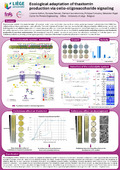
[en] Streptomyces scabiei, the causative agent of common scab in root and tuber crops such as potato, produces thaxtomin phytotoxins that inhibit host cellulose biosynthesis and weaken plant cell walls. The main inducers of thaxtomin production are the cello-oligosaccharides cellobiose and cellotriose, both byproducts of cellulose degradation. However, because cellulose is the most abundant polysaccharide on Earth and ubiquitous in soil, S. scabiei is frequently exposed to these molecules even outside its plant host. This raises the question of how S. scabiei limits activating virulence and thaxtomin production in non-host environments. We investigated here if S. scabiei has evolutionarily tuned its cellulolytic machinery to limit the generation of cellobiose/cellotriose, thereby preventing inappropriate induction of thaxtomin biosynthesis when not in contact with a suitable host.