Abstract :
[en] The robotic shape servoing of deformable objects presents significant challenges due to their theoretically infinite configuration space, making the choice of suitable shape and deformation representations crucial. Our study proposes an
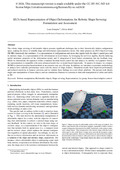
SE(3)-based servoing (SE3BS) framework that combines: (1) a representation of configurations and errors that capture both the object’s spatial pose and its intrinsic shape, (2) a representation of the deformations in local frames, by leveraging the se(3) Lie algebra, thereby inducing useful invariance properties of the deformation model, and (3) integration of local frames orientations into the feedback loop. While we demonstrate the approach within a standard Jacobian-based control law and analyze its stability via Lyapunov theory, the representation is compatible with more advanced model-free or model-based frameworks. To analyze its impact, we compare SE3BS to classical position-based methods in an extensive way on a 2D setup. In addition, we introduce a systematic methodology to analyze how controller performance varies with the choice of shape features. Simulation results show improved performance and reduced sensitivity to features selection, and we validate these findings on a real robotic platform. The present work details single-arm manipulation of linear objects, and our simulations illustrate its extension to dual-arm manipulation of cables and shells in 3D.
Scopus citations®
without self-citations
0