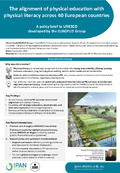
The alignment of physical education with physical literacy across 40 European countries: A policy brief to UNESCO developed by the EUROPLIT Group - 2026
[en] Based on two publications in The Lancet Regional Health Europe (accepted) and in the Journal of Curriculum Studies (https://www.tandfonline.com/doi/full/10.1080/00220272.2025.2523436), we have developed this policy brief. Key Findings: • Across Europe, national PE curricula show mixed alignment with physical literacy. • Countries with stronger education, development, and innovation systems show stronger alignment. • Some countries face barriers including lack of consensus on how physical literacy is defined and translated. Key Recommendations: 1. Maintain and strengthen UNESCO’s leadership: Continue to explicitly highlight physical literacy across UNESCO strategies (including updated Quality Physical Education guidelines). 2. Support policy and curriculum implementation • Support curriculum reform by providing assistance and resources for ministries of education. • Promote teacher education so PE teachers can deliver physical literacy in practice. • Facilitate global and regional exchange of best practices and translations of the PL concept.
Disciplines :
Education & instruction
Author, co-author :
Carl, Johannes; Deakin University
Casper Salin; University of Jyvaskyla
Peter Elsborg; Frederiksberg Hospital
Vlček Petr; Goethe University Frankfurt
Mouton, Alexandre ; Université de Liège - ULiège > Département des Sciences de l'activité physique et de la réadaptation > Intervention et gestion en activités physiques et sportives ; Université de Liège - ULiège > Unités de recherche interfacultaires > Research Unit for a life-Course perspective on Health and Education (RUCHE)
Language :
English
Title :
The alignment of physical education with physical literacy across 40 European countries: A policy brief to UNESCO developed by the EUROPLIT Group
Publication date :
February 2026
Development Goals :
3. Good health and well-being 4. Quality education