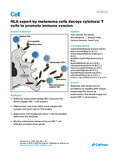
[en] While melanoma cells often express a high burden of mutated proteins, the infiltration of reactive T cells rarely results in tumor-eradicating immunity. We discovered that large extracellular vesicles, known as melanosomes, secreted by melanoma cells are decorated with major histocompatibility complex (MHC) molecules that stimulate CD8+ T cells through their T cell receptor (TCR), causing T cell dysfunction and apoptosis. Immunopeptidomic and T cell receptor sequencing (TCR-seq) analyses revealed that these melanosomes carry MHC-bound tumor-associated antigens with higher affinity and immunogenicity, which compete with their tumor cell of origin for direct TCR-MHC interactions. Analysis of biopsies from melanoma patients confirmed that melanosomes trap infiltrating lymphocytes, induce partial activation, and decrease CD8+ T cell cytotoxicity. Inhibition of melanosome secretion in vivo significantly reduced tumor immune evasion. These findings suggest that MHC export protects melanoma from the cytotoxic effects of T cells. Our study highlights a novel immune evasion mechanism and proposes a therapeutic avenue to enhance tumor immunity.
Disciplines :
Immunology & infectious disease
Author, co-author :
Chemla, Yoav ✱; Department of Human Genetics and Biochemistry, Gray Faculty of Medical and Health Sciences, Tel Aviv University, Tel Aviv 69978, Israel
Itzhaki, Orit ✱; Department of Human Genetics and Biochemistry, Gray Faculty of Medical and Health Sciences, Tel Aviv University, Tel Aviv 69978, Israel, Ella Lemelbaum Institute for Immuno-Oncology and Melanoma, Sheba Medical Center, Ramat Gan 52621, Israel
Melamed, Stav ✱; Department of Human Genetics and Biochemistry, Gray Faculty of Medical and Health Sciences, Tel Aviv University, Tel Aviv 69978, Israel
Weller, Chen ✱; Department of Molecular Cell Biology, Weizmann Institute of Science, Rehovot, Israel
Sade, Yuval ✱; Department of Human Genetics and Biochemistry, Gray Faculty of Medical and Health Sciences, Tel Aviv University, Tel Aviv 69978, Israel
Manich, Paulee ✱; Department of Human Genetics and Biochemistry, Gray Faculty of Medical and Health Sciences, Tel Aviv University, Tel Aviv 69978, Israel
Reshef, Keren ✱; Department of Pathology, Gray Faculty of Medical and Health Sciences, Tel Aviv University, Tel Aviv 69978, Israel
Xenidis, Nicolas ✱; Department of Human Genetics and Biochemistry, Gray Faculty of Medical and Health Sciences, Tel Aviv University, Tel Aviv 69978, Israel
Maliah, Avishai ✱; Department of Human Genetics and Biochemistry, Gray Faculty of Medical and Health Sciences, Tel Aviv University, Tel Aviv 69978, Israel
Levy, Gilad ✱; Sagol School of Neuroscience, Tel Aviv University, Tel Aviv, Israel
Parikh, Roma ✱; Department of Human Genetics and Biochemistry, Gray Faculty of Medical and Health Sciences, Tel Aviv University, Tel Aviv 69978, Israel
Bartok, Osnat ✱; Department of Molecular Cell Biology, Weizmann Institute of Science, Rehovot, Israel
Levy, Opal ✱; Department of Human Genetics and Biochemistry, Gray Faculty of Medical and Health Sciences, Tel Aviv University, Tel Aviv 69978, Israel
Tal, Itay ✱; Department of Human Genetics and Biochemistry, Gray Faculty of Medical and Health Sciences, Tel Aviv University, Tel Aviv 69978, Israel
Aziel, Gal ✱; Department of Human Genetics and Biochemistry, Gray Faculty of Medical and Health Sciences, Tel Aviv University, Tel Aviv 69978, Israel
Nissani, Abraham ✱; Ella Lemelbaum Institute for Immuno-Oncology and Melanoma, Sheba Medical Center, Ramat Gan 52621, Israel
Yunger, Sharon ✱; Ella Lemelbaum Institute for Immuno-Oncology and Melanoma, Sheba Medical Center, Ramat Gan 52621, Israel
Likonen, Daniela ✱; Department of Dermatology, Sheba Medical Center, Ramat Gan, Israel
Kliminsky, Vitaly ✱; Department of Dermatology, Sheba Medical Center, Ramat Gan, Israel
Golan, Tamar ✱; Department of Human Genetics and Biochemistry, Gray Faculty of Medical and Health Sciences, Tel Aviv University, Tel Aviv 69978, Israel
Ace, Valentina ✱; Department of Human Genetics and Biochemistry, Gray Faculty of Medical and Health Sciences, Tel Aviv University, Tel Aviv 69978, Israel
Levy, Ronen ✱; Department of Molecular Cell Biology, Weizmann Institute of Science, Rehovot, Israel
Rasoulouniriana, Diana; Department of Pathology, Gray Faculty of Medical and Health Sciences, Tel Aviv University, Tel Aviv 69978, Israel
Eyal, Zohar; Department of Molecular Genetics, Weizmann Institute of Science, Rehovot 76100, Israel
Barzilay, Yuval; Department of Molecular Genetics, Weizmann Institute of Science, Rehovot 76100, Israel
Balaban, Roi; Department of Clinical Microbiology and Immunology, Gray Faculty of Medical and Health Sciences, Tel Aviv University, Tel Aviv, Israel
Khateeb, Aseel; Department of Pathology, Gray Faculty of Medical and Health Sciences, Tel Aviv University, Tel Aviv 69978, Israel
Khosravi, Rami; Single Cell Genomics Core, Gray Faculty of Medical and Health Sciences, Tel Aviv University, Tel Aviv, Israel
Grau, Amir; Biomedical Core Facility, Rappaport Faculty of Medicine, Technion-Israel Institute of Technology, Haifa, Israel
Ziv, Tamar; Smoler Proteomics Center, Lokey Interdisciplinary Center for Life Sciences & Engineering, Technion-Israel Institute of Technology, Haifa, Israel
Greenberg, Polina; Department of Molecular Cell Biology, Weizmann Institute of Science, Rehovot, Israel
Netanely, Dvir; Blavatnik School of Computer Science and Artificial Intelligence, Tel Aviv University, Tel Aviv, Israel
Vaknin, Hananya; Institute of Oncology, E. Wolfson Medical Center, Holon, Israel
Wu, Xunwei; Department of Dermatology, Massachusetts General Hospital, Boston, MA, USA
Amitay, Yael; Department of Molecular Cell Biology, Weizmann Institute of Science, Tel Aviv, Israel
Brenner, Ronen; Institute of Oncology, E. Wolfson Medical Center, Holon, Israel
Martínez Gómez, Julia María; Laboratory of Cancer Stemness, GIGA Institute, University of Liège, Liège, Belgium
Hershkovitz, Dov; Institute of Pathology, Tel Aviv Sourasky Medical Center, Tel Aviv, Israel
Yardeni, Tal; Metabolic Center, Sheba Medical Center, Tel-Hashomer, Ramat Gan, Israel
Zemser-Werner, Valentina; Institute of Pathology, Tel Aviv Sourasky Medical Center, Tel Aviv, Israel
Kobiler, Oren; Department of Clinical Microbiology and Immunology, Gray Faculty of Medical and Health Sciences, Tel Aviv University, Tel Aviv, Israel
Friedmann, Yael; Bio-Imaging Unit, Hebrew University, Jerusalem 91904, Israel
Bassan, David; Department of Immunology and Regenerative Biology, Weizmann Institute of Science, Rehovot, Israel
Shamir, Ron; Blavatnik School of Computer Science and Artificial Intelligence, Tel Aviv University, Tel Aviv, Israel
Eisenbach, Lea; Department of Immunology and Regenerative Biology, Weizmann Institute of Science, Rehovot, Israel
Santana-Magal, Nadine; Department of Pathology, Gray Faculty of Medical and Health Sciences, Tel Aviv University, Tel Aviv 69978, Israel
Milyavsky, Michael; Department of Pathology, Gray Faculty of Medical and Health Sciences, Tel Aviv University, Tel Aviv 69978, Israel
Eisenberg, Galit; Hadassah Cancer Research Institute, Hadassah Hebrew University Hospital, Jerusalem, Israel
Keren, Leeat; Department of Molecular Cell Biology, Weizmann Institute of Science, Tel Aviv, Israel
Cohen, Merav; Department of Clinical Microbiology and Immunology, Gray Faculty of Medical and Health Sciences, Tel Aviv University, Tel Aviv, Israel
Gur, Dvir; Department of Molecular Genetics, Weizmann Institute of Science, Rehovot 76100, Israel
Barak, Boaz; Sagol School of Neuroscience, Tel Aviv University, Tel Aviv, Israel, The School of Psychological Sciences, Tel Aviv University, Tel Aviv, Israel
Lotem, Michal; Hadassah Cancer Research Institute, Hadassah Hebrew University Hospital, Jerusalem, Israel
Sprinzak, David; School of Neurobiology, Biochemistry and Biophysics, George S. Wise Faculty of Life Sciences, Tel Aviv University, Tel Aviv 6997801, Israel
Greenberger, Shoshana; Department of Clinical Microbiology and Immunology, Gray Faculty of Medical and Health Sciences, Tel Aviv University, Tel Aviv, Israel
Fisher, David; Department of Dermatology, Massachusetts General Hospital, Boston, MA, USA
Besser, Michal J; Ella Lemelbaum Institute for Immuno-Oncology and Melanoma, Sheba Medical Center, Ramat Gan 52621, Israel, Department of Clinical Microbiology and Immunology, Gray Faculty of Medical and Health Sciences, Tel Aviv University, Tel Aviv, Israel, Samueli Integrative Pioneering Institute and Davidoff Center, Rabin Medical Center, Petach Tikva, Israel, Felsenstein Cancer Research Center, Gray Faculty of Medical and Health Sciences, Tel Aviv University, Tel Aviv, Israel
Khaled, Mehdi ✱; Gustave Roussy Cancer Campus, INSERM U1015, Universite Paris-Saclay, 114 rue Edouard Vaillant, 94800 Villejuif, France. Electronic address: mehdi.khaled@gustaveroussy.fr
Close, Pierre ✱; Université de Liège - ULiège > Département de pharmacie
Shapira, Ronnie ✱; Ella Lemelbaum Institute for Immuno-Oncology and Melanoma, Sheba Medical Center, Ramat Gan 52621, Israel. Electronic address: ronnie.shapira@sheba.health.gov.il
Apcher, Sebastien ✱; Gustave Roussy Cancer Campus, INSERM U1015, Universite Paris-Saclay, 114 rue Edouard Vaillant, 94800 Villejuif, France. Electronic address: sebastien.apcher@gustaveroussy.fr
Madi, Asaf ✱; Department of Pathology, Gray Faculty of Medical and Health Sciences, Tel Aviv University, Tel Aviv 69978, Israel. Electronic address: asafmadi@tauex.tau.ac.il
Levesque, Mitchell P ✱; University of Zurich, Faculty of Medicine, University Hospital of Zurich, Department of Dermatology, Schlieren 8952, Switzerland. Electronic address: mitchell.levesque@usz.ch
Rapino, Francesca ✱; Université de Liège - ULiège > GIGA > GIGA Cancer - Cancer Stemness
Carmi, Yaron ✱; Department of Pathology, Gray Faculty of Medical and Health Sciences, Tel Aviv University, Tel Aviv 69978, Israel. Electronic address: yaroncarmi@gmail.com
Parikh, Shivang; Department of Human Genetics and Biochemistry, Gray Faculty of Medical and Health Sciences, Tel Aviv University, Tel Aviv 69978, Israel, Ragon Institute of Mass General, MIT and Harvard, Cambridge, MA, USA. Electronic address: ssparikh@mgh.harvard.edu
Samuels, Yardena ✱; Department of Molecular Cell Biology, Weizmann Institute of Science, Rehovot, Israel. Electronic address: yardena.samuels@weizmann.ac.il
Levy, Carmit ✱; Department of Human Genetics and Biochemistry, Gray Faculty of Medical and Health Sciences, Tel Aviv University, Tel Aviv 69978, Israel. Electronic address: carmitlevy@tauex.tau.ac.il
Galon, J., Costes, A., Sanchez-Cabo, F., Kirilovsky, A., Mlecnik, B., Lagorce-Pages, C., Tosolini, M., Camus, M., Berger, A., Wind, P., et al. (2006). Type, density, and location of immune cells within human colorectal tumors predict clinical outcome. Science 313, 1960-1964. 10.1126/science.1129139.
Fridman, W.H., Pages, F., Sautes-Fridman, C., and Galon, J. (2012). The immune contexture in human tumours: impact on clinical outcome. Nat. Rev. Cancer 12, 298-306. 10.1038/nrc3245.
Restifo, N.P., Dudley, M.E., and Rosenberg, S.A. (2012). Adoptive immunotherapy for cancer: harnessing the T cell response. Nat. Rev. Immunol. 12, 269-281. 10.1038/nri3191.
Gross, G., Gorochov, G., Waks, T., and Eshhar, Z. (1989). Generation of effector T cells expressing chimeric T cell receptor with antibody type-specificity. Transplant. Proc. 21, 127-130.
Kalos, M., Levine, B.L., Porter, D.L., Katz, S., Grupp, S.A., Bagg, A., and June, C.H. (2011). T cells with chimeric antigen receptors have potent antitumor effects and can establish memory in patients with advanced leukemia. Sci. Transl. Med. 3, 95ra73. 10.1126/scitranslmed.3002842.
Pardoll, D.M. (2012). The blockade of immune checkpoints in cancer immunotherapy. Nat. Rev. Cancer 12, 252-264. 10.1038/nrc3239.
Hodi, F.S., O'Day, S.J., McDermott, D.F., Weber, R.W., Sosman, J.A., Haanen, J.B., Gonzalez, R., Robert, C., Schadendorf, D., Hassel, J.C., et al. (2010). Improved survival with ipilimumab in patients with metastatic melanoma. N. Engl. J. Med. 363, 711-723. 10.1056/NEJMoa1003466.
Bell, R.E., and Levy, C. (2011). The three M's: melanoma, microphthalmia-associated transcription factor and microRNA. Pigment Cell Melanoma Res. 24, 1088-1106. 10.1111/j.1755-148X.2011.00931.x.
Hodis, E., Watson, I.R., Kryukov, G.V., Arold, S.T., Imielinski, M., Theurillat, J.-P., Nickerson, E., Auclair, D., Li, L., Place, C., et al. (2012). A landscape of driver mutations in melanoma. Cell 150, 251-263. 10.1016/j.cell.2012.06.024.
Carlino, M.S., Larkin, J., and Long, G.V. (2021). Immune checkpoint inhibitors in melanoma. Lancet 398, 1002-1014. 10.1016/S0140-6736(21)01206-X.
Harel, M., Ortenberg, R., Varanasi, S.K., Mangalhara, K.C., Mardamshina, M., Markovits, E., Baruch, E.N., Tripple, V., Arama-Chayoth, M., Greenberg, E., et al. (2019). Proteomics of melanoma response to immunotherapy reveals mitochondrial dependence. Cell 179, 236-250.e18. 10.1016/j.cell.2019.08.012.
Gide, T.N., Wilmott, J.S., Scolyer, R.A., and Long, G.V. (2018). Primary and acquired resistance to immune checkpoint inhibitors in metastatic melanoma. Clin. Cancer Res. 24, 1260-1270. 10.1158/1078-0432.CCR-17-2267.
Schadendorf, D., Hodi, F.S., Robert, C., Weber, J.S., Margolin, K., Hamid, O., Patt, D., Chen, T.-T., Berman, D.M., and Wolchok, J.D. (2013). Pooled analysis of long-term survival data from phase II and phase III trials of ipilimumab in metastatic or locally advanced, unresectable melanoma. J. Clin. Oncol. 33, 1889-1894. 10.1200/JCO.2014.56.2736.
Topalian, S.L., Sznol, M., McDermott, D.F., Kluger, H.M., Carvajal, R.D., Sharfman, W.H., Brahmer, J.R., Lawrence, D.P., Atkins, M.B., Powderly, J.D., et al. (2023). Survival, Durable Tumor Remission, and Long-Term Safety in Patients With Advanced Melanoma Receiving Nivolumab. J. Clin. Oncol. 41, 943-954. 10.1200/JCO.22.02272.
Schumacher, T.N., and Schreiber, R.D. (2015). Neoantigens in cancer immunotherapy. Science 348, 69-74. 10.1126/science.aaa4971.
Straetemans, T., Berrevoets, C., Coccoris, M., Treffers-Westerlaken, E., Wijers, R., Cole, D.K., Dardalhon, V., Sewell, A.K., Taylor, N., Verweij, J., and Debets, R. (2015). Recurrence of melanoma following T cell treatment: continued antigen expression in a tumor that evades T cell recruitment. Mol. Ther. 23, 396-406. 10.1038/mt.2014.215.
Raposo, G., and Marks, M.S. (2007). Melanosomes--dark organelles enlighten endosomal membrane transport. Nat. Rev. Mol. Cell Biol. 8, 786-797. 10.1038/nrm2258.
Malcov-Brog, H., Alpert, A., Golan, T., Parikh, S., Nordlinger, A., Netti, F., Sheinboim, D., Dror, I., Thomas, L., Cosson, C., et al. (2018). UV-Protection Timer Controls Linkage between Stress and Pigmentation Skin Protection Systems. Mol. Cell 72, 444-456.e7. 10.1016/j.molcel.2018.09.022.
Peinado, H., Aleckovic, M., Lavotshkin, S., Matei, I., Costa-Silva, B., Moreno-Bueno, G., Hergueta-Redondo, M., Williams, C., Garcia-Santos, G., Ghajar, C., et al. (2012). Melanoma exosomes educate bone marrow progenitor cells toward a pro-metastatic phenotype through MET. Nat. Med. 18, 883-891. 10.1038/nm.2753.
Dror, S., Sander, L., Schwartz, H., Sheinboim, D., Barzilai, A., Dishon, Y., Apcher, S., Golan, T., Greenberger, S., Barshack, I., et al. (2016). Melanoma miRNA trafficking controls tumour primary niche formation. Nat. Cell Biol. 18, 1006-1017. 10.1038/ncb3399.
Netanely, D., Leibou, S., Parikh, R., Stern, N., Vaknine, H., Brenner, R., Amar, S., Factor, R.H., Perluk, T., Frand, J., et al. (2021). Classification of node-positive melanomas into prognostic subgroups using keratin, immune, and melanogenesis expression patterns. Oncogene 40, 1792-1805. 10.1038/s41388-021-01665-0.
Leichner, G.S., Schweitzer, I., Dror, S., Levin, L., Geva, P., Golan, T., Zaremba, L., Shapira, G., Parikh, R., Shomron, N., et al. (2023). Primary Melanoma miRNA Trafficking Induces Lymphangiogenesis. J. Investig. Dermatol. 143, 1788-1798.e7. 10.1016/j.jid.2023.02.030.
Parikh, R., Parikh, S., Berzin, D., Vaknine, H., Ovadia, S., Likonen, D., Greenberger, S., Scope, A., Elgavish, S., Nevo, Y., et al. (2024). Recycled melanoma-secreted melanosomes regulate tumor-associated macrophage diversification. EMBO J. 43, 3553-3586. 10.1038/s44318-024-00103-7.
Chen, K.G., Valencia, J.C., Lai, B., Zhang, G., Paterson, J.K., Rouzaud, F., Berens, W., Wincovitch, S.M., Garfield, S.H., Leapman, R.D., et al. (2006). Melanosomal sequestration of cytotoxic drugs contributes to the intractability of malignant melanomas. Proc Natl. Acad. Sci. USA 103, 9903-9907. 10.1073/pnas.0600213103.
Pinner, S., Jordan, P., Sharrock, K., Bazley, L., Collinson, L., Marais, R., Bonvin, E., Goding, C., and Sahai, E. (2009). Intravital imaging reveals transient changes in pigment production and Brn2 expression during metastatic melanoma dissemination. Cancer Res. 69, 7969-7977. 10.1158/0008-5472.CAN-09-0781.
Riaz, N., Havel, J.J., Makarov, V., Desrichard, A., Urba, W.J., Sims, J.S., Hodi, F.S., Martin-Algarra, S., Mandal, R., Sharfman, W.H., et al. (2017). Tumor and Microenvironment Evolution during Immunotherapy with Nivolumab. Cell 171, 934-949.e16. 10.1016/j.cell.2017.09.028.
Brozyna, A.A., Jozwicki, W., Carlson, J.A., and Slominski, A.T. (2013). Melanogenesis affects overall and disease-free survival in patients with stage III and IV melanoma. Hum. Pathol. 44, 2071-2074. 10.1016/j.humpath.2013.02.022.
Slominski, A., Zbytek, B., and Slominski, R. (2009). Inhibitors of melanogenesis increase toxicity of cyclophosphamide and lymphocytes against melanoma cells. Int. J. Cancer 124, 1470-1477. 10.1002/ijc.24005.
Du, J., Miller, A.J., Widlund, H.R., Horstmann, M.A., Ramaswamy, S., and Fisher, D.E. (2003). MLANA/MART1 and SILV/PMEL17/GP100 are transcriptionally regulated by MITF in melanocytes and melanoma. Am. J. Pathol. 163, 333-343. 10.1016/S0002-9440(10)63657-7.
Lo, J.A., Kawakubo, M., Juneja, V.R., Su, M.Y., Erlich, T.H., LaFleur, M.W., Kemeny, L.V., Rashid, M., Malehmir, M., Rabi, S.A., et al. (2021). Epitope spreading toward wild-type melanocyte-lineage antigens rescues suboptimal immune checkpoint blockade responses. Sci. Transl. Med. 13, eabd8636. 10.1126/scitranslmed.abd8636.
Godefroy, E., Scotto, L., Souleimanian, N.E., Ritter, G., Old, L.J., Jotereau, F., Valmori, D., and Ayyoub, M. (2006). Identification of two Melan-A CD4+ T cell epitopes presented by frequently expressed MHC class II alleles. Clin. Immunol. 121, 54-62. 10.1016/j.clim.2006.05.007.
Cochlovius, B., Linnebacher, M., Zewe-Welschof, M., and Zoller, M. (1999). Recombinant gp100 protein presented by dendritic cells elicits a T-helper-cell response in vitro and in vivo. Int. J. Cancer 83, 547-554. 10.1002/(sici)1097-0215(19991112)83:4<547::aid-ijc18>3.0.co;2-6.
Peri, A., Salomon, N., Wolf, Y., Kreiter, S., Diken, M., and Samuels, Y. (2023). The landscape of T cell antigens for cancer immunotherapy. Nat. Cancer 4, 937-954. 10.1038/s43018-023-00588-x.
Rudd, C.E. (2023). CD8+ T cell killing of MHC class I-deficient tumors. Nat. Cancer 4, 1214-1216. 10.1038/s43018-023-00606-y.
Watts, C., and Powis, S. (1999). Pathways of antigen processing and presentation. Rev. Immunogenet. 1, 60-74. https://pubmed.ncbi.nlm.nih.gov/11256573/.
Friedmann-Morvinski, D., Bendavid, A., Waks, T., Schindler, D., and Eshhar, Z. (2005). Redirected primary T cells harboring a chimeric receptor require costimulation for their antigen-specific activation. Blood 105, 3087-3093. 10.1182/blood-2004-09-3737.
Sugiura, D., Okazaki, I.M., Maeda, T.K., Maruhashi, T., Shimizu, K., Arakaki, R., Takemoto, T., Ishimaru, N., and Okazaki, T. (2022). PD-1 agonism by anti-CD80 inhibits T cell activation and alleviates autoimmunity. Nat. Immunol. 23, 399-410. 10.1038/s41590-021-01125-7.
Haile, S.T., Dalal, S.P., Clements, V., Tamada, K., and Ostrand-Rosenberg, S. (2013). Soluble CD80 restores T cell activation and overcomes tumor cell programmed death ligand 1-mediated immune suppression. J. Immunol. 191, 2829-2836. 10.4049/jimmunol.1202777.
Waldman, A.D., Fritz, J.M., and Lenardo, M.J. (2020). A guide to cancer immunotherapy: from T cell basic science to clinical practice. Nat. Rev. Immunol. 20, 651-668. 10.1038/s41577-020-0306-5.
Cancer Genome Atlas Network. (2015). Genomic classification of cutaneous melanoma. Cell 161, 1681-1696. 10.1016/j.cell.2015.05.044.
Wherry, E.J., Ha, S.J., Kaech, S.M., Haining, W.N., Sarkar, S., Kalia, V., Subramaniam, S., Blattman, J.N., Barber, D.L., and Ahmed, R. (2007). Molecular signature of CD8+ T cell exhaustion during chronic viral infection. Immunity 27, 670-684. 10.1016/j.immuni.2007.09.006.
Amitay, Y., Milo, I., Haran, T.K., Deis, S., Truzman, G., Elhanani, O., Salame, T.-M., Azimov, M., Stein, I., and Cohen, J.E. et al. (2025). Immune organization in sentinel lymph nodes of melanoma patients is prognostic of distant metastases. Preprint at bioRxiv. https://www.biorxiv.org/content/10.1101/2024.11.24.625041v1.
Sakai, C., Kawakami, Y., Law, L.W., Furumura, M., and Hearing, V.J., Jr. (1997). Melanosomal proteins as melanoma-specific immune targets. Melanoma Res. 7, 83-95. 10.1097/00008390-199704000-00001.
Chen, J., He, Q., Liu, J., Xiao, Y., Xiao, C., Chen, K., Xie, D., and Zhang, X. (2018). CD8+ tumor-infiltrating lymphocytes as a novel prognostic biomarker in lung sarcomatoid carcinoma, a rare subtype of lung cancer. Cancer Manag. Res. 10, 3505-3511. 10.2147/CMAR.S169074.
O'Keefe, J.P., Blaine, K., Alegre, M.L., and Gajewski, T.F. (2004). Formation of a central supramolecular activation cluster is not required for activation of naive CD8+ T cells. Proc. Natl. Acad. Sci. USA 101, 9351-9356. 10.1073/pnas.0305965101.
Smith, F.O., Downey, S.G., Klapper, J.A., Yang, J.C., Sherry, R.M., Royal, R.E., Kammula, U.S., Hughes, M.S., Restifo, N.P., Levy, C.L., et al. (2008). Treatment of metastatic melanoma using interleukin-2 alone or in conjunction with vaccines. Clin. Cancer Res. 14, 5610-5618. 10.1158/1078-0432.CCR-08-0116.
Zilles, J.C., Dos Santos, F.L., Kulkamp-Guerreiro, I.C., and Contri, R.V. (2022). Biological activities and safety data of kojic acid and its derivatives: A review. Exp. Dermatol. 31, 1500-1521. 10.1111/exd.14662.
Garcia-Gavin, J., Gonzalez-Vilas, D., Fernandez-Redondo, V., and Toribio, J. (2010). Pigmented contact dermatitis due to kojic acid. A paradoxical side effect of a skin lightener. Contact Derm. 62, 63-64. 10.1111/j.1600-0536.2009.01673.x.
Lajis, A.F.B., Hamid, M., and Ariff, A.B. (2012). Depigmenting effect of Kojic acid esters in hyperpigmented B16F1 melanoma cells. J. Biomed. Biotechnol. 2012, 952452. 10.1155/2012/952452.
Azumi, J., Takeda, T., Shimada, Y., Aso, H., and Nakamura, T. (2019). The Organogermanium Compound THGP Suppresses Melanin Synthesis via Complex Formation with L-DOPA on Mushroom Tyrosinase and in B16 4A5 Melanoma Cells. Int. J. Mol. Sci. 20, 4785. 10.3390/ijms20194785.
Saeedi, M., Eslamifar, M., and Khezri, K. (2019). Kojic acid applications in cosmetic and pharmaceutical preparations. Biomed. Pharmacother. 110, 582-593. 10.1016/j.biopha.2018.12.006.
Calis, J.J.A., Maybeno, M., Greenbaum, J.A., Weiskopf, D., De Silva, A.D., Sette, A., Kesmir, C., and Peters, B. (2013). Properties of MHC class I presented peptides that enhance immunogenicity. PLoS Comput. Biol. 9, e1003266. 10.1371/journal.pcbi.1003266.
Rosa, F.M., and Fellous, M. (1988). Regulation of HLA-DR gene by IFN-gamma. Transcriptional and post-transcriptional control. J. Immunol. 140, 1660-1664. 10.4049/jimmunol.140.5.1660.
Balogh, K.N., Templeton, D.J., and Cross, J.V. (2018). Macrophage Migration Inhibitory Factor protects cancer cells from immunogenic cell death and impairs anti-tumor immune responses. PLoS One 13, e0197702. 10.1371/journal.pone.0197702.
Van der Jeught, K., Joe, P.T., Bialkowski, L., Heirman, C., Daszkiewicz, L., Liechtenstein, T., Escors, D., Thielemans, K., and Breckpot, K. (2014). Intratumoral administration of mRNA encoding a fusokine consisting of IFN-beta and the ectodomain of the TGF-beta receptor II potentiates antitumor immunity. Oncotarget 5, 10100-10113. 10.18632/oncotarget.2463.
Quezada, S.A., Simpson, T.R., Peggs, K.S., Merghoub, T., Vider, J., Fan, X., Blasberg, R., Yagita, H., Muranski, P., Antony, P.A., et al. (2010). Tumor-reactive CD4(+) T cells develop cytotoxic activity and eradicate large established melanoma after transfer into lymphopenic hosts. J. Exp. Med. 207, 637-650. 10.1084/jem.20091918.
Kearl, T.J., Jing, W., Gershan, J.A., and Johnson, B.D. (2013). Programmed death receptor-1/programmed death receptor ligand-1 blockade after transient lymphodepletion to treat myeloma. J. Immunol. 190, 5620-5628. 10.4049/jimmunol.1202005.
Le, L., Sires-Campos, J., Raposo, G., Delevoye, C., and Marks, M.S. (2021). Melanosome Biogenesis in the Pigmentation of Mammalian Skin. Integr. Comp. Biol. 61, 1517-1545. 10.1093/icb/icab078.
Jiang, K., Dong, C., Yin, Z., Li, R., Mao, J., Wang, C., Zhang, J., Gao, Z., Liang, R., Wang, Q., and Wang, L. (2020). Exosome-derived ENO1 regulates integrin α6β4 expression and promotes hepatocellular carcinoma growth and metastasis. Cell Death Dis. 11, 972. 10.1038/s41419-020-03179-1.
Tyanova, S., Temu, T., Sinitcyn, P., Carlson, A., Hein, M.Y., Geiger, T., Mann, M., and Cox, J. (2016). The Perseus computational platform for comprehensive analysis of (prote)omics data. Nat. Methods 13, 731-740. 10.1038/nmeth.3901.
Dersh, D., Yewdell, J.W., and Wei, J. (2019). A SIINFEKL-Based System to Measure MHC Class I Antigen Presentation Efficiency and Kinetics. Methods Mol. Biol. 1988, 109-122. 10.1007/978-1-4939-9450-2_9.
Feng, D., Zhao, W.L., Ye, Y.Y., Bai, X.C., Liu, R.Q., Chang, L.F., Zhou, Q., and Sui, S.F. (2010). Cellular internalization of exosomes occurs through phagocytosis. Traffic 11, 675-687. 10.1111/j.1600-0854.2010.01041.x.
Das, K., Eisel, D., Lenkl, C., Goyal, A., Diederichs, S., Dickes, E., Osen, W., and Eichmuller, S.B. (2017). Generation of murine tumor cell lines deficient in MHC molecule surface expression using the CRISPR/Cas9 system. PLoS One 12, e0174077. 10.1371/journal.pone.0174077.
Kalaora, S., Barnea, E., Merhavi-Shoham, E., Qutob, N., Teer, J.K., Shimony, N., Schachter, J., Rosenberg, S.A., Besser, M.J., Admon, A., and Samuels, Y. (2016). Use of HLA peptidomics and whole exome sequencing to identify human immunogenic neo-antigens. Oncotarget 7, 5110-5117. 10.18632/oncotarget.6960.
Chowell, D., Krishna, S., Becker, P.D., Cocita, C., Shu, J., Tan, X., Greenberg, P.D., Klavinskis, L.S., Blattman, J.N., and Anderson, K.S. (2015). TCR contact residue hydrophobicity is a hallmark of immunogenic CD8+ T cell epitopes. Proc. Natl. Acad. Sci. USA 112, E1754-E1762. 10.1073/pnas.1500973112.
Krokhin, O.V., Craig, R., Spicer, V., Ens, W., Standing, K.G., Beavis, R.C., and Wilkins, J.A. (2004). An improved model for prediction of retention times of tryptic peptides in ion pair reversed-phase HPLC: its application to protein peptide mapping by off-line HPLC-MALDI MS. Mol. Cell. Proteomics 3, 908-919. 10.1074/mcp.M400031-MCP200.
Marcu, A., Bichmann, L., Kuchenbecker, L., Kowalewski, D.J., Freudenmann, L.K., Backert, L., Muhlenbruch, L., Szolek, A., Lubke, M., Wagner, P., et al. (2021). HLA Ligand Atlas: a benign reference of HLA-presented peptides to improve T-cell-based cancer immunotherapy. J. Immunother. Cancer 9, e002071. 10.1136/jitc-2020-002071.
Refaeli, Y., Van Parijs, L., Alexander, S.I., and Abbas, A.K. (2002). Interferon gamma is required for activation-induced death of T lymphocytes. J. Exp. Med. 196, 999-1005. 10.1084/jem.20020666.
Otano, I., Alvarez, M., Minute, L., Ochoa, M.C., Migueliz, I., Molina, C., Azpilikueta, A., de Andrea, C.E., Etxeberria, I., Sanmamed, M.F., et al. (2020). Human CD8 T cells are susceptible to TNF-mediated activation-induced cell death. Theranostics 10, 4481-4489. 10.7150/thno.41646.
Bertrand, F., Rochotte, J., Colacios, C., Montfort, A., Andrieu-Abadie, N., Levade, T., Benoist, H., and Segui, B. (2016). Targeting TNF alpha as a novel strategy to enhance CD8+ T cell-dependent immune response in melanoma? Oncoimmunology 5, e1068495. 10.1080/2162402X.2015.1068495.
Harding, F.A., McArthur, J.G., Gross, J.A., Raulet, D.H., and Allison, J.P. (1992). CD28-mediated signalling co-stimulates murine T cells and prevents induction of anergy in T-cell clones. Nature 356, 607-609. 10.1038/356607a0.
Croft, M. (2003). Co-stimulatory members of the TNFR family: keys to effective T-cell immunity? Nat. Rev. Immunol. 3, 609-620. 10.1038/nri1148.
Courtney, A.H., Lo, W.L., and Weiss, A. (2018). TCR Signaling: Mechanisms of Initiation and Propagation. Trends Biochem. Sci. 43, 108-123. 10.1016/j.tibs.2017.11.008.
Yu, Y.R., Imrichova, H., Wang, H., Chao, T., Xiao, Z., Gao, M., Rincon-Restrepo, M., Franco, F., Genolet, R., Cheng, W.C., et al. (2020). Disturbed mitochondrial dynamics in CD8+ TILs reinforce T cell exhaustion. Nat. Immunol. 21, 1540-1551. 10.1038/s41590-020-0793-3.
Maliah, A., Santana-Magal, N., Parikh, S., Gordon, S., Reshef, K., Sade, Y., Khateeb, A., Richter, A., Gutwillig, A., Parikh, R., et al. (2024). Crosslinking of Ly6a metabolically reprograms CD8 T cells for cancer immunotherapy. Nat. Commun. 15, 8354. 10.1038/s41467-024-52079-x.
Raposo, G., Nijman, H.W., Stoorvogel, W., Liejendekker, R., Harding, C.V., Melief, C.J., and Geuze, H.J. (1996). B lymphocytes secrete antigen-presenting vesicles. J. Exp. Med. 183, 1161-1172. 10.1084/jem.183.3.1161.
Buzas, E.I. (2023). The roles of extracellular vesicles in the immune system. Nat. Rev. Immunol. 23, 236-250. 10.1038/s41577-022-00763-8.
Thery, C., Duban, L., Segura, E., Veron, P., Lantz, O., and Amigorena, S. (2002). Indirect activation of naive CD4+ T cells by dendritic cell-derived exosomes. Nat. Immunol. 3, 1156-1162. 10.1038/ni854.
Vincent-Schneider, H., Stumptner-Cuvelette, P., Lankar, D., Pain, S., Raposo, G., Benaroch, P., and Bonnerot, C. (2002). Exosomes bearing HLA-DR1 molecules need dendritic cells to efficiently stimulate specific T cells. Int. Immunol. 14, 713-722. 10.1093/intimm/dxf048.
Guan, S., Li, Q., Liu, P., Xuan, X., and Du, Y. (2014). Umbilical cord blood-derived dendritic cells loaded with BGC823 tumor antigens and DC-derived exosomes stimulate efficient cytotoxic T-lymphocyte responses and antitumor immunity in vitro and in vivo. Cent. Eur. J. Immunol. 39, 142-151. 10.5114/ceji.2014.43713.
Nakayama, M. (2014). Antigen Presentation by MHC-Dressed Cells. Front. Immunol. 5, 672. 10.3389/fimmu.2014.00672.
Thery, C., Ostrowski, M., and Segura, E. (2009). Membrane vesicles as conveyors of immune responses. Nat. Rev. Immunol. 9, 581-593. 10.1038/nri2567.
Khabar, K.S.A., and Young, H.A. (2007). Post-transcriptional control of the interferon system. Biochimie 89, 761-769. 10.1016/j.biochi.2007.02.008.
Chen, G., Huang, A.C., Zhang, W., Zhang, G., Wu, M., Xu, W., Yu, Z., Yang, J., Wang, B., Sun, H., et al. (2018). Exosomal PD-L1 contributes to immunosuppression and is associated with anti-PD-1 response. Nature 560, 382-386. 10.1038/s41586-018-0392-8.
Hoshino, A., Costa-Silva, B., Shen, T.L., Rodrigues, G., Hashimoto, A., Tesic Mark, M., Molina, H., Kohsaka, S., Di Giannatale, A., Ceder, S., et al. (2015). Tumour exosome integrins determine organotropic metastasis. Nature 527, 329-335. 10.1038/nature15756.
Tang, M.L., Varigos, G., and Kemp, A.S. (1994). Reduced interferon-gamma (IFN-gamma) secretion with increased IFN-gamma mRNA expression in atopic dermatitis: evidence for a post-transcriptional defect. Clin. Exp. Immunol. 97, 483-490. 10.1111/j.1365-2249.1994.tb06114.x.
Savan, R. (2014). Post-transcriptional regulation of interferons and their signaling pathways. J. Interferon Cytokine Res. 34, 318-329. 10.1089/jir.2013.0117.
Hodge, D.L., Martinez, A., Julias, J.G., Taylor, L.S., and Young, H.A. (2002). Regulation of nuclear gamma interferon gene expression by interleukin 12 (IL-12) and IL-2 represents a novel form of posttranscriptional control. Mol. Cell. Biol. 22, 1742-1753. 10.1128/MCB.22.6.1742-1753.2002.
Benito-Martinez, S., Salavessa, L., Raposo, G., Marks, M.S., and Delevoye, C. (2021). Melanin Transfer and Fate within Keratinocytes in Human Skin Pigmentation. Integr. Comp. Biol. 61, 1546-1555. 10.1093/icb/icab094.
Marks, M.S., Theos, A.C., and Raposo, G. (2003). Melanosomes and MHC class II antigen-processing compartments: a tinted view of intracellular trafficking and immunity. Immunol. Res. 27, 409-426. 10.1385/IR:27:2-3:409.
Hurbain, I., Romao, M., Sextius, P., Bourreau, E., Marchal, C., Bernerd, F., Duval, C., and Raposo, G. (2018). Melanosome distribution in keratinocytes in different skin types: melanosome clusters are not degradative organelles. J. Investig. Dermatol. 138, 647-656. 10.1016/j.jid.2017.09.039.
Tarafder, A.K., Bolasco, G., Correia, M.S., Pereira, F.J.C., Iannone, L., Hume, A.N., Kirkpatrick, N., Picardo, M., Torrisi, M.R., Rodrigues, I.P., et al. (2014). Rab11b mediates melanin transfer between donor melanocytes and acceptor keratinocytes via coupled exo/endocytosis. J. Investig. Dermatol. 134, 1056-1066. 10.1038/jid.2013.432.
Delevoye, C., Marks, M.S., and Raposo, G. (2019). Lysosome-related organelles as functional adaptations of the endolysosomal system. Curr. Opin. Cell Biol. 59, 147-158. 10.1016/j.ceb.2019.05.003.
Barras, D., Ghisoni, E., Chiffelle, J., Orcurto, A., Dagher, J., Fahr, N., Benedetti, F., Crespo, I., Grimm, A.J., Morotti, M., et al. (2024). Response to tumor-infiltrating lymphocyte adoptive therapy is associated with preexisting CD8+ T-myeloid cell networks in melanoma. Sci. Immunol. 9, eadg7995. 10.1126/sciimmunol.adg7995.
Valpione, S., Mundra, P.A., Galvani, E., Campana, L.G., Lorigan, P., De Rosa, F., Gupta, A., Weightman, J., Mills, S., Dhomen, N., and Marais, R. (2021). The T cell receptor repertoire of tumor infiltrating T cells is predictive and prognostic for cancer survival. Nat. Commun. 12, 4098. 10.1038/s41467-021-24343-x.
Hugo, W., Zaretsky, J.M., Sun, L., Song, C., Moreno, B.H., Hu-Lieskovan, S., Berent-Maoz, B., Pang, J., Chmielowski, B., Cherry, G., et al. (2016). Genomic and Transcriptomic Features of Response to Anti-PD-1 Therapy in Metastatic Melanoma. Cell 165, 35-44. 10.1016/j.cell.2016.02.065.
Amitay, Y., Milo, I., Haran, T.K., Deis, S., Truzman, G., Elhanani, O., Salame, T.-M., Azimov, M., Stein, I., Cohen, J.E., et al. (2024). Immune organization in sentinel lymph nodes of melanoma patients is prognostic of distant metastases. Preprint at bioRxiv. https://doi.org/10.1101/2024.11.24.625041.
Itzhaki, O., Hovav, E., Ziporen, Y., Levy, D., Kubi, A., Zikich, D., Hershkovitz, L., Treves, A.J., Shalmon, B., Zippel, D., et al. (2011). Establishment and large-scale expansion of minimally cultured “young” tumor infiltrating lymphocytes for adoptive transfer therapy. J. Immunother. 34, 212-220. 10.1097/CJI.0b013e318209c94c.
Farhat-Younis, L., Na, M., Zarfin, A., Khateeb, A., Santana-Magal, N., Richter, A., Gutwillig, A., Rasoulouniriana, D., Gleiberman, A., Beck, L., et al. (2024). Expression of modified FcγRI enables myeloid cells to elicit robust tumor-specific cytotoxicity. eLife 12, RP91999. 10.7554/eLife.91999.
Wang, K., Liu, C., Di, C.J., Ma, C., Han, C.G., Yuan, M.R., Li, P.F., Li, L., and Liu, Y.X. (2014). Kojic acid protects C57BL/6 mice from gamma-irradiation induced damage. Asian Pac. J. Cancer Prev. 15, 291-297. 10.7314/apjcp.2014.15.1.291.
Elkoshi, N., Parikh, S., Malcov-Brog, H., Parikh, R., Manich, P., Netti, F., Maliah, A., Elkoshi, H., Haj, M., Rippin, I., et al. (2023). Ataxia Telangiectasia Mutated Signaling Delays Skin Pigmentation upon UV Exposure by Mediating MITF Function toward DNA Repair Mode. J. Investig. Dermatol. 143, 2494-2506.e4. 10.1016/j.jid.2023.03.1686.
Sheinboim, D., Parikh, S., Manich, P., Markus, I., Dahan, S., Parikh, R., Stubbs, E., Cohen, G., Zemser-Werner, V., Bell, R.E., et al. (2022). An exercise-induced metabolic shield in distant organs blocks cancer progression and metastatic dissemination. Cancer Res. 82, 4164-4178. 10.1158/0008-5472.CAN-22-0237.
Cox, J., Hein, M.Y., Luber, C.A., Paron, I., Nagaraj, N., and Mann, M. (2014). Accurate proteome-wide label-free quantification by delayed normalization and maximal peptide ratio extraction, termed MaxLFQ. Mol. Cell. Proteomics 13, 2513-2526. 10.1074/mcp.M113.031591.
Kong, A.T., Leprevost, F.V., Avtonomov, D.M., Mellacheruvu, D., and Nesvizhskii, A.I. (2017). MSFragger: ultrafast and comprehensive peptide identification in mass spectrometry-based proteomics. Nat. Methods 14, 513-520. 10.1038/nmeth.4256.
Yang, K.L., Yu, F., Teo, G.C., Li, K., Demichev, V., Ralser, M., and Nesvizhskii, A.I. (2023). MSBooster: improving peptide identification rates using deep learning-based features. Nat. Commun. 14, 4539. 10.1038/s41467-023-40129-9.
Weller, C., Bartok, O., McGinnis, C.S., Palashati, H., Chang, T.G., Malko, D., Shmueli, M.D., Nagao, A., Hayoun, D., Murayama, A., et al. (2025). Translation dysregulation in cancer as a source for targetable antigens. Cancer Cell 43, 823-840.e18. 10.1016/j.ccell.2025.03.003.
Reynisson, B., Alvarez, B., Paul, S., Peters, B., and Nielsen, M. (2020). NetMHCpan-4.1 and NetMHCIIpan-4.0: improved predictions of MHC antigen presentation by concurrent motif deconvolution and integration of MS MHC eluted ligand data. Nucleic Acids Res. 48, W449-W454. 10.1093/nar/gkaa379.
Pitcovski, J., Shahar, E., Aizenshtein, E., and Gorodetsky, R. (2017). Melanoma antigens and related immunological markers. Crit. Rev. Oncol. Hematol. 115, 36-49. 10.1016/j.critrevonc.2017.05.001.
Durinck, S., Spellman, P.T., Birney, E., and Huber, W. (2009). Mapping identifiers for the integration of genomic datasets with the R/Bioconductor package biomaRt. Nat. Protoc. 4, 1184-1191. 10.1038/nprot.2009.97.
Durinck, S., Moreau, Y., Kasprzyk, A., Davis, S., De Moor, B., Brazma, A., and Huber, W. (2005). BioMart and Bioconductor: a powerful link between biological databases and microarray data analysis. Bioinformatics 21, 3439-3440. 10.1093/bioinformatics/bti525.
Li, H., and Durbin, R. (2009). Fast and accurate short read alignment with Burrows-Wheeler transform. Bioinformatics 25, 1754-1760. 10.1093/bioinformatics/btp324.
Van der Auwera, G.A., Carneiro, M.O., Hartl, C., Poplin, R., Del Angel, G., Levy-Moonshine, A., Jordan, T., Shakir, K., Roazen, D., Thibault, J., et al. (2013). From FastQ data to high confidence variant calls: the Genome Analysis Toolkit best practices pipeline. Curr. Protoc. Bioinform. 43, 11.10.1-11.10.33. 10.1002/0471250953.bi1110s43.
Wang, K., Li, M., and Hakonarson, H. (2010). ANNOVAR: functional annotation of genetic variants from high-throughput sequencing data. Nucleic Acids Res. 38, e164. 10.1093/nar/gkq603.
Chen, S., Francioli, L.C., Goodrich, J.K., Collins, R.L., Kanai, M., Wang, Q., Alfoldi, J., Watts, N.A., Vittal, C., Gauthier, L.D., et al. (2024). A genomic mutational constraint map using variation in 76,156 human genomes. Nature 625, 92-100. 10.1038/s41586-023-06045-0.
Ferreira, H.J., Stevenson, B.J., Pak, H., Yu, F., Almeida Oliveira, J., Huber, F., Taillandier-Coindard, M., Michaux, J., Ricart-Altimiras, E., Kraemer, A.I., et al. (2024). Immunopeptidomics-based identification of naturally presented non-canonical circRNA-derived peptides. Nat. Commun. 15, 2357. 10.1038/s41467-024-46408-3.
Mitchell, J., Milite, S., Bartram, J., Walker, S., Volkova, N., Yavorska, O., Zarowiecki, M., Chalker, J., Thomas, R., Vago, L., et al. (2024). Clinical application of tumour-in-normal contamination assessment from whole genome sequencing. Nat. Commun. 15, 323. 10.1038/s41467-023-44158-2.
Li, Y., Kind, T., Folz, J., Vaniya, A., Mehta, S.S., and Fiehn, O. (2021). Spectral entropy outperforms MS/MS dot product similarity for small-molecule compound identification. Nat. Methods 18, 1524-1531. 10.1038/s41592-021-01331-z.
Stuart, T., Butler, A., Hoffman, P., Hafemeister, C., Papalexi, E., Mauck, W.M., 3rd, Hao, Y., Stoeckius, M., Smibert, P., and Satija, R. (2019). Comprehensive Integration of Single-Cell Data. Cell 177, 1888-1902.e21. 10.1016/j.cell.2019.05.031.
Kurtulus, S., Madi, A., Escobar, G., Klapholz, M., Nyman, J., Christian, E., Pawlak, M., Dionne, D., Xia, J., Rozenblatt-Rosen, O., et al. (2019). Checkpoint Blockade Immunotherapy Induces Dynamic Changes in PD-1(-)CD8(+) Tumor-Infiltrating T Cells. Immunity 50, 181-194.e6. 10.1016/j.immuni.2018.11.014.
Bolger, A.M., Lohse, M., and Usadel, B. (2014). Trimmomatic: a flexible trimmer for Illumina sequence data. Bioinformatics 30, 2114-2120. 10.1093/bioinformatics/btu170.
Dobin, A., Davis, C.A., Schlesinger, F., Drenkow, J., Zaleski, C., Jha, S., Batut, P., Chaisson, M., and Gingeras, T.R. (2013). STAR: ultrafast universal RNA-seq aligner. Bioinformatics 29, 15-21. 10.1093/bioinformatics/bts635.
Baxter, L.L., Watkins-Chow, D.E., Pavan, W.J., and Loftus, S.K. (2019). A curated gene list for expanding the horizons of pigmentation biology. Pigment Cell Melanoma Res. 32, 348-358. 10.1111/pcmr.12743.
Buchfink, B., Reuter, K., and Drost, H.G. (2021). Sensitive protein alignments at tree-of-life scale using DIAMOND. Nat. Methods 18, 366-368. 10.1038/s41592-021-01101-x.