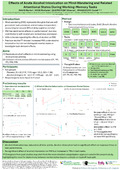
[en] Mind-wandering (MW) refers to the occurrence of self-generated thoughts that drift away from the task at hand in the sense that their content is both task-unrelated and stimulus-independent. These thoughts represent a key form of self-referential mental activity that often serves social and motivational functions, such as autobiographical thinking and goal planning. While numerous studies have examined their cognitive and neural underpinnings, little is known about how alcohol intoxication influences MW and related mental states during task performance. The present study investigated the effect of acute alcohol intoxication (0.65 g/L) on attentional fluctuations, focusing on the frequency of self-generated thoughts and the differentiation between MW and other types of mental experiences across two tasks with varying working-memory demands. Forty-five participants were randomly assigned to an alcohol or placebo condition and completed two levels of an n-back task (0-back, 2-back). Thought probes intermittently interrupted the tasks, prompting participants to report and categorize their experience into several types of mental content (i.e., focused on the task, task-related interference, MW, external distraction and mind blanking). Analyses did not reveal a robust effect of alcohol on overall MW frequency. However, alcohol was associated in both tasks with a higher frequency of task-related interferences—thoughts that occur when participants are thinking about the task but are not directly focused on following the instructions. Together, these preliminary findings highlight how alcohol intoxication differentially affects distinct types of thoughts during task performance. They emphasize the importance of distinguishing MW from task-related interferences instead of grouping them under a broad “off-task” label, supporting the view that these categories of thoughts reflect distinct phenomena.
Disciplines :
Neurosciences & behavior
Author, co-author :
David, Martin ; Université de Liège - ULiège > Département de Psychologie
Heck, Michelle ; Université de Liège - ULiège > Département de Psychologie > Psychologie quantitative ; Université de Liège - ULiège > Psychologie et Neuroscience Cognitives (PsyNCog)
Quertemont, Etienne ; Université de Liège - ULiège > Département de Psychologie > Psychologie quantitative ; Université de Liège - ULiège > Psychologie et Neuroscience Cognitives (PsyNCog)
Stawarczyk, David ; Université de Liège - ULiège > Département de Psychologie ; Université de Liège - ULiège > Psychologie et Neuroscience Cognitives (PsyNCog)
Language :
English
Title :
Effects of Acute Alcohol Intoxication on Mind-Wandering and Related Attentional States During Working-Memory Tasks
Publication date :
03 December 2025
Event name :
Social Cognition Workshop “From Self-Knowledge to Knowing Others”