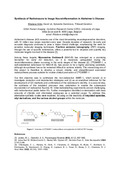
[en] Alzheimer’s disease (AD) remains one of the most devastating neurodegenerative disorders, with 10 million new cases reported every year. Despite decades of research, its early and accurate diagnosis continues to pose a major clinical challenge, emphasizing the need for sensitive molecular imaging techniques. Positron emission tomography (PET) imaging, through the use of specific radiotracers, offers a powerful tool to visualize and quantify key molecular targets involved in the disease [1].
Among these targets, Monoamine Oxidase-B (MAO-B) has emerged as a promising biomarker for early AD detection, as it is massively upregulated during the neuroinflammatory phase occurring in the early stages of the disease [2]. [¹⁸F]SMBT-1, a well-established radiotracer for MAO-B [3], has proven to be a highly promising candidate, although its synthesis has so far remained difficult to achieve reliably. The overarching aim of this project is therefore to develop a robust, reliable, and straightforward automated radiosynthesis process suitable for routine clinical production of [¹⁸F]SMBT-1. Our first objective was to synthesize the non-radioactive SMBT-1, which served (i) to investigate protection and deprotection strategies and (ii) as an analytical reference for the development of QC methods and confirmation of the radiotracer’s identity. In a second step, the synthesis of the tosylated precursor was undertaken to enable the subsequent incorporation of radioactive fluorine-18. Initial radiolabelling experiments proved challenging, with radiochemical yields below 5%. Further investigation identified contamination with trace amounts of chloride and chlorinated analogues as a potential cause. To address this, alternative synthetic routes were explored, focusing on the reactivity of tosylated epoxides, allyl derivatives, and the various alcohol groups within the molecule.
Dammicco, Sylvestre ; Université de Liège - ULiège > Département de chimie (sciences) ; Université de Liège - ULiège > Unités de recherche interfacultaires > GIGA-CRC In vivo Imaging (Centre de Recherche du Cyclotron)
Gendron, Thibault ; Université de Liège - ULiège > Département de chimie (sciences) > Chimie organique-nucléaire ; Université de Liège - ULiège > GIGA > GIGA Platforms - In Vivo Imaging
Language :
English
Title :
Synthesis of Radiotracers to Image Neuroinflammation in Alzheimer’s Disease