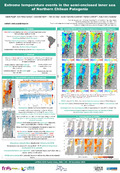
[en] Marine heatwaves (MHWs) and marine cold spells (MCSs) are extreme temperature events, respectively warm and cold, that can last for days, weeks or even months, and occur in every ocean of the world. However, due to global warming, the frequency of MCSs has decreased during the last decades, while MHWs have increased dramatically. In this work, we investigated the occurrence and characteristics of MHWs and MCSs in Northern Chilean Patagonia, a complex region characterised by a system of fjords and channels. These events are typically detected using satellite data. However, the spatial resolution of satellite products is insufficient to fully capture the narrow and intricate features of this region. To address this, we propose a method that combines in situ measurements with satellite data to better represent the spatial variability of extreme temperature events, particularly within fjords. Our results reveal a high spatial variability in both MHWs and MCSs. These events are more intense in enclosed basins (especially fjords), where stratification is stronger. In these areas, MHWs have an average intensity of 2.5°C, while MCSs can reach -2°C. We also observe that MHWs are becoming more frequent, increasing by approximately 1 event/decade across most of the region. In contrast, the frequency of MCSs is sharply declining by about 1.5 event/decade. Interestingly, while the intensity of MCSs is increasing by 0.2°C/decade, the intensity of MHWs is decreasing by 0.2°C/decade in the northern part of the domain. Finally, we also present the case study of an exceptional MHW that occurred during summer and fall 2016. This event was driven by unusually high solar radiation, reduced cloud cover and positive air temperature anomaly. It was associated with an important drought and widespread harmful algal blooms, which led to severe economic losses for aquaculture farms in Northern Patagonia.
Disciplines :
Aquatic sciences & oceanology
Author, co-author :
Pujol, Cécile ✱; Université de Liège - ULiège > Département d'astrophysique, géophysique et océanographie (AGO) > GeoHydrodynamics and Environment Research (GHER)
Barth, Alexander ; Université de Liège - ULiège > Département d'astrophysique, géophysique et océanographie (AGO) > GeoHydrodynamics and Environment Research (GHER)
Pérez-Santos, Iván; Universidad de Los Lagos, Puerto Montt, Chile > i~mar
Mancilla-Gutiérrez, Guido; Universidad de Los Lagos, Puerto Montt, Chile > i~mar
Linford, Pamela; University of Concepción, Concepción, Chile > Centro de Investigación Oceanográfica COPAS Sur-Austral and COPAS COASTAL
Díaz, Patricio; Universidad de Los Lagos, Puerto Montt, Chile > Instituto de investigaciones i~mar
Alvera Azcarate, Aida ✱; Université de Liège - ULiège > Département d'astrophysique, géophysique et océanographie (AGO) > GeoHydrodynamics and Environment Research (GHER) ; Université de Liège - ULiège > Freshwater and OCeanic science Unit of reSearch (FOCUS)
✱ These authors have contributed equally to this work.
Language :
English
Title :
Extreme temperature events in the semi-enclosed inner sea of Northern Chilean Patagonia
Publication date :
26 November 2025
Event name :
Latin American Physics of Estuaries and Coastal Oceans (LAPECO)