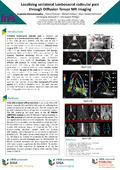
[en] Unilateral lumbosacral radicular pain is common, yet localizing its anatomical origin remains challenging. Patients with radicular pain may or may not present with radiculopathy, often caused by mechanical compression such as a herniated disc. Diffusion tensor imaging (DTI) enables three-dimensional visualization of lumbosacral nerves and can detect subtle microstructural nerve damage, particularly when conventional MRI appears normal. For instance, fractional anisotropy derived from DTI can differentiate between symptomatic and asymptomatic contralateral nerve roots. Thus, DTI has the potential to serve as an imaging biomarker, complementing or augmenting the current clinical gold standard by identifying nerve root compression, inflammation, or degeneration even before anatomical changes manifest on conventional MRI. Furthermore, it can assist in diagnosing early-stage nerve damage and quantitatively evaluating treatment effectiveness for lumbosacral radiculopathy and radicular pain. Nonetheless, the optimal diffusion MRI protocol for reliably identifying symptomatic nerve roots and clarifying the relationship between DTI parameters and patient-reported symptoms remains unclear. Therefore, this study aims to propose the most relevant DTI protocol for assessing lumbosacral nerves and to develop robust computational tools for processing the resulting data. Such software will facilitate extracting reliable diffusion MRI parameters to serve as potential imaging biomarkers. Additionally, fiber tractography (FT) will be applied, as it has demonstrated superior intra- and inter-rater reliability for fractional anisotropy, especially when combined with tractography-based approaches.
Kornaropoulos, Evgenios ; Université de Liège - ULiège > Département d'électricité, électronique et informatique (Institut Montefiore)
Pesesse Pierre; ULiège - University of Liège > Departments of Sport and Rehabilitation Sciences
Zubkov, Mikhail ; Université de Liège - ULiège > GIGA > GIGA Neurosciences - Sleep and chronobiology
Vanderthommen, Marc ; Université de Liège - ULiège > Département des Sciences de l'activité physique et de la réadaptation > Kinésithérapie spécifique et réadaptation motrice
Demoulin, Christophe ; Université de Liège - ULiège > Département des Sciences de l'activité physique et de la réadaptation > Kinésithérapie spécifique et réadaptation motrice
Phillips, Christophe ; Université de Liège - ULiège > Département d'électricité, électronique et informatique (Institut Montefiore)
Language :
English
Title :
Localising unilateral lumbosacral radicular pain through Diffusion Tensor Imaging: an experimental study