Abstract :
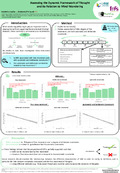
[en] Although mind-wandering (MW) constitutes a substantial part of our mental activity and may play a role in self-construction, future planning, and, more generally, in how we interact with others and the world around us, there is currently no definitive consensus on its definition. MW is commonly referred to as thoughts whose content is unrelated to both the task at hand and the immediate environment. However, the Dynamic Framework of Thought (DFT; Christoff et al., 2016, Nature) proposes a definition grounded in the dynamics of thought, emphasizing two components: automatic and deliberate constraints. Specifically, MW is conceptualized as freely moving thoughts characterized by low automatic constraints (i.e., factors such as habits or sensory input that limit variability in thought content) and low deliberate constraints (i.e., intentional, goal-directed processes shaping thought content). However, evidence supporting this framework is currently scarce. To assess it, participants completed a go/no-go task intermittently interrupted by thought probes assessing whether they were focused on the task or engaged in MW. They then rated the level of automatic constraints, deliberate constraints, and free movement of their attentional state on Likert scales. In line with the DFT, linear mixed models revealed that MW was associated with higher free movement and lower deliberate constraints. Free movement was also negatively related to deliberate constraints. However, contrary to DFT predictions, MW and free movement were not associated with low automatic constraints. Together, these results partially support the DFT and suggest that free movement of thought cannot be equated with low automatic constraints. This highlights the importance of considering the dynamics of thought when investigating MW. Future studies should extend these findings by using additional methods to assess constraints and free movement more comprehensively.