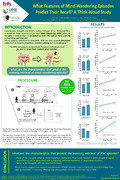
[en] Background. The human mind exhibits a pervasive tendency to generate spontaneous thoughts, both during task performance and in idle moments. A subset of these experiences, termed “mind-wandering” refers to thoughts whose content is unrelated to both the task at hand and the surrounding environment. While typically perceived as disruptive, mind-wandering can also support functional roles, such as fostering creativity, problem solving, or future planning. For such thoughts to be beneficial, however, individuals must be able to recall them when needed. Yet, it is currently unknown whether some mind-wandering episodes possess features that make them more easily recallable than others.
Methods. To answer this question, participants underwent a Think-Aloud Procedure, in which they vocalized their mental experiences continuously for ten minutes. The following day, participants completed a surprise free recall task to retrieve the content of their Think-Aloud experiences, followed by a Thought Content Questionnaire to assess the features of their mind-wandering episodes. We then examined which features predicted whether a mind-wandering was recalled vs forgotten.
Results. We found that mind-wandering episodes that were rated as more important, structured, related to other people, or associated with planning function were more likely to be correctly recalled. Conversely, mind-wandering episodes perceived as having no apparent function were more likely to be forgotten.
Conclusions. These results suggest that several dimensions of mind-wandering episodes play a critical role in determining their later accessibility in memory, offering new perspectives on the adaptive potential of this phenomenon.
Research Center/Unit :
PsyNCog - Psychologie et Neuroscience Cognitives - ULiège
Disciplines :
Theoretical & cognitive psychology
Author, co-author :
Gilles, Arya ; Université de Liège - ULiège > Psychologie et Neuroscience Cognitives (PsyNCog)
D'Argembeau, Arnaud ; Université de Liège - ULiège > Département de Psychologie ; Université de Liège - ULiège > Psychologie et Neuroscience Cognitives (PsyNCog) ; F.R.S.-FNRS - Fonds de la Recherche Scientifique
Stawarczyk, David ; Université de Liège - ULiège > Département de Psychologie ; Université de Liège - ULiège > Psychologie et Neuroscience Cognitives (PsyNCog) ; F.R.S.-FNRS - Fonds de la Recherche Scientifique
Language :
English
Title :
What Features of Mind-Wandering Episodes Predict Their Recall? A Think-Aloud Study
Publication date :
April 2025
Event name :
4th edition of the Recollection, Familiarity, and Novelty Conference