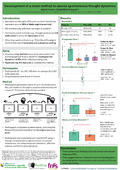
[en] Background: A defining feature of human cognition is its ability to spontaneously generate thoughts that continuously shift from one topic to another. When decoupled from the present moment, these thoughts constitute mind-wandering episodes, accounting for approximately 30% of daily cognitive activity. The most common method for assessing such thoughts is the probe technique, in which participants are randomly asked to report the content of their thoughts at intervals ranging from seconds to minutes. However, this approach is poorly suited for capturing thought dynamics. More recently, researchers have used the Think-Aloud Procedure to track changes in thought content over time. However, the unstructured nature of this task often requires extensive and subjective coding to segment participants’ reports into individual thoughts, limiting its practicality.
Method: Inspired by associative and autobiographical fluency tasks, we developed a method in which participants generate chains of successive thoughts. This structured approach allows for the investigation of thought dynamics while reducing the time and resources needed for analysis. To validate this method, we then examined key thought features to determine whether we could replicate well-documented findings from the literature.
Results: Our analysis revealed the expected prospective bias and link to personal goals in reported thoughts. We also replicated the finding that participants tend to generate several related thoughts before transitioning to a new topic.
Conclusion: These preliminary results suggest that this method is a promising alternative to thought-probes and unstructured Think-Aloud procedures for investigating the features and dynamics of spontaneous thought and mind-wandering.
Disciplines :
Neurosciences & behavior
Author, co-author :
David, Martin ; Université de Liège - ULiège > Département de Psychologie ; Université de Liège - ULiège > Psychologie et Neuroscience Cognitives (PsyNCog)
Stawarczyk, David ; Université de Liège - ULiège > Département de Psychologie ; Université de Liège - ULiège > Psychologie et Neuroscience Cognitives (PsyNCog)
Language :
English
Title :
Development of a novel method to assess spontaneous thought dynamics
Publication date :
27 May 2025
Event name :
Belgian Association for Psychological Sciences (BAPS)