Keywords :
Behavioral avoidance, behavioral activation, rumination, insomnia, depression
Abstract :
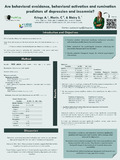
[en] Introduction: Insomnia is a frequent symptom of depression, with a well-established bidirectional link between the two disorders (Sivertsen et al., 2012). However, the psychological processes underlying this comorbidity remain poorly understood. Identifying them is essential for developing effective interventions, in the absence of specific psychotherapeutic treatment. Processes such as behavioral avoidance, behavioral activation deficit and rumination have recently been identified as potential factors. This study examines the role of behavioral avoidance, behavioral activation and rumination in predicting depression, insomnia and their comorbidity.
Method: An online study distributed via social networks and in hospitals recruited 2612 adults. This study included French validated questionnaires measuring independent variables (behavioral avoidance, behavioral activation, rumination), dependant variables (insomnia and depression) and control variables (age and anxiety). After exclusions (insufficient knowledge of French, age under 18 or above 75 years, inattention during completion, acute risk of sleep apnea, sleepwalking, night work) the final sample comprised 1850 participants (74% women, mean age = 37). Correlations and regressions were used to identify processes predictive of insomnia and depression on the whole sample. To explore predictors of insomnia/depression comorbidity, the same analyses were performed in participants with a score ≥11 on the ISI (insomnia) and ≥9 on the PHQ-9 (depression).
Resultats: In the whole sample, analyses show that linear regression models for predicting depression and insomnia from behavioral avoidance, behavioral activation and rumination are significant. All three predictors are significant predictors, predicting a considerable amount of variance in depression and insomnia, with 37% and 22% respectively for behavioral avoidance, 14% and 7% for behavioral activation, and 44% and 27% for rumination. Control variables do not influence previous results and the significativity of predictors. Age is not a significant predictor of insomnia and depression contrary to anxiety. Hierarchical regression analyses suggest that the predictors remain significant predictors of insomnia and depression after controlling for the influence of other predictors. Regression analyses also suggest that insomnia is a significant predictor of depression and vice versa with a part of variance of 49% explained by one the others. Sub-sample of participant with ISI ≥11 and PhQ-9 ≥9 includes 637 participants (Age = 34). As reported in the overall sample results, regression analyses on depression suggest that all three predictors remain significant, as does anxiety. However, regression analyses on insomnia suggest that only anxiety remains a significant predictor.
Discussion: The results confirm a bidirectional relationship between insomnia and depression. Behavioral avoidance, behavioral activation and rumination explain depression better than insomnia but explain both troubles in the whole sample. These processes then constitute relevant therapeutic targets for the management of depression and insomnia in general with rumination as the most relevant therapeutic targets, followed by behavioral avoidance and the behavioral activation. However, our analyses suggest that these processes do not significantly predict insomnia in the comorbid sample. Targeting these processes in a clinical setting would not be efficient to reduce insomnia in people suffering from both disorders. Future research need to pursue the investigation of other psychological processes in the future.