Abstract :
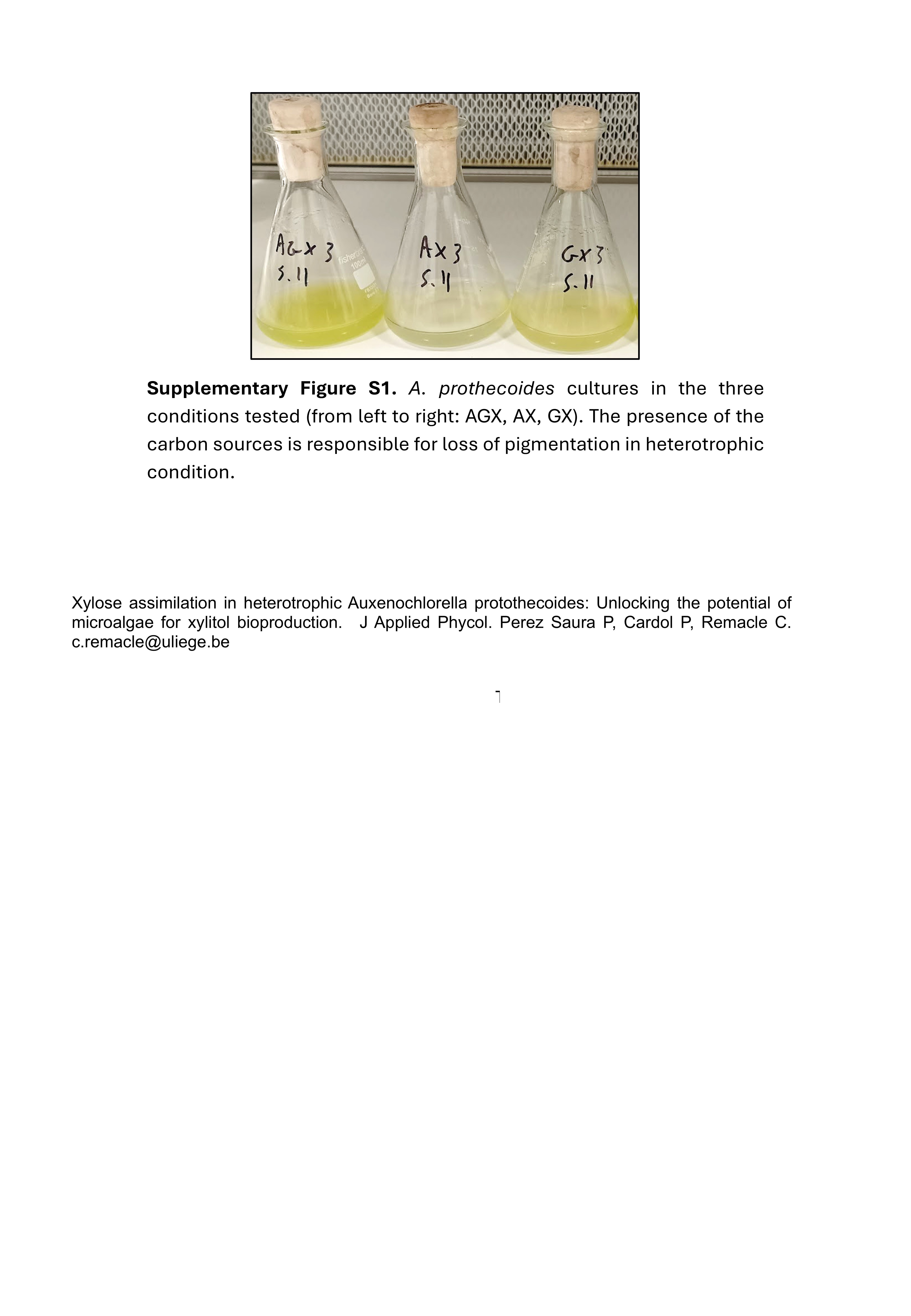
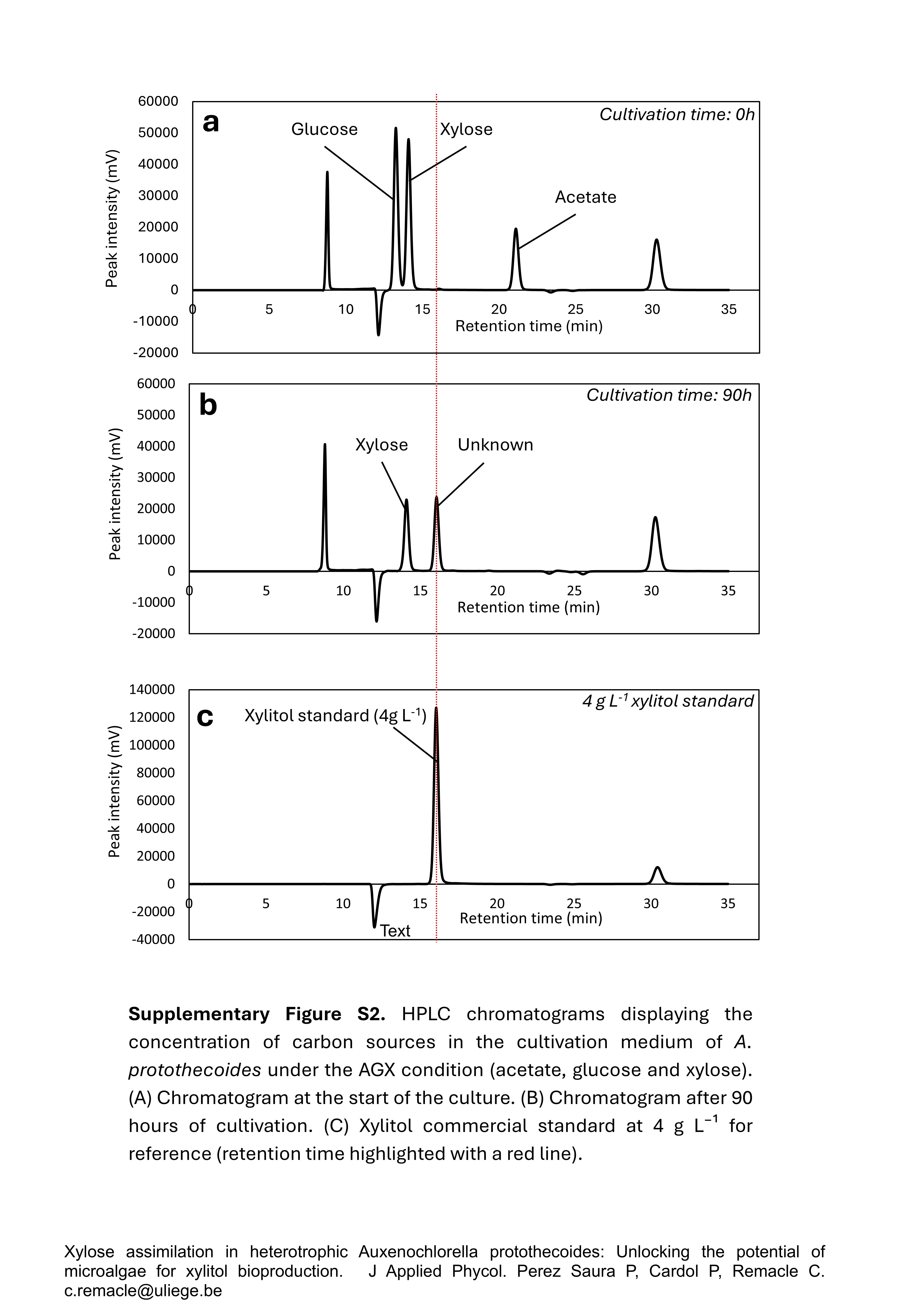
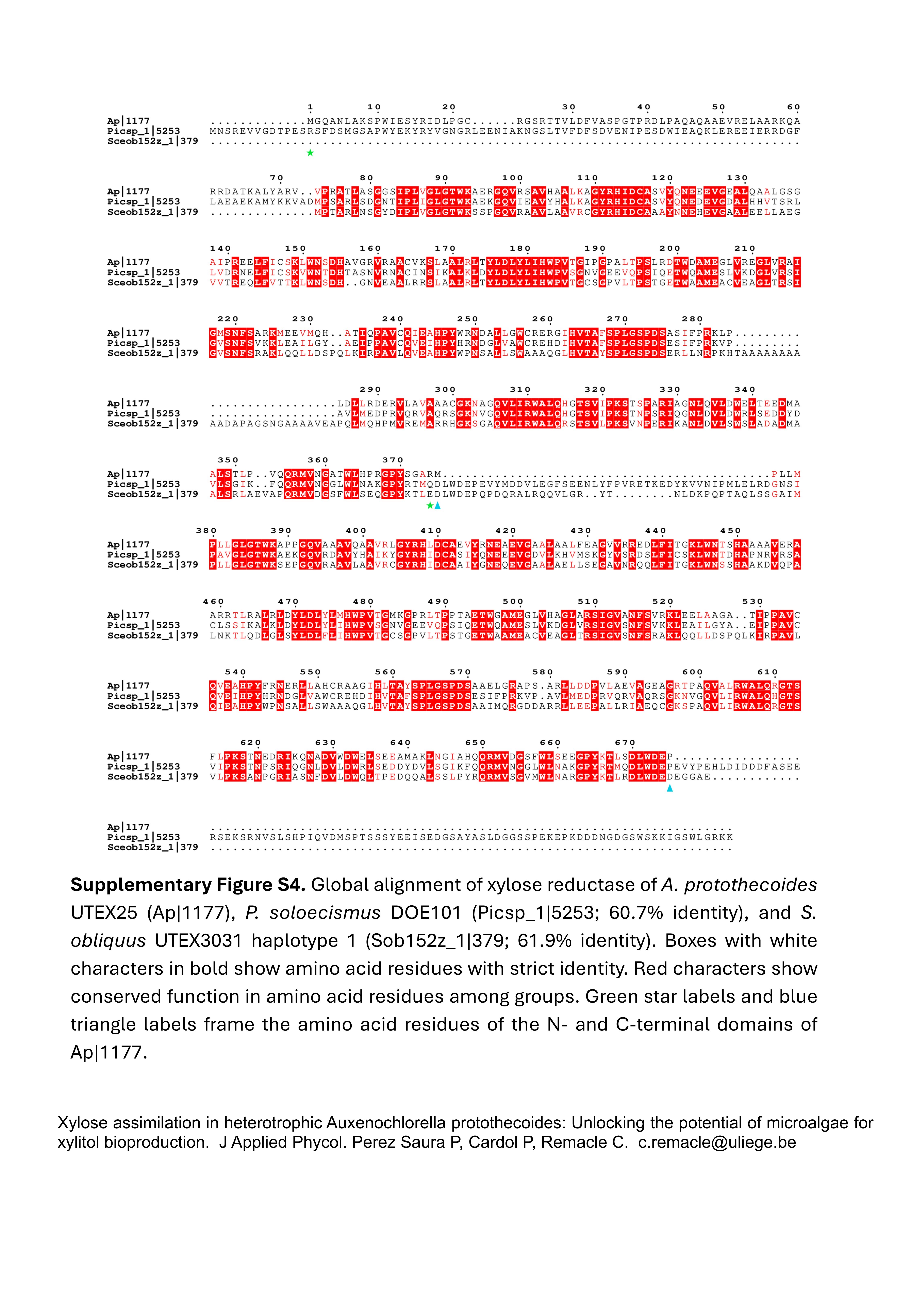
[en] Xylitol is a high-value sugar alcohol widely used in the food and pharmaceutical industries. While microbial xylitol production primarily relies on fermentative organisms, sustainable alternatives involving photosynthetic microorganisms as a substitute for chemical hydrogenation remain largely unexplored. Here, we investigate whether the microalga Auxenochlorella protothecoides UTEX 25 can assimilate xylose and produce xylitol under heterotrophic conditions when glucose, acetate, or both carbon sources were simultaneously provided to the medium. When supplemented with glucose, xylose uptake was initially inhibited but later accelerated, leading to the highest xylose consumption rate (0.84 ± 0.10 g gDW⁻1 day⁻1). When supplemented with acetate, xylose assimilation occurred gradually with a lower consumption rate (0.24 ± 0.01 g gDW⁻1 day⁻1). Xylose uptake was linked to xylitol excretion, with a 1:1 xylose-to-xylitol conversion ratio in all conditions. When supplemented with both carbon sources, xylose metabolism was enhanced, combining the benefits of both glucose-induced transport and acetate-sustained metabolism. This condition resulted in an intermediate xylose consumption rate (0.64 ± 0.06 g gDW⁻1 day⁻1) and the highest xylitol production rate (0.65 ± 0.01 g gDW⁻1 day⁻1). A fed-batch strategy further improved xylose conversion and increased final xylitol yield to 0.91 g gxylose⁻1, comparable to xylitol bioproduction rates in engineered yeasts. Genome analysis identified putative xylose transporters and a putative xylose reductase. These findings establish A. protothecoides as a promising candidate for microalgal-based xylitol production, providing a foundation for further metabolic engineering and process optimization for sustainable xylose valorization.
Funders :
SPF Economie - Service Public Fédéral Économie, PME, Classes moyennes et Énergie
F.R.S.-FNRS - Fonds de la Recherche Scientifique
FWO - Fonds Wetenschappelijk Onderzoek Vlaanderen
ULiège. ARC - Université de Liège. Actions de Recherche Concertées
Funding text :
This work was supported by Fonds de la Recherche Scientifique (FNRS) (CDR J.0175.20 and J.0149.23 to CR and J.0025.24 to PC); Fonds Wetenschappelijk Onderzoek \u2013 Vlaanderen (FWO) and FNRS under the Excellence of Science (EOS) Project No. 30829584; Action de Recherche Concert\u00E9e from the University of Liege (DARKMET ARC grant 17/21- 08), and ADV_BIO grant (SPF \u00C9conomie, P.M.E., Classes moyennes et \u00C9nergie, Direction g\u00E9n\u00E9rale de l\u2019\u00C9nergie).
Scopus citations®
without self-citations
1