Abstract :
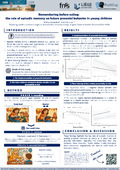
[en] The directive function of episodic memory – i.e., using past experiences to guide future decisions and behaviors – is assumed to exert a major influence of human behaviors. A key example comes from studies showing that children who recall a past good deed are more likely to engage in prosocial behaviors compared to those who were not asked to remember such an event. To date, however, the question of when the relation between episodic memory for past good deeds and subsequent social decisions emerges in young children remains unexplored. To fill this gap, 134 French-speaking preschoolers aged from 24 to 47 months were recruited and assigned into one of two experimental conditions: the “good deed” condition where children were placed in a scripted situation requiring them to help an accomplice hide a gift for a birthday party or the “neutral” condition where children observed the accomplice hiding the birthday gift without being asked to help. One week later, the memory of the previously experienced event was assessed. Immediately after recounting what they remembered about the event, children were put into a situation where their help was needed (i.e., the experimenter dropped some cards on the floor and had to pick them up). Prosocial behavior was coded as present if participants tried to help the experimenter in any way (e.g., by picking up at least one card, by looking around to ensure no cards were missing, etc.). Observing the experimenter while they were gathering the cards or leaning forward to have a better look were not considered helping behaviors. Generalized Linear Analyses revealed that, in the good-deed condition, children with more detailed and richer memory for the past event were more likely to help the experimenter and initiated this help more quickly. Such an effect was not found in the neutral condition. Interestingly, however, the relation between children’s memory for past good deeds and the likelihood of showing prosocial behaviors was found to decrease as children grew older, suggesting a shift in how younger and older children use their memories to guide their decisions. Indeed, these results align with prior studies showing that decisions to engage in prosocial behaviors start to depend on more deliberate reasoning and cognitively demanding decision-making balance as children grow older. Overall, our findings bring new insights on the key role of episodic memory in guiding children’s future social decisions. In a clinical perspective, our data provide important information for the creation of a potential new revalidation program targeting children with behavior problems due to developmental or acquired disorders.