Abstract :
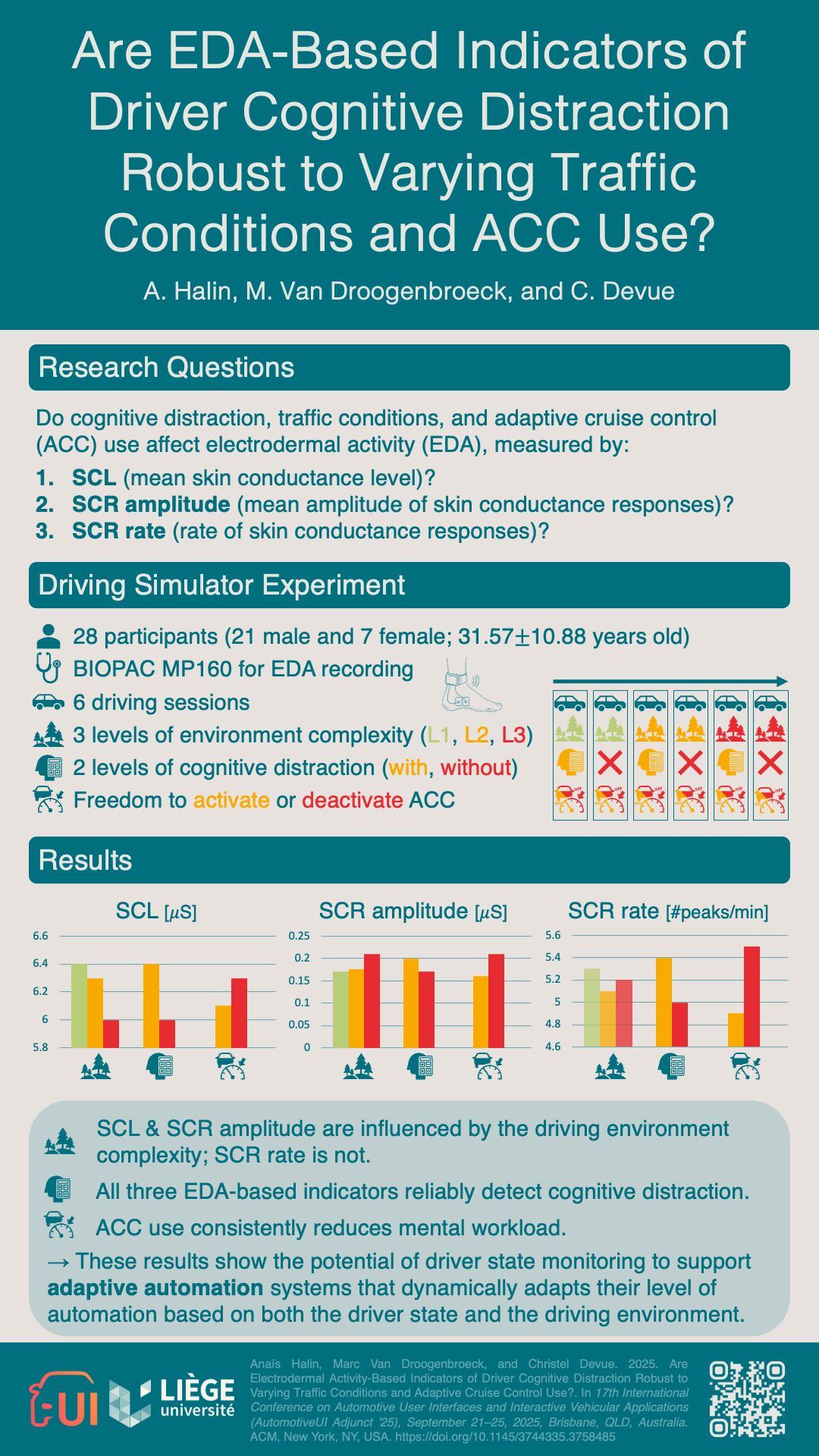
[en] In this simulator study, we investigate whether and how electrodermal
activity (EDA) reflects driver cognitive distraction under varying traffic
conditions and adaptive cruise control (ACC) use. Participants drove in six
scenarios, combining two levels of cognitive distraction (presence/absence of a
mental calculation task) and three levels of driving environment complexity
(different traffic conditions). Throughout the experiment, they were free to
activate or deactivate ACC (ACC use, two levels). We analyzed three EDA-based
indicators of cognitive distraction: SCL (mean skin conductance level), SCR
amplitude (mean amplitude of skin conductance responses), and SCR rate (rate of
skin conductance responses). Results indicate that all three indicators were
significantly influenced by cognitive distraction and ACC use, while
environment complexity influenced SCL and SCR amplitude, but not SCR rate.
These findings suggest that EDA-based indicators reflect variations in drivers'
mental workload due not only to cognitive distraction, but also to driving
environment and automation use.
Scopus citations®
without self-citations
1