Abstract :
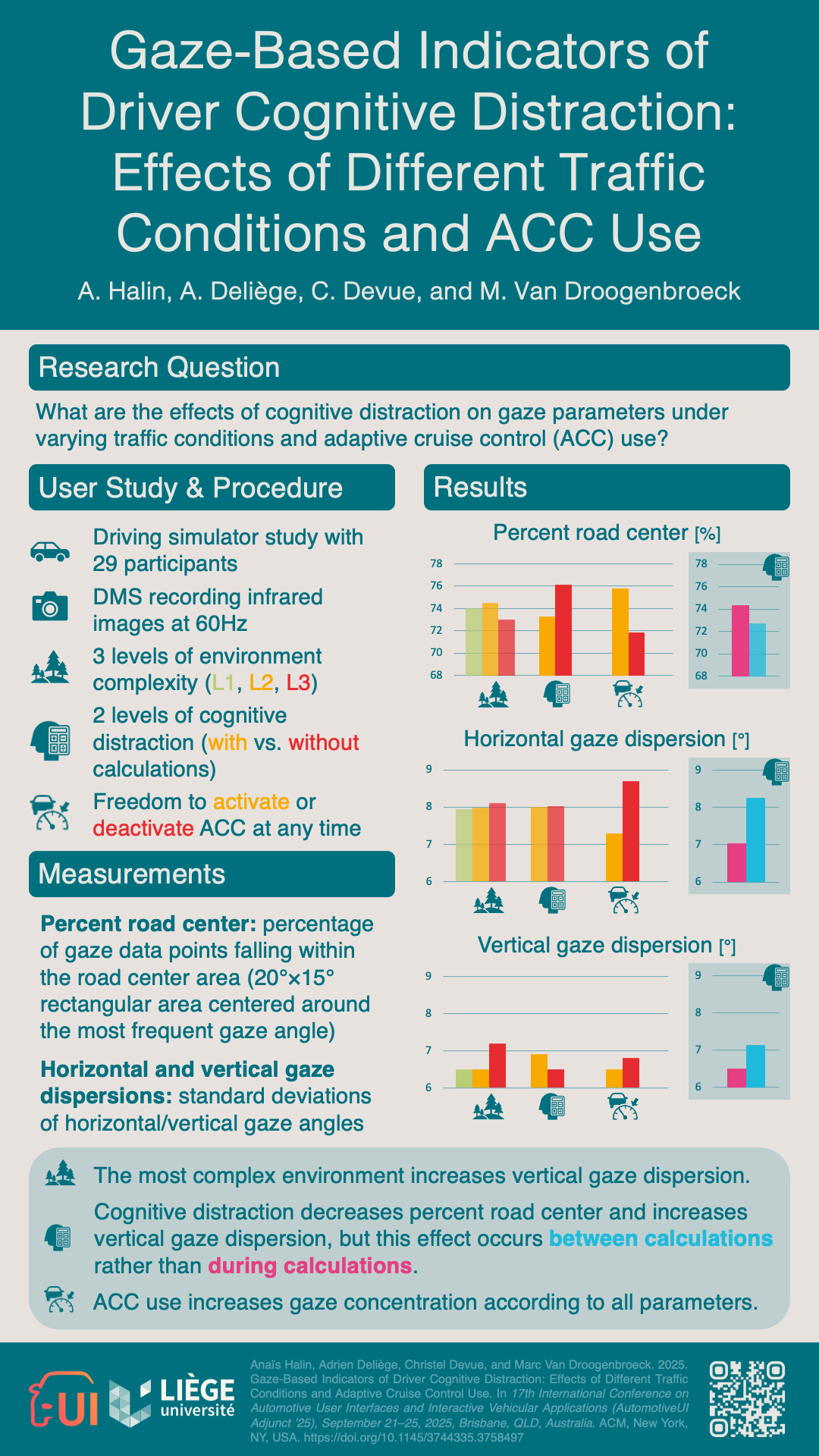
[en] In this simulator study, we investigate how gaze parameters reflect driver
cognitive distraction under varying traffic conditions and adaptive cruise
control (ACC) use. Participants completed six driving scenarios that combined
two levels of cognitive distraction (with/without mental calculations) and
three levels of driving environment complexity. Throughout the experiment,
participants were free to activate or deactivate an ACC. We analyzed two
gaze-based indicators of driver cognitive distraction: the percent road center,
and the gaze dispersions (horizontal and vertical). Our results show that
vertical gaze dispersion increases with traffic complexity, while ACC use leads
to gaze concentration toward the road center. Cognitive distraction reduces
road center gaze and increases vertical dispersion. Complementary analyses
revealed that these observations actually arise mainly between mental
calculations, while periods of mental calculations are characterized by a
temporary increase in gaze concentration.
Scopus citations®
without self-citations
0