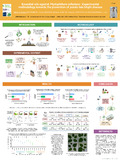
[en] While intensive use of synthetic and mineral (copper sulfate notably) pesticides depletes resources, pollutes water and threatens human health and ecosystems, new and more sustainable alternatives for crop protection must be urgently suggested. This study explores the use of essential oils (EOs) – plant secondary metabolites which have shown multiple biological activities – as natural alternatives for controlling potato late blight, a disease caused by the oomycete Phytophthora infestans.
For this purpose, several EOs were chemically analysed, then emulsified in water with Tween20 and tested in vitro against three P. infestans genotypes (EU-13-A2, EU-36-A2, EU-37-A2). Oils rich in phenylpropanoids such as oregano, clove or cinnamon completely inhibited both mycelium growth and spore germination from 1 µL/mL, more efficiently than terpene-rich oils (bergamot, rosemary). Ex vivo assays on potato leaves confirmed the increasing susceptibility of three different potato varieties (Bintje, Fontane, Carolus) known to exhibit respectively no, low and high resistance against the disease. This underscores how varietal selection plays another key role in disease management. Phytotoxicity assessments did not show visible lesions nor significant decrease in chlorophyll fluorescence caused by any EO under 2.5 µL/mL, although chlorosis appeared at higher concentrations. Currently, in planta experiments are being carried out to evaluate the protective properties of essential oils together with how they could induce plant systemic resistance.
All these findings, together with deep comprehension of cellular sites and modes of action, will reveal promising EO for the development of effective and non-toxic biofungicides, paving the way for future applications in sustainable late blight management.
Disciplines :
Agriculture & agronomy
Author, co-author :
Martini, Florian ; Université de Liège - ULiège > Département GxABT > Chemistry for Sustainable Food and Environmental Systems (CSFES)
Burgeon, Clément ; Université de Liège - ULiège > Département GxABT > Microbial technologies
Jijakli, Haissam ; Université de Liège - ULiège > Département GxABT > Gestion durable des bio-agresseurs
Gontier, Eric; UPJV - Université de Picardie Jules Verne > UFR des Sciences > BIOPI
Fauconnier, Marie-Laure ; Université de Liège - ULiège > Département GxABT > Chemistry for Sustainable Food and Environmental Systems (CSFES)
Language :
English
Title :
Essential oils against Phytophthora infestans : Experimental methodology towards the prevention of potato late blight disease
Alternative titles :
[fr] Les huiles essentielles contre Phytophthora infestans : méthodologie expérimentale pour le développement d'un produit pour lutter contre le mildiou de la pomme de terre
Original title :
[en] Essential oils against Phytophthora infestans : Experimental methodology towards the prevention of potato late blight disease
Publication date :
09 July 2025
Event name :
17th International Congress of the Mediterranean Phytopathological union