Abstract :
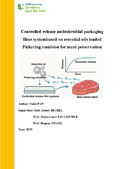
[en] In recent years, increasing concerns regarding food safety and waste have accelerated the development of antimicrobial active packaging materials. However, conventional antimicrobial packaging systems often suffer from issues such as burst release, poor stability of active compounds, and limited long-term efficacy. To address these challenges, this thesis proposes a novel packaging platform based on Pickering emulsions (PEs), in which essential oils (EOs) are stably encapsulated and released in a controlled system. This dissertation systematically investigated a EOs loaded PE delivery manner and two PEs-based film systems were designed and evaluated for their physicochemical properties, antimicrobial performance, release behavior and meat preservation.
Firstly, a EOs loaded PEs delivery was developed and optimized by loading cinnamon essential oil (CEO) in zein- tannic acid (ZT) complex particles stabilizer. The interfacial properties of the ZT particles were optimized by modulating the zein-tannic acid interactions through pH adjustment, thereby enhanced emulsion stability and improved CEO sustained-release behavior. The ZT5 complex (formed at pH 5) showed the most balanced interfacial properties, as evidenced by its lower interfacial tension (11.31 mN/m), stronger interfacial viscoelasticity, and stable anchoring at the oil-water interface, resulting in the smallest in Turbiscan Stability Index (TSI) and highest CEO encapsulation efficiency (86.83%) compared to other ZT complexes. ZTC5 showed excellent antimicrobial activity against critical meat spoilage species P. paralactis MN10 and L. sakei VMR17 with slow-release features.
Secondly, a biodegradable film with Janus structure was fabricated by incorporating the optimized CEO-loaded PEs into chitosan-based matrices, combined with a zein barrier layer, to regulate CEO release directionally, achieving unidirectional and prolonged CEO release. The good interfacial compatibility of CEO-loaded PEs/chitosan active layer and zein barrier layer was driven by non-covalent interactions, promoting interfacial adhesion and stability. The differential swelling behavior between the chitosan active layers (47.61% ~ 51.71%) and zein barrier layer (162.52%), played a crucial role in regulating the release kinetics of CEO. The films showed excellent antimicrobial activity against meat spoilage species and radical scavenging activity (2.5-fold enhancement). Moreover, the film loading layer showed predominantly controlled by a quasi-Fickian diffusion, and prolonged the shelf life of pork by 6 days under the unidirectional sustained release.
In parallel, CEO-loaded PEs were incorporated into chitosan/polyvinyl alcohol (CS/PVA) composites film, combined with quercetin nanocrystals (QNs) as functional fillers (named PCE@QNs), to improve the cross-linking density of the polymer network and thereby further controlled release of CEO. The physical entanglement and hydrogen bonding interactions created a spatial barrier that restricted droplet migration or coalescence. This structural integrity contributes to enhanced mechanical properties in PCE@QNs, achieving a tensile strength of 39.09 ± 0.46 MPa. Moreover, PCE@QNs exhibited potent antimicrobial activity against food spoilage bacteria (achieving over 99.99% inhibition) and significantly improved antioxidant capacity (approximately 5-fold increase), along with superior UV-shielding, water sensitivity, volatile ammonia responsiveness, and biodegradability. CEO release from PCE@QNs followed Fickian diffusion. The multifunctional properties of PCE@QNs make it highly suitable for meat preservation, effectively extending shelf life of pork to 11 days at 4°C by reducing microbial diversity.
In conclusion, through systematic investigation, this research elucidated the structure-property-function relationships in PE-based packaging systems, providing theoretical insights into the role of interfacial engineering and microstructural modulation in regulating antimicrobial agents’ release. The findings of this dissertation provided theoretical and practical guidance for future innovations in bio-based controlled-release systems and open new possibilities for the practical application of Pes-based technologies in the food packaging field.