Abstract :
[en] Carbon storage in agricultural soils might help to reduce our current excess atmospheric carbon while simultaneously improving soil quality1. Attempts at increasing soil carbon often involve residue restitution, i.e. the return of organic matter to the soil after harvest of a cash-crop or destruction of a cover-crop. This practice might, however, lead to greater nitrous oxide (N2O) emissions2. N2O is the single greatest ozone-depleting substance4 and a greenhouse gas with a 273 times stronger global warming potential than carbon dioxide3. Understanding this trade-off is relevant when assessing the mitigation potential of carbon storage in agricultural soils.
Residue management affects residue quantity, quality (C:N ratio, particle size) as well as the timing and depth of residue incorporation in the soil. All of these factors might impact on the biotic and abiotic redox reactions that lead to N2O emissions. Recent meta-analysis shows that immature residues (e.g. covercrops) stimulate N2O emissions while mature residues (e.g. straw) only have marginal effects 5,6. Further, lower N2O emissions seem to be obtained with shallow incorporation and residue C:N ratios above 30 7. Overall, however, meta-analysis shows high-unexplained variability and stresses that, little long-term data on interactions between residue management and other agricultural practices, exist.
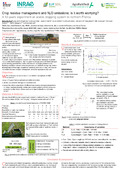
To assess the long-term impact of crop residue management on N2O emissions we use a 12-year dataset from an ongoing experiment in Estrées-Mons (northern France). Since 2011, automatic-chambers have been used for daily N2O measurements. Eight experimental treatments reflect a range of management practices representative for regional cropping systems. They include differences in practices such as tillage (conventional, reduced), nitrogen input (rate, origin), pesticide application (organic, conventional) and residue management (quantity, quality, restitution depth). Crop successions include spring and winter cereals, rapeseed, spring pea and covercrops. Cash crop residues are either exported or incorporated into the soil by superficial tillage and/or ploughing, covercrop residues are always incorporated. The carbon to nitrogen ratio of residues varies between 11 and 83 . Over the monitored period, a wide range of weather conditions was observed. The N2O fluxes are integrated over time periods defined from one residue return event to the next (length ranging from 108 to 363 days, N = 171). We associate 40 explanatory variables with each of these units (e.g. climate, soil moisture and temperature, residue quality, carbon and nitrogen availability). We use Random Forest Analysis, a machine learning tool able to deal with complex relationships, thresholds, non-linearity and the presence of optima , to analyse the driving factors of N2O emissions and to identify and weigh the role of the different crop residue management factors.
Preliminary results indicate that long-term cumulative N2O emissions are best predicted by the amount of nitrogen input and precipitation, but that large uncertainty exists. Further, for our site-specific pedo-climatic conditions and agricultural management practices, the quantity and quality of restituted residues appears to have a significant but much smaller effect. Overall, our data suggest little risk of elevated N2O emissions offsetting the benefits of residue restitution as a means of stimulating soil carbon inputs.