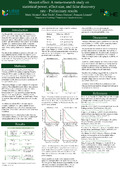
[en] The Mozart effect, originally reported by Rauscher et al. (1993), refers to the claim that listening to Mozart’s Sonata for Two Pianos in D Major (K. 448) enhances spatial and spatial-temporal abilities. However, replication studies have produced inconsistent results. Previous meta-analyses have reported conflicting findings, with effect sizes ranging from small to moderate. One meta-analysis also identified a publication bias that substantially reduced the estimated effect size (Pietschnig et al., 2010). These inconsistencies cast serious doubt on the existence of the Mozart effect. They could be partially explained by low statistical power resulting in overestimated effect sizes, and high false discovery rates. We conduct a meta-research analysis focusing on four key aspects: plausible effect sizes, effect size overestimation, statistical power, and the false discovery rate (FDR). Standard and multilevel meta-analyses are used to estimate effect sizes while accounting for publication bias. A multilevel model with sample size as a moderator examines effect size inflation. Statistical power is estimated for each study based on various meta-analytical effect size estimates, and FDR is evaluated under different assumptions about the prior probability that the effect is genuine, following Ioannidis (2005). We anticipate that reported effect sizes will range from very small to moderate, with smaller studies likely overestimating effects. Median statistical power is expected to fall well below the recommended 80%, leading to an elevated FDR. These findings will provide insight into the robustness of the Mozart effect and may have broader implications for research reproducibility.
Research Center/Unit :
RUCHE - Research Unit for a life-Course perspective on Health & Education - ULiège
Disciplines :
Social & behavioral sciences, psychology: Multidisciplinary, general & others Social & behavioral sciences, psychology: Multidisciplinary, general & others
Author, co-author :
Meunier, Marie ; Université de Liège - ULiège > Faculté de Psychologie, Logopédie et Sciences de l'Education > Master sc. psycho., fin. spéc.
Tirelli, Ezio ; Université de Liège - ULiège > Département de Psychologie
Durieux, Nancy ; Université de Liège - ULiège > Unités de recherche interfacultaires > Research Unit for a life-Course perspective on Health and Education (RUCHE)
Léonard, François ; Université de Liège - ULiège > Unités de recherche interfacultaires > Research Unit for a life-Course perspective on Health and Education (RUCHE)
Language :
English
Title :
Mozart effect: A meta-research study on statistical power, effect size, and false discovery rate - Preliminary results
Publication date :
26 May 2025
Event name :
Annual Meeting of the Belgian Association of Psychological Sciences