Abstract :
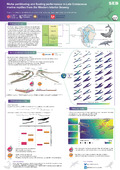
[en] The coexistence of numerous sympatric predatory marine reptiles in the Western Interior Seaway (WIS), a vast inland sea that stretched across North America during the Late Cretaceous, suggests ecological partitioning within higher trophic niches. Many studies have focused on dental morphology as a proxy to infer feeding habits of aquatic tetrapods, but much more ecological insight may be gained through simulations of mechanical performances. Here, we conducted the first, large-scale, comparative study of WIS marine reptile jaw biomechanics, applying muscle-driven finite element analyses (FEA) on a dataset of high-resolution three-dimensional models of Santonian-Maastrichtian mosasaurids and polycotylid plesiosaurians. For comparative purposes, mosasaur jaws were modeled with a fused symphysis and immobile intramandibular joint, forming a single functional element. Muscle insertions were identified to reconstruct jaw adductor muscles and assess respective muscle and bite force. We used Metafor software to simulate realistic muscle traction dynamics during biting, including simulations at multiple opening angles and multiple biting locations. We recover clearly distinct biomechanical performances among the sample, notably between the slender-snouted mosasaurids (e.g., Clidastes) and polycotylids, and the robust-jawed mosasaurids (e.g., Prognathodon). By integrating jaw size, mechanical efficiency, and strain, we provide strong support for niche partitioning among these marine predators, as influenced by physical biting capabilities. Our results offer deeper insight into feeding ecologies in Late Cretaceous marine predators, and provide a unified protocol to assess niche partitioning in sympatric marine reptiles from well-sampled regions.