Keywords :
Rice, Cold tolerance, Microbial community, Microbacterium testaceum, Agricultural sustainability
Abstract :
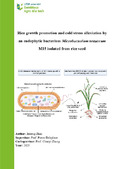
[en] Rice (Oryza sativa L.) is one of the world's most essential food crops. With global climate change intensifying, cold stress has become a significant environmental factor that negatively affects rice growth, yield, and quality, thus posing a major threat to food security. Enhancing rice cold tolerance is crucial not only for maintaining growth and yield under cold conditions but also for ensuring its quality. Recent advances in plant-microbe interaction studies have provided new insights and technical strategies for enhancing crop resilience to environmental stresses. Microbial communities play a crucial role in supporting plant growth, aiding in environmental adaptation, and enhancing stress tolerance. Despite this, their impact on rice cold tolerance has not been extensively studied.
This study systematically investigates the relationship between microbial communities and rice cold tolerance using a multifaceted experimental approach. Firstly, the microbial communities in the seeds and seedlings of two rice varieties, the cold-tolerant JG117 and cold-sensitive CB9, were compared. The results revealed that cold-tolerant varieties harbored more diverse and abundant microbial communities, with a relative high level of abundance of Microbacteriaceae family. This finding supports the hypothesis that microbial communities play a vital role in rice cold tolerance and suggests a potential link between microbial communities and rice stress tolerance, providing a foundation for future research.
Subsequently, microorganisms were isolated from the seeds of the cold-tolerant variety JG117, with a focus on the Microbacteriaceae family. Microbacterium testaceum M15 was found to exhibit significant plant growth-promoting properties, such as indole-3-acetic acid (IAA) production, phosphate solubilization, and siderophore production. Inoculation of the cold-sensitive variety CB9 with the M. testaceum M15 strain through seed soaking and root drenching resulted in notable improvements in growth and enhanced cold tolerance under cold stress.
Additionally, the study conducted a comprehensive analysis to understand how M. testaceum M15 enhances cold tolerance in rice. M15-inoculated rice seedlings showed higher chlorophyll content, total protein levels, and catalase activity, while malondialdehyde content was reduced, indicating that M. testaceum M15 helps mitigate oxidative damage and improve cold tolerance. Genomic and transcriptomic analyses revealed that M. testaceum M15 aids rice in adapting to low temperatures by solubilizing phosphate, enhancing phosphate transport, and inducing the expression of cold tolerance-related genes. Additionally, M. testaceum M15 enhances the activity of the rice antioxidant system, further improving cold tolerance. Inoculating M. testaceum M15 during the rice booting stage increased cold tolerance and improved agronomic traits at maturity, such as plant height, panicle length, 1,000-grain weight, and filled grain number, while reducing the number of unfilled grains. Microbial community analysis showed that M. testaceum M15 not only colonized the endophytic environment but also optimized the microbiome, promoting growth and enhancing cold tolerance in rice.
This study provides new theoretical insights into the intrinsic relationship between rice cold tolerance and microbial communities. It also offers a novel perspective on the application of microbial technology in agriculture. As extreme climate events associated with global climate change become more frequent, microorganisms offer a sustainable solution to enhance crop tolerance to adverse conditions, thereby improving food crop yield and quality. The findings of this study provide a foundation for potential microbe-based approaches to enhance rice cold tolerance and support the sustainable advancement of agriculture.