Abstract :
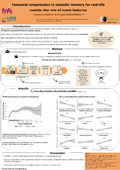
[en] The continuous flow of information that constitutes daily life events is temporally compressed in episodic memory, so that the time needed to remember an event is generally lower than its actual duration. Recent studies suggest that the rate of event compression during remembering is not constant, but the specific characteristics of events that influence their temporal compression remain poorly understood. In the present study, we used wearable camera technology to investigate how different event features, including duration, familiarity, importance and emotionality, shape their temporal compression in memory. Over three days, participants wore the camera during three distinct daily-life events, each lasting between thirty seconds to seventy minutes. After a delay of 2 to 4 days , participants were asked to mentally replay each recorded event. On each trial, images extracted from the videos representing the beginning and end of the event were presented, and participants had to remember everything that happened between these two moments, in as much detail as possible; the time needed to remember the event was recorded. After their mental replay, participants rated the subjective quality of their memory and verbally described everything that had come to mind during the mental replay. After completing the memory task, participants rated each event on several dimensions, such as familiarity, importance and emotionality, and provided a retrospective duration estimate. The results showed a significant non-linear relationship between event duration and remembering duration: remembering duration increased as a function of event duration for events lasting up to 10 minutes, beyond which the time required to recall events remained more stable. Beyond event duration, event characteristics significantly influenced remembering duration, with unfamiliar, unpredictable, positive, social and events with a high degree of change being less compressed in episodic memory. In addition, both subjective memory quality and objective measures of the amount of detail in memory representations -computed by analyzing verbal narratives using an automated scoring method - were predictive of remembering duration. Finally, retrospective duration estimates were predicted by remembering duration. Taken together, these results provide new insights into how the temporal compression of daily-life events is shaped by their intrinsic characteristics.