Abstract :
[en] INTRODUCTION: Environmental enrichment (EE) of the housing cages is used as a method to enhance the welfare of laboratory rodents. It encompasses any modification of standard housing conditions aimed at increasing its complexity (adding objects or running wheels, modifying the structure, etc.; 1). Amidst the current reproducibility crisis, considering the variability of the welfare indicators used in research as well as the variability of housing conditions (2,3), it seems appropriate to reassess the true effectiveness of such enrichment practices (4).
AIM: To synthesize the effects of housing conditions when comparing enriched to standard housing on anhedonia, assessed by the sucrose preference test in mice and rats. A systematic review will be conducted in accordance with JBI methodology for systematic reviews of effectiveness (5) and the guidelines outlined in the CAMARADES wiki (6).
METHODS: The databases to be searched will include Medline, PsycINFO, Embase, Scopus, CAB Abstract, and Google Scholar. Based on eligibility criteria, studies will be screened by two independent researchers in two phases, first on their title/abstract then on their full text. Data will then be extracted from included studies, and papers will be critically appraised with the Critical Appraisal of Methodological (technical) Quality of Reporting and Risk of Bias in Animal Research (CRIME-Q) tool (7). Statistical meta-analysis will be performed where possible; otherwise, findings will be presented in narrative format, complemented with tables and figures to aid in data presentation.
EXPECTED RESULTS: Only standard groups should display anhedonia. We expect that EE will increase sucrose preference. The results of the systematic review and potential meta-analysis could provide evidence-based recommendations to improve the welfare of laboratory rodents.
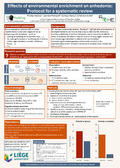
This poster will present the different steps planned in the future review.
***REFERENCES
1) Simpson, J., & Kelly, J. P. (2011). The impact of environmental enrichment in laboratory rats—Behavioural and neurochemical aspects. Behavioural Brain Research, 222(1), 246–264. https://doi.org/10.1016/j.bbr.2011.04.002
2) Mieske, P., Hobbiesiefken, U., Fischer-Tenhagen, C., Heinl, C., Hohlbaum, K., Kahnau, P., Meier, J., Wilzopolski, J., Butzke, D., Rudeck, J., Lewejohann, L., & Diederich, K. (2022). Bored at home? A systematic review on the effect of environmental enrichment on the welfare of laboratory rats and mice. Frontiers in Veterinary Science, 9, Article 899219. https://doi.org/10.3389/fvets.2022.899219
3) Ratuski, A. S., & Weary, D. M. (2022). Environmental enrichment for rats and mice housed in laboratories: A metareview. Animals, 12(4), Article 4. https://doi.org/10.3390/ani12040414
4) Marx, J. O., Jacobsen, K. O., Petervary, N. A., & Casebolt, D. B. (2021). A survey of laboratory animal veterinarians regarding mouse welfare in biomedical research. Journal of the American Association for Laboratory Animal Science, 60(2), 139–145. https://doi.org/10.30802/AALAS-JAALAS-20-000063
5) Aromataris, E., Lockwood, C., Porritt, K., Pilla, B., & Jordan, Z. (Eds.). (2024). JBI manual for evidence synthesis. JBI. https://synthesismanual.jbi.global. https://doi.org/10.46658/JBIMES-24-01
6) https://www.camarades.de/
7) Andersen, M. S., Kofoed, M. S., Paludan-Müller, A. S., Pedersen, C. B., Mathiesen, T., Mawrin, C., Olsen, B. B., Halle, B., & Poulsen, F. R. (2024). CRIME-Q—a unifying tool for critical appraisal of methodological (technical) quality, quality of reporting and risk of bias in animal research. BMC Medical Research Methodology, 24, Article 306. https://doi.org/10.1186/s12874-024-02413-0