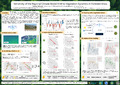
[en] Climate change is having profound effects on forest ecosystems. Forests, as major carbon sinks, play a vital role in regulating the Earth’s climate. However, climate-induced disturbances threaten these ecosystems, creating feedback loops that exacerbate global warming. Monitoring vegetation dynamics and simulating future conditions are crucial for sustainable ecosystem management.While global climate models or Earth System models (ESMs) are useful for large-scale assessments, they often fail to capture local phenomena. Regional Climate Models (RCMs), offer higher-resolution simulations but also face challenges in accurately representing biosphere-atmosphere interactions.In this study, we explore the sensitivity of the Modèle Atmosphérique Régional (MAR) to vegetation changes to support the future coupling of MAR with the dynamic vegetation model CARAIB. We conducted multiple simulations by perturbing the MAR Leaf Area Index (LAI) input. The perturbations consist of varying scenarios of vegetation growth and decline and changes in dynamics by using MODIS satellite LAI observations varying weekly as input instead of fixed monthly climatology from MERRA2 reanalysis LAI data and applying Gaussian noise.Our results show that the impact of LAI perturbations is non-linear, with distinct differences between increased and decreased vegetation. For instance, when vegetation was decreased by an average of 92%, evapotranspiration (ET) rates dropped by 83.4%. In contrast, a scenario with a 178.4% increase in LAI showed less drastic changes, with an increase of 29.8%. This behavior of the model suggests an asymmetric response to vegetation perturbations.Further analysis highlighted how MAR simulates daily ET when used with an observed LAI instead of a climatology. The study reveals a moderate correlation between MAR ET and observation data (r²=0.37) overall with MAR performing slightly better during drought conditions (r²=0.38) than in moist periods (r²=0.36). The model tends to underestimate ET in drought conditions and often overestimates it during moist periods.These findings provide valuable insights into the influence of vegetation dynamics on regional climate simulations. They emphasize the importance of accounting for vegetation-climate interactions in RCMs to improve local-scale predictions and understand feedback mechanisms under various climate scenarios.
Disciplines :
Earth sciences & physical geography
Author, co-author :
Dethinne, Thomas ; Université de Liège - ULiège > Sphères ; Université de Liège - ULiège > Département de géographie > Earth Observation and Ecosystem Modelling (EOSystM Lab)
Lecart, Benjamin ; Université de Liège - ULiège > Sphères ; Université de Liège - ULiège > Département de géographie > Earth Observation and Ecosystem Modelling (EOSystM Lab)
Fettweis, Xavier ; Université de Liège - ULiège > Département de géographie > Climatologie et Topoclimatologie
Jonard, François ; Université de Liège - ULiège > Département de géographie ; Université de Liège - ULiège > Sphères ; Université de Liège - ULiège > Département de géographie > Earth Observation and Ecosystem Modelling (EOSystM Lab)
Language :
English
Title :
Sensitivity of the Regional Climate Model MAR to Vegetation Dynamics in Forested Areas