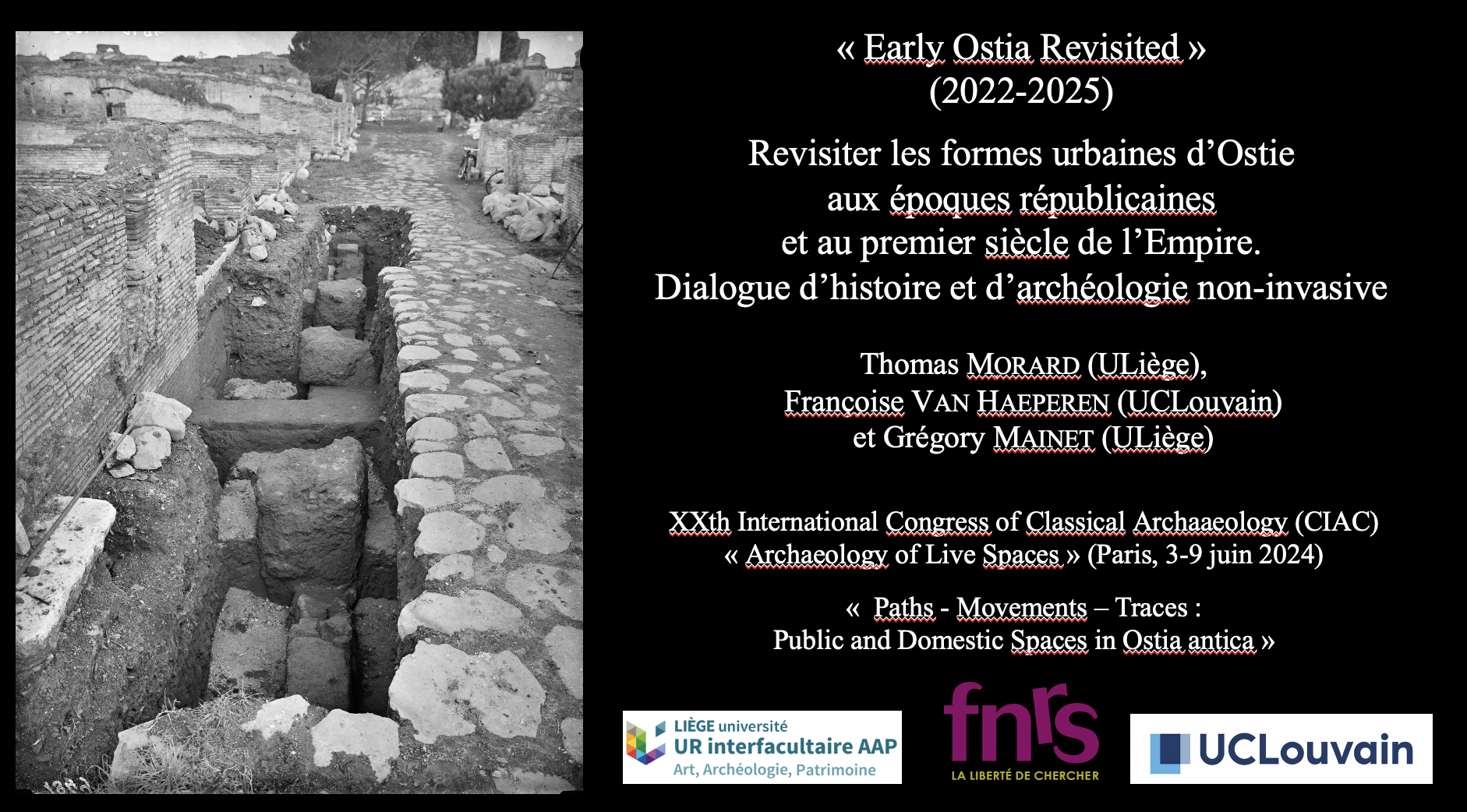
Revisiter les formes urbaines d'Ostie à l'époque républicaine et au premier siècle de l'Empire: dialogue d'histoire et d'archéologie non invasive. - 2024
Unpublished conference/Abstract (Scientific congresses and symposiums)
Revisiter les formes urbaines d'Ostie à l'époque républicaine et au premier siècle de l'Empire: dialogue d'histoire et d'archéologie non invasive.
Morard, Thomas; Van Haeperen Françoise; Mainet, Grégory
2024 • XXth International Congress of Classical Archaeology (AIAC). Archaeology of Live Spaces / Session « Paths - Movements - Traces : Public and Domestic Spaces in Ostia antica »
Ostia; Période républicaine; Archéologie romaine; Urbanisme et Architecture; Investigations non invasives
Abstract :
[fr] Les premières formes urbaines d’Ostie (IVe s. av. J.-C. - Ier s. ap. J.-C.) demeurent méconnues. Elles apparaissent très fragmentaires dans la Topografia Generale publiée en 1953 et aucune étude détaillée de ces phases n’a été proposée depuis lors, malgré de nouvelles découvertes, comme la Domus dei Bucrani exhumée sous la Schola del Traiano (Université Lumière Lyon 2 et ULiège). De manière générale, les phases urbaines d’époque républicaine et des premiers temps de l’Empire n’ont jamais été étudiées globalement, parce qu’elles ont été en grande partie recouvertes par les structures des phases médio-impériales (IIe-IIIe s.) et tardo-antiques (IVe-VIe s.) : une lacune que nous souhaitons combler en faisant dialoguer données archéologiques (ULiège) et historiques (UCLouvain). Afin de pallier les problèmes induits par la reconstruction de la ville au IIe s. ap. J.-C., les promoteurs de ce projet de recherche interdisciplinaire entendent combiner différentes méthodes d’investigation non-invasives pour éclairer le développement de la forme urbaine d’Ostie depuis sa fondation jusqu’au Bauboom consécutif à l’aménagement du Port de Trajan. Dans cette optique, quatre approches archéologiques ont été retenues : a) le dépouillement de la documentation inédite des fouilles anciennes ; b) l’étude de structures appartenant aux derniers temps de la République et aux premiers temps de l’Empire encore visibles sur le site archéologique ; c) des prospections Ground-Penetrating Radar ; d) l’étude du sous-sol au moyen de carottages. Les résultats obtenus lors de ces enquêtes seront confrontés aux informations fournies par les sources épigraphiques, littéraires et juridiques, afin de mettre en évidence les acteurs des changements urbains et d’ancrer les résultats de l’étude archéologique dans l’histoire d’Ostie, dont le destin a toujours été lié à celui de l’Urbs et de son imperium. [en] The urban forms of early Ostia (4th c. BC - 1st c. AD) remain poorly known. They are fragmented in the Topografia Generale published in 1953 and no detailed study of these phases has been proposed since then despite new findings, such as the Domus dei Bucrani unearthed under the Schola del Traiano (Université Lumière Lyon 2 and ULiège). Broadly speaking, the urban phases of the Republican and early Imperial periods have never been studied as a whole, because they have been largely concealed under the structures of the mid-Imperial (2st-3rd c. AD) and Late Antique phases (4th-6th c. AD): this is a gap that we aim to fill by bringing together archaeological (ULiège) and historical (UCLouvain) evidence. In order to overcome the problems caused by the reconstruction of the city in the 2nd c. AD, the promoters of this interdisciplinary research project intend to combine different non-invasive methods of investigation to shed new lights on the development of the urban form of Ostia from its foundation until the Bauboom following the construction of Trajan’s Harbour. To this end, four archaeological approaches have been selected: a) scrutinizing unpublished archival evidence; b) inspecting Republican and early Imperial structures that are still visible/accessible across the archaeological site; c) carrying out Ground-Penetrating-Radar surveys; d) studying the subsoil by core sampling. The results of these investigations will be compared with the information provided by epigraphic, literary and legal sources in order to highlight the actors of the urban changes and to anchor the archaeological data in the history of Ostia, whose destiny was always linked to that of the Urbs and its imperium.
Research Center/Unit :
AAP - Art, Archéologie et Patrimoine - ULiège
Disciplines :
Archaeology
Author, co-author :
Morard, Thomas ; Université de Liège - ULiège > Département des sciences historiques > Histoire de l'art et archéologie de l'antiquité gréco-romaine
Van Haeperen Françoise; UCLouvain
Mainet, Grégory ; Université de Liège - ULiège > Département des sciences historiques > Histoire de l'art et archéologie de l'antiquité gréco-romaine
Language :
French
Title :
Revisiter les formes urbaines d'Ostie à l'époque républicaine et au premier siècle de l'Empire: dialogue d'histoire et d'archéologie non invasive.
Alternative titles :
[en] Republican and Early Imperial Urban Forms of Ostia Revisited: a Dialogue of History and Non-Invasive Archaeology
Publication date :
06 June 2024
Event name :
XXth International Congress of Classical Archaeology (AIAC). Archaeology of Live Spaces / Session « Paths - Movements - Traces : Public and Domestic Spaces in Ostia antica »