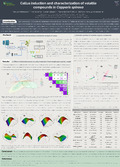
[en] Caper (Capparis spinosa L.) is a well-established medicinal plant in the Mediterranean region, renowned for its medicinal, pharmacological and culinary properties. Several bioactive phytochemical compounds have been isolated and identified from the various parts of this plant, making it a valuable source of molecules for the pharmaceutical industry. Plant metabolites are also increasingly used in agronomy, due to their beneficial properties, such as insecticidal and herbicidal activity. However, the increasing use of these metabolites makes it necessary to optimize their production. The integration of biotechnological technologies, in particular in vitro culture systems, offers economic and environmental advantages for the sustainable production of these compounds. Callus culture is an effective method for producing biologically active molecules from medicinal plants. Although the production of volatile compounds from C. spinosa using callus culture has not yet been studied, this approach could reduce the need to harvest all the plant material, while offering great potential for ensuring the sustainable production of these secondary metabolites. In this context, the aim of this study was to induce callus formation from C. spinosa leaf explants grown on a medium enriched in two cytokinin’s (kinetin and 6-benzylaminopurine) and two auxins (1- naphthaleneacetic acid and 2,4-dichlorophenoxyacetic acid). We explored various combinations of these phytohormones using response surface methodology (RSM), which enabled us to determine the optimum concentrations for biomass maximization, while evaluating the linear and quadratic effects of the hormones on growth. Next, we analyzed the volatile compounds present in the callus, comparing them with those of fresh leaves. The volatile profiles were characterized by gas chromatography-mass spectrometry (GC-MS) for each hormone combination, revealing significant variations in volatile components depending on the treatments applied. This study thus makes it possible to establish a metabolomic relationship between phytohormones and the production of these volatile compounds. In parallel with the analysis of volatile compounds, this study focused on the non-volatile secondary metabolites of C. spinosa callus, such as flavonoids and phenols, which are essential to the plant's pharmacological and biological properties. Current research aims to identify and quantify these molecules using techniques such as liquid chromatography and mass spectrometry (LC-MS). These results offer promising prospects for the sustainable industrial production of secondary metabolites. They also pave the way for scaling up suspension cultures by optimising culture parameters to obtain constant yields. By simultaneously analysing volatile and non-volatile compounds, this research provides a comprehensive metabolomic characterisation of C. spinosa callus, laying the foundations for large-scale suspension culture systems and future biotechnological applications.
Disciplines :
Physical, chemical, mathematical & earth Sciences: Multidisciplinary, general & others
Genva, Manon ; Université de Liège - ULiège > TERRA Research Centre > Chemistry for Sustainable Food and Environmental Systems (CSFES)
Burgeon, Clément ; Université de Liège - ULiège > Département GxABT > Microbial technologies
El-Goumi Younes; Polyyvalent Team in R&D, Higher School of Technology of Fkih Ben Salah, Sultan Moulay Slimane University, USMS, Beni Mellal 23000, Morocco
Fakiri Malika; 2 Laboratory of Agrifood and Health, Faculty of Sciences and Techniques, Hassan First University of Settat, BP 577, Settat 26000, Morocco
Fauconnier, Marie-Laure ; Université de Liège - ULiège > TERRA Research Centre > Chemistry for Sustainable Food and Environmental Systems (CSFES)
Language :
English
Title :
Callus induction and characterization of volatile compounds in Capparis spinosa