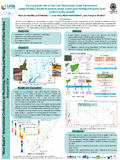
Poster (Scientific congresses and symposiums)Modeling mercury pollution in the Lom River basin (East Cameroon): using PEGASE model to assess small-scale gold mining pressures over surface water quality
Bella Atangana, Marie Sorella; Ndam Ngoupayou, Jules Rémy; Deliège, Jean-François
2024 • RIVER BASINS 2024 INTERNATIONAL CONFERENCE ON MONITORING, MODELLING AND MANAGEMENT OF RIVER BASINS
Keywords :
modeling, mercury pollution, Lom River basin, PEGASE model, artisanal small-scale, gold mining
Abstract :
[en] Mercury contamination from artisanal small-scale gold mining (ASGM) activities is a major environmental concern. Worldwide, 1800 tons/years of mercury are released by anthropogenic activities among which 67% come from ASGM. In the East Cameroon region, the Lom River and its tributaries drain a watershed of 11100 km2 where gold mining is practiced in artisanal and semi-mechanized ways. More than 50 open-pit mining sites are listed, with an estimated production of 318 Kg of gold in 2019. In this type of mining, mercury is used to extract gold by amalgamation, in equal proportions. About 5 to 45% of the used mercury is directly discharged into rivers. This study aims to assess the impact of artisanal gold mining on water quality in the Lom basin. A physically based modeling approach involving the model PEGASE(Planification Et Gestion de l’ASsainissement des Eaux)is used to simulate the transport of mercury from mining effluents. PEGASE is a deterministic integrated basin/river model that allows predictive calculations of river water quality according to pollutant discharges and inputs.From2021to2023,seasonal monitoring was carried out on surface water at 15 stations. Physico-chemical parameters (pH, EC, DO, TDS, TSS, Na+,Ca2+,Mg2+, K+,NH4+, SO42-,Cl-,NO3-,F-, PO43-) and total mercury(Hg)concentrations were measured. The calibration method involved, on the one hand, the representation of open-pit mining sites in the land cover, in order to better calibrate the soil input functions. On the other hand, mercury discharges from mining effluents were considered for the representation of industrial releases. The results of the 2 simulations provided a better description of water quality in the river Lom and helped identify areas exposed to mercury pollution. Based on the European tool called Water-SEQ (System for Evaluation of the Quality of rivers), the alteration indices for oxidizable organic matter, nitrogenous matter, nitrates and phosphorus vary overall from Good to Very Good (60-100) in the river Lom. However, near inhabited areas, the various indices sometimes vary from poor to very good (40 -100). Mercury concentrations are above the limit of the Environmental Quality Standard (EQS = 0.05 µg/l) near mining sites. This reveals a mercury pollution localized to the environment close to gold mining sites. The contribution of gold mining activities as sources of pollution was also highlighted. We were able to examine the potential impact of soil inputs and industrial releases, and we found that mercury and suspended matters are the main factors in the degradation of Lom water quality. Seasonal variations in the hydrodynamic regime are also a determining factor in the Lom water quality.
Disciplines :
Physical, chemical, mathematical & earth Sciences: Multidisciplinary, general & others
Event organizer :
Budapest University of Technology and Economics Department of Sanitary and Environmental Engineering; Technical University Vienna Institute of Water Quality and Resource Management; Karlsruhe Institute of Technology Institute for Water and Environment; Environment Agency Austria; Environment Agency Germany; German Federal Institute of Hydrology; Deltares; International Committee for Protection of the Danube River