Contribution to collective works (Parts of books)
The mode of action of diuretics
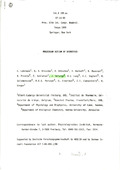
Lohrmann, E.; Nitschke, R. B.; Nitschke, R. et al.
1991In Proc. XIth Int. Congr. Nephrol. Tokyo
 

Files


Full Text
DelargeJ_8_Molecular action_1990.pdf
Author postprint (627.06 kB)
Download

All documents in ORBi are protected by a user license.

Send to


Details


Abstract :
[en] This review will address several recent findings regarding the interaction of so called loop diuretics of the furosemide type with the Na+2Cl-K+ cotransporter in the thick ascending limb of the loop of Henle (TAL); (i) The organ selectivity of these transport inhibitors is caused by their secretion by the proximal tubule leading to an increase in their luminal concentration. We have examined whether probenecid, a selective inhibitor of proximal organic anion secretion reduces the diuretic effect of know loop diuretics and we show that all tested compounds: furosemide (FUR), piretanide (PIR), bumetanide (BUM), azosemide (AZO) loose part of their diuretic effect when administered in the presence of probenecid. (ii) Previously we have shown that all loop diuretics of the furosemide type require an acidic group for the binding to the Na+2Cl-K+ cotransporter. This is a carboxylate group in case of FUR, PIR and BUM, a tetrazolic acid group in case of AZO, and a sulfonylurea group in a case of torasemide (TOR). Now we show that TOR-derivatives with an even less acidic sulfonylurea group (pka >8) still are very potent inhibitors of the Na+2Cl-K+ cotransporter. Experiments at various pH-values indicate that, even for these substances, it is only the anionic form which inhibits the Na+2Cl-K+ cotransporter. (iii) Most of the loop diuretics with the exception of TOR are rather hydrophilic (FUR, PIR, BUM, AZO). Now we have examined whether one can design compounds which sustain their inhibitory effect on the Na+2Cl-K+ cotransporter. (iv) Previous data suggested that loop diuretics bind to the Na+2Cl-K+ cotransporter at the extracellular side of the luminal membrane. Now we have designed impermeable macromolecular derivatives of PIR and show that these macromolecular probes inhibit the Na+2Cl-K+ cotransporter as well as PIR. (v) Previous data indicated that loop diuretics interrupt the macula dense feedback mechanism, and circumstantial evidence suggested that the uptake of Cl- and/or Na+ by macula dense cells may occur via the Na+2Cl-K+ cotransporter. Now we show that macula dense cells sense the luminal NaCl concentration via FUR sensitive Na+2Cl-K+ cotransport.
Disciplines :
Pharmacy, pharmacology & toxicology
Author, co-author :
Lohrmann, E.;  Albert-Ludwigs-Universität
Nitschke, R. B.;  Albert-Ludwigs-Universität
Nitschke, R.;  Albert-Ludwigs-Universität
Burhoff, I.;  Albert-Ludwigs-Universität
Masereel, Bernard ;  Université de Liège - ULiège > Département de pharmacie
Pirotte, Bernard ;  Université de Liège - ULiège > Département de pharmacie
Schlatter, E.;  Albert-Ludwigs-Universität
Delarge, Jacques ;  ULg - Université de Liège > Institut de pharmacie
Lang, H. J.;  Hoechst Pharma
Englert, H. C.;  Hoechst Pharma
Salomonsson, M.;  University of Lund > Department of Physiology and Biophysics
Persson, A. E. G.;  University of Lund > Department of Physiology and Biophysics
Eidelman, O.;  Hebrew University of Jerusalem > Department of Biological Chemistry
Cabantchik, Z. I.;  Hebrew University of Jerusalem > Department of Biological Chemistry
Greger, R.;  Albert-Ludwigs-Universität
More authors (5 more) Less
Language :
English
Title :
The mode of action of diuretics
Publication date :
1991
Main work title :
Proc. XIth Int. Congr. Nephrol. Tokyo
Publisher :
Springer-Verlag, Tokyo
Collection name :
Nephrology, ed. Michinobu Hatano, vol.II
Pages :
1072-1081
Available on ORBi :
since 07 December 2009

Statistics


Number of views
70 (3 by ULiège)
Number of downloads
4 (0 by ULiège)

Bibliography


Similar publications


Contact ORBi