Keywords :
capitalism, social and solidarity economy, pragmatism, sociology; anarchy, grammar
Abstract :
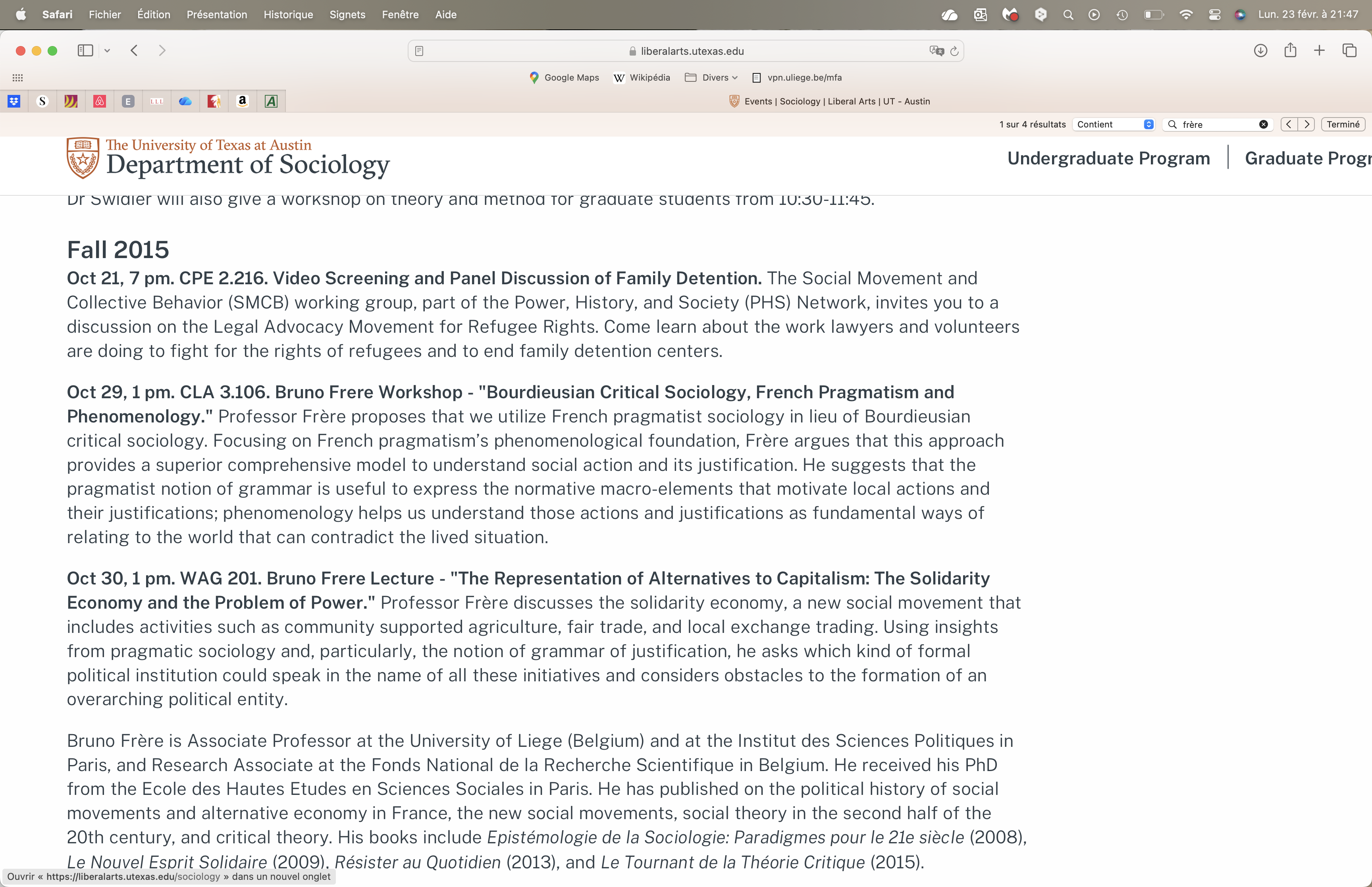
[en] ‘Solidarity economy’, a widely used term for which the most common French equivalent is economie solidaire, is generally thought of as comprising five distinct classes of activity : Social Entrepreneurship Consulting Services, Micro-finance, Local Exange Trading Systems, proximity services, organic small-scale farming and fairtrade distributions. Because they try to answer to the Aristotelian theoretical question “what can we do to live harmoniously together?”, these solidarity initiatives are deeply political in the philosophical sense of the term. They galvanize civic commitment at the “micro” level. But today, an important question arises regarding the kind of formal political institution that would speak in the name of all these initiatives. In France, some intellectuals who have an interest in these solidarity initiatives see them as new economic models with the potential to solve the current financial crisis, and they are eager for academic specialists and leaders of the movement to achieve some kind of consensus about the kind of concrete political identity such initiatives may be expected to generate. However my own research studies their way of establishing a basis for moving from micro level initiatives to substantial “macro” polity unity. This communication, using the insights of french pragmatic sociology, and particularly the notion of grammar of justification, aims to understand what the obstacles to this aim being realised are.
In this paper I will first present what we are calling “solidarity economy in France”. Second, I will show that leaders of its organisations share with sociologist a common grammar to talk about their concrete political identity on the very local field. Their argue that their political characteristics are on the one hand a kind of horizontal, direct and participative democracy and on the other hand a strong critic of the Leninist or Trotskyite left in which some leaders pretend to talk in the name of unemployed and excluded people when Solidarity Economy gives them a real voice. Third I will analyse a struggle between two Solidarity Economy Network. Then, in a fourth point, I will point out how the question of the political representation of the Solidarity Economy is a problem even if they share the same political libertarian grammar.