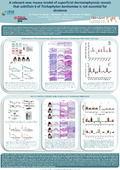
Abstract :
[en] Introduction: Dermatophytoses are the most common cutaneous mycoses, affecting both humans and animals. The increasing resistance of dermatophytes to antifungal agents poses a major public health concern, highlighting the need to better understand the pathogenesis of dermatophytoses. Dermatophytes are able to switch from a saprophytic to a parasitic lifestyle by reprogramming their gene expression, requiring the development of reliable animal models to study the involvement of different genes in the pathophysiology of dermatophytoses. Our aims were (1) to develop a robust and relevant mouse model of superficial dermatophytosis to study host-pathogen interactions, using Trichophyton benhamiae as a reference species, and (2) to assess the role of a secreted protease, subtilisin 6 (SUB6), in virulence.
Methods: Trichophyton benhamiae IHEM 20161 was used in a new epicutaneous infection model in mice, using a mixture of spores (1x10⁸ CFU), germ tubes and mycelium (100 mg) as an inoculum. Kinetic monitoring of infection was performed by establishing a global clinical score based on the intensity (0 to 4) of three clinical signs, i.e. erythema, scaling and crusting, while the expression of fungal and host genes was analyzed by real-time quantitative PCR two and five days after infection. To assess the contribution of SUB6 to virulence, a SUB6-deleted (ΔSUB6) strain and the complemented strain were generated by genetic transformation. The pathogenicity of these strains was compared with that of the parental strain based on the evolution of cutaneous symptoms, histopathological lesions and molecular analyses targeting the expression of host pro-inflammatory genes and fungal genes encoding subtilisins from the same family as SUB6.
Results: The specific, standardized inoculum prepared from the wild-type strain of T. benhamiae, generated visible cutaneous symptoms mimicking a natural, self-resolving infection, lasting more than twice as long (16 days vs 7 days) as those obtained in the past with an inoculum containing only spores. Histopathological lesions showed a superficial invasion of the epidermis by hyphae and inflammatory infiltration of the epidermis and dermis by mononuclear and polymorphonuclear cells. While the pro-inflammatory cytokines IL-1β, IL-12β and TNFα, and the antimicrobial peptide β-defensin 2 were significantly overexpressed on day 2 after infection, the fungal genes SUB1, SUB3, SUB6, SUB8 and SUB10 were also strongly overexpressed during infection. The ΔSUB6 strain induced superficial skin symptoms and histopathological inflammatory lesions similar to those caused by the parental strain. It also induced significant overexpression of the same host pro-inflammatory genes and fungal genes in the tissues, with no difference from the parental strain.
Conclusions: Our new dermatophytosis mouse model is a powerful tool for studying the pathophysiology of acute superficial dermatophytosis. It has enabled us to show that certain subtilisins, including SUB6, are overexpressed during infection and could play an important role in the infectious process. However, SUB6, while being a marker of infection, is not a virulence factor, at least not acting alone.