Einstein Telescope; Gravitational Waves; Euregio Meuse Rhine; Limburg; Seismic Noise
Abstract :
[en] The European 2011 Conceptual Design Report for Einstein Telescope identified the Euregio
Meuse-Rhine and in particular the South Limburg border region as one of the prospective sites
for this next generation gravitational wave observatory. Compared to current gravitational
wave observatories, Einstein Telescope will have a superior sensitivity all across its 2-10,000
Hz frequency band. In particular at low (2-10 Hz) frequencies anthropogenic (due to human
activities) seismic noise risks to limit performance introducing unwanted minute excursions
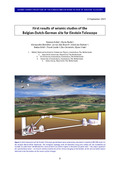
(vibrations) of the mirrors –the key components of Einstein Telescope– in two ways (Figure
3):
Indirectly via the mirror suspensions. These can easily be suppressed by many orders
of magnitude through advanced vibration isolation systems integrated in the mirror
suspension towers as already proven by the current gravitational wave observatories
such as LIGO (USA) and Virgo (Europe);
Directly by fluctuations in the gravitational force on the mirrors. Seismic noise causes
mass density fluctuations which induce variations in the gravitational force exerted
on the mirrors which as a result start to jitter. This effect is called gravity gradient
noise (GGN). The gravitational force cannot be shielded against. To keep GGN
acceptable Einstein Telescope must be sited at a seismically quiet location and an
active GGN compensation scheme using a network of accelerometers to reconstruct in
real time the fluctuating gravitational force on the mirrors is envisaged.
To reduce anthropogenic seismic noise, Einstein Telescope will be realized underground at
depths between 200-300 meters. In this respect, the geology in the South Limburg border
region is ideal. It is expected to combine hard rock at the depth where Einstein Telescope will
be realized facilitating the underground civil engineering with a ‘soft’ surface layer on top of
the hard rock which is expected to strongly attenuate anthropogenic seismic noise.
This study quantifies the geology and seismic noise characteristics in the South Limburg
border region based on a number of passive and active seismic campaigns deploying grids of
seismic sensors in the region and two deep boreholes drilled in the 2017-2019 period at
Terziet near Epen on the Dutch-Belgian border.
Refraction tomography analysis of the data from the seismic campaigns reveals a 30-50
meters thick soft top layer with hard rock underneath (Figure 9). This was subsequently
unambiguously confirmed by direct measurements in the first 167 meters deep borehole
(Figure 10). Both approaches show the deepest hard rock layers to have a hardness
similar to granite, excellent for underground civil engineering.
In June 2019 a seismic sensor was installed in a second borehole at a depth of 250 meters.
Together with a seismic sensor near the surface, the attenuation of seismic noise going
underground was measured to yield about a factor 10,000 in power (100 in amplitude) during
the day and a factor 200 during the night (Figure 11). Qualitatively the same results were seen
in an active seismic campaign where most injected power was found to be confined to the top
30-50 meters thick soft layer. These findings are in good agreement with earlier simulation
results (Figure 5). Since Einstein Telescope is envisaged for 50 years, the strong
attenuation of anthropogenic seismic noise is a key asset of the South Limburg border
region since it protects also against possible future new anthropogenic seismic noise
sources on the surface. As a by-product of this study it was also shown that local seismic
activity –e.g. in the nearby Eifel– will have a negligible effect on the downtime of
Einstein Telescope compared to the site-independent downtime due to teleseismic
(more than 1000 kilometers away) events.
Disciplines :
Physics
Author, co-author :
Koley, Soumen ; Université de Liège - ULiège > Département d'astrophysique, géophysique et océanographie (AGO) > Ondes gravitationnelles
Language :
English
Title :
First results of seismic studies of the Belgian-Dutch-German site for Einstein Telescope