Article (Scientific journals)
The Movement of CO2 Through the Frozen World of Sea Ice
Crabeck, Odile; Campbell, Karley; Moreau, Sebastien et al.
2021In Frontiers for Young Minds, 8
Peer reviewed
 

Files


Full Text
frym.2020.516072.pdf
Publisher postprint (1.67 MB) Creative Commons License - Attribution
Download

All documents in ORBi are protected by a user license.

Send to


Details


Abstract :
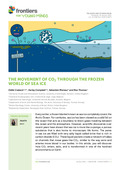
[en] Every winter, a frozen blanket known as sea ice completely covers the Arctic Ocean. For centuries, sea ice has been viewed as a solid lid on the ocean that acts as a boundary to block gases traveling between the ocean and the atmosphere. However, scientific discoveries over recent years have shown that sea ice is more like a sponge, a porous substance that is also home to microscopic life forms. The pores in sea ice are filled with very salty liquid called brine that is rich in carbon dioxide (CO2). These liquid pockets create a network of tubes or channels that move gases like CO2, similar to the way veins and arteries move blood in our bodies. In this article, you will discover how CO2 enters, exits, and is transformed in one of the harshest environments on Earth.
Disciplines :
Earth sciences & physical geography
Author, co-author :
Crabeck, Odile  ;  Université de Liège - ULiège > Freshwater and OCeanic science Unit of reSearch (FOCUS)
Campbell, Karley
Moreau, Sebastien
Thomas, Max
Language :
English
Title :
The Movement of CO2 Through the Frozen World of Sea Ice
Publication date :
20 January 2021
Journal title :
Frontiers for Young Minds
eISSN :
2296-6846
Publisher :
Frontiers Media SA
Volume :
8
Peer reviewed :
Peer reviewed
Available on ORBi :
since 14 December 2025

Statistics


Number of views
5 (0 by ULiège)
Number of downloads
2 (0 by ULiège)

OpenCitations
 
5
OpenAlex citations
 
6

Bibliography


Similar publications


Contact ORBi