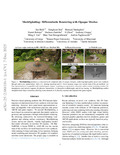
[en] Primitive-based splatting methods like 3D Gaussian Splatting have revolutionized novel view synthesis with real-time rendering. However, their point-based representations remain incompatible with mesh-based pipelines that power AR/VR and game engines. We present MeshSplatting, a mesh-based reconstruction approach that jointly optimizes geometry and appearance through differentiable rendering. By enforcing connectivity via restricted Delaunay triangulation and refining surface consistency, MeshSplatting creates end-to-end smooth, visually high-quality meshes that render efficiently in real-time 3D engines. On Mip-NeRF360, it boosts PSNR by +0.69 dB over the current state-of-the-art MiLo for mesh-based novel view synthesis, while training 2x faster and using 2x less memory, bridging neural rendering and interactive 3D graphics for seamless real-time scene interaction. The project page is available at https://meshsplatting.github.io/.
Research Center/Unit :
Montefiore Institute - Montefiore Institute of Electrical Engineering and Computer Science - ULiège VIULab TELIM
Disciplines :
Electrical & electronics engineering
Author, co-author :
Held, Jan ; Université de Liège - ULiège > Montefiore Institute of Electrical Engineering and Computer Science
Son, Sanghyun
Vandeghen, Renaud ; Université de Liège - ULiège > Montefiore Institute of Electrical Engineering and Computer Science
Rebain, Daniel
Gadelha, Matheus
Zhou, Yi
Cioppa, Anthony ; Université de Liège - ULiège > Montefiore Institute of Electrical Engineering and Computer Science
Lin, Ming C.
Van Droogenbroeck, Marc ; Université de Liège - ULiège > Département d'électricité, électronique et informatique (Institut Montefiore) > Télécommunications
Tagliasacchi, Andrea
Language :
English
Title :
MeshSplatting: Differentiable Rendering with Opaque Meshes
CÉCI : Consortium des Équipements de Calcul Intensif
Funders :
FRIA - Fund for Research Training in Industry and Agriculture SPW - Service Public de Wallonie
Funding number :
1910247
Funding text :
We thank Bernhard Kerbl and George Kopanas for their helpful feedback and for proofreading the paper. J. Held is funded by the F.R.S.-FNRS. The present research benefited from computational resources made available on Lucia, the Tier-1 supercomputer of the Walloon Region, infrastructure funded by the Walloon Region under the grant agreement n°1910247.