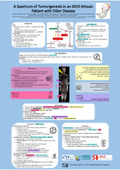
[en] We report the case of a 20-year-old woman with a childhood diagnosis of Ollier disease, a rare skeletal dysplasia marked by multiple enchondromas and a high risk of malignant transformation into chondrosarcoma. She later developed acute myeloid leukaemia (AML) and a parathyroid adenoma, all harbouring the same IDH1 (c.394C>T; p.Arg132Cys) pathogenic variant. This gain-of-function mutation leads to the aberrant production of D-2-hydroxyglutarate, which promotes tumorigenesis through mechanisms such as DNA hypermethylation and impaired cellular differentiation. The presence of this mutation in neoplasms arising from both mesodermal (bone marrow, enchondromas) and endodermal (parathyroid) tissues, with variant allele frequencies ranging from 37% to 44%, supports the hypothesis of an early post-zygotic mosaic event. This case illustrates the broad oncogenic potential of IDH1 mosaicism and underscores the need for long-term, multidisciplinary surveillance. In particular, the risk of chondrosarcoma and glioma, previously reported in association with IDH1-mutant Ollier disease, warrants regular enchondroma surveillance and brain imaging in affected individuals.